

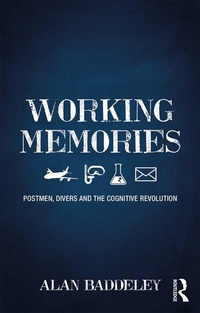
Working Memories
Postmen, Divers and the Cognitive Revolution
1st Edition
Published on 13. September 2018
386 pages
978-1-317-23853-9 (ISBN)
Description

Technological developments during the Second World War led to an approach that linked ideas from computer science to neuroscience, linguistics, philosophy and psychology, known today as the Cognitive Revolution. Leaving behind traditional behaviourist approaches popular at the time, psychology began to utilise artificial intelligence and computer science to develop testable theories and design groundbreaking new experiments. The Cognitive Revolution dramatically changed the way that psychological research and studies were conducted and proposed a new way of thinking about the mind.
In Working Memories, Alan Baddeley, one of the world's leading authorities on Human Memory, draws on his own personal experience of this time, recounting the radical development of a pioneering science in parallel with his own transatlantic, vibrant and distinguished career.
Detailing the excitement and sometimes frustration experienced in taking psychology into the world beyond the laboratory, Working Memories presents unique insights into the mind and psychological achievements of one of the most influential psychologists of our time.
In Working Memories, Alan Baddeley, one of the world's leading authorities on Human Memory, draws on his own personal experience of this time, recounting the radical development of a pioneering science in parallel with his own transatlantic, vibrant and distinguished career.
Detailing the excitement and sometimes frustration experienced in taking psychology into the world beyond the laboratory, Working Memories presents unique insights into the mind and psychological achievements of one of the most influential psychologists of our time.
Reviews / Votes
'This is a fantastic book, on several dimensions. It tells a wonderful personal story, provides a needed (if personal) history of the cognitive revolution, and it imparts a marvellous overview of much of the field of human memory. The author is one of the world's most eminent cognitive psychologists, one whose career spans from the early days of the cognitive revolution to today. I view the book as required reading for cognitive psychologists and their students.' Professor Henry L. Roediger, Washington University in St. Louis, USA'Does it matter how a scientist's biography is related to research? Here a top experimental psychologist, Alan Baddeley, shows why it matters. Though a scientist is often identified with a single achievement, Baddeley's prolific, enduring pursuit of one key topic, working memory, the limited information currently in mind, is portrayed as rooted in a range of work on attention, stress, mental illness, neurological disorders, test construction, and education. His seminal studies were shaped by aspirations, deliberations, philosophical musings, and fascinating interpersonal experiences worldwide. The book is a rousing guide for anyone interested in cognitive science.' Professor Nelson Cowan, University of Missouri, USA
'By his unique position in the field of cognitive psychology, Alan Baddeley's memories tell the story of his life, which is in fact the history of a science that went through incredible changes in the past 60 years. Working Memories should hence interest scholars in working memory (of course), and more generally anyone interested in psychology. But, beyond its scientific content, this book is an entertaining read of a wonderful human adventure and it should become a great source of inspiration for young generations that want to make their life a pathway to knowledge whatever their field of interest.' Professor Valerie Camos, University of Fribourg, Switzerland
'Engaging from the start, with lovely touches of humour throughout, this book is accessible, entertaining, stimulating and offers personal and scientific insight into six decades of cognitive psychology from someone who has had, and still has a major influence on its development. Alan Baddeley has achieved a wonderful integration of the human and the scientific story.' Robert Logie, University of Edinburgh, UK
"This book is not only a quiet account of Alan's personal contributions to our subject over the last 60 years. It discusses these substantial achievements concisely and always places them in the larger context of what others were doing at the same time, the insights and input of collaborators, often very junior, and the ways in which our thinking developed during the confusion that Alan calls the "Cognitive Revolution."... The book is held together by enjoyment of a long life and treats as equal pleasures family life, doing research, academic administration (!?); Scuba-diving for knowledge of various kinds; warm enjoyment of colleagues; the pleasures of travel and the happy particularities of many cities. To be able to convey all this in a Scientific Autobiography is splendid. To have lived it must be even better." Patrick Rabbitt, Quarterly Journal of Experimental Psychology
"Alan Baddeley is one of the most eminent cognitive psychologists of our time and a leading authority on human memory. His accomplished career spans from the early days of the cognitive revolution to the present days. His work covers a huge range of topics and collaborations, and the book pleasantly indulges on his aspirations, deliberations, philosophical remarks, and fascinating anecdotes based on unique sets of personal experiences. The privilege of accessing the narration of the unfolding story of memory studies from the first-person perspective of its main protagonist makes this book an entertaining read of a wonderful human adventure." - Andrea E. Cavanna, Cognitive Neuropsychiatry
More details
Edition
1. Auflage
Language
English
Place of publication
London
United Kingdom
Publishing group
Taylor & Francis Ltd
Target group
College/higher education
Illustrations
2 Line drawings, black and white; 7 Halftones, color; 20 Halftones, black and white
File size
6,39 MB
ISBN-13
978-1-317-23853-9 (9781317238539)
Copyright in bibliographic data and cover images is held by Nielsen Book Services Limited or by the publishers or by their respective licensors: all rights reserved.
Schweitzer Classification
Other editions
Additional editions
Book
09/2018
1st Edition
Routledge
€39.40
Shipment within 10-20 days
Book
09/2018
1st Edition
Routledge
€206.90
Shipment within 10-20 days
Person
Alan Baddeley is Professor of Psychology at the University of York and one of the world's leading authorities on Human Memory. He is celebrated for devising the groundbreaking and highly influential working memory model with Graham Hitch in the early 1970s, a model which has been cited over 10,000 times to date. He was awarded a CBE for his contributions to the study of memory and is a Fellow of the Royal Society, of the British Academy, of the Academy of Medical Sciences and of the American Academy of Arts and Sciences. His outstanding record of personal achievements and significant contributions to the advancement of psychological knowledge were recognised in 2001 by the American Psychological Association Distinguished Contribution Award, in 2012 by the Lifetime Achievement Award of the British Psychological Society and in 2016 by the International Union of Psychological Sciences Award for Major Achievement in Psychological Science.
Content
Contents
Preface
Further Reading
Leeds 1934-53
Chapter 1 - Growing up in Yorkshire
London 1953-56
Chapter 2 - Psychology in the 1950s: Seeds of the Cognitive Revolution
Princeton - Los Angeles 1956-77
Chapter 3 - The Trip of a Lifetime
Leeds and Bristol 1957-58
Chapter 4 - In Search of a Job
Cambridge 1958-67
Chapter 5 - From Cognitive Science to Applied Psychology
Chapter 6 - Psychology Under Water
Chapter 7 - Practical Applications and Theoretical Implications: Postmen and Watchkeepers
Chapter 8 - Acoustic and Semantic codes: Evidence for Separate Memory Systems?
Sussex 1967-72
Chapter 9 - From Full-time Research to a New University
Chapter 10 -Amnesia
San Diego 1970-71
Chapter 11 - California and New Directions in Memory Research
Chapter 12 - The Emergence of Semantic Memory
Returning to Sussex 1971-72
Chapter 13 - Working Memory and the Phonological Loop
Stirling 1972-74
Chapter 14 - Working Memory and Visual Imagery
Cambridge 1974-95
Chapter 15 - Returning to the Unit
Chapter 16 - Encounters with the Law
Chapter 17 - Stress: From Sky Diving to Anaesthetics
Chapter 18 - When Long-term Memory Fails
Chapter 19 - Working Memory and Language
Chapter 20 - Boston and the Central Executive
Chapter 21 - Psychology Around the World
Bristol 1995-2003
Chapter 22 -The Episodic Buffer
Chapter 23 - Patients, Parasites and Mobile Phones
Stanford 2001-02
Chapter 24 - Working Memory in Context: Neuroscience, Emotion and Philosophy
Returning to Yorkshire 2003 -
Chapter 25 - Exploring the Episodic Buffer
Chapter 26 - Summing up: From Behaviourism to Cognitive Neuroscience
Preface
Further Reading
Leeds 1934-53
Chapter 1 - Growing up in Yorkshire
London 1953-56
Chapter 2 - Psychology in the 1950s: Seeds of the Cognitive Revolution
Princeton - Los Angeles 1956-77
Chapter 3 - The Trip of a Lifetime
Leeds and Bristol 1957-58
Chapter 4 - In Search of a Job
Cambridge 1958-67
Chapter 5 - From Cognitive Science to Applied Psychology
Chapter 6 - Psychology Under Water
Chapter 7 - Practical Applications and Theoretical Implications: Postmen and Watchkeepers
Chapter 8 - Acoustic and Semantic codes: Evidence for Separate Memory Systems?
Sussex 1967-72
Chapter 9 - From Full-time Research to a New University
Chapter 10 -Amnesia
San Diego 1970-71
Chapter 11 - California and New Directions in Memory Research
Chapter 12 - The Emergence of Semantic Memory
Returning to Sussex 1971-72
Chapter 13 - Working Memory and the Phonological Loop
Stirling 1972-74
Chapter 14 - Working Memory and Visual Imagery
Cambridge 1974-95
Chapter 15 - Returning to the Unit
Chapter 16 - Encounters with the Law
Chapter 17 - Stress: From Sky Diving to Anaesthetics
Chapter 18 - When Long-term Memory Fails
Chapter 19 - Working Memory and Language
Chapter 20 - Boston and the Central Executive
Chapter 21 - Psychology Around the World
Bristol 1995-2003
Chapter 22 -The Episodic Buffer
Chapter 23 - Patients, Parasites and Mobile Phones
Stanford 2001-02
Chapter 24 - Working Memory in Context: Neuroscience, Emotion and Philosophy
Returning to Yorkshire 2003 -
Chapter 25 - Exploring the Episodic Buffer
Chapter 26 - Summing up: From Behaviourism to Cognitive Neuroscience
