

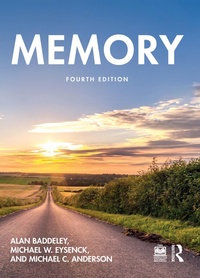
Memory
4th Edition
Published on 13. May 2025
756 pages
978-1-040-30200-2 (ISBN)
Description

This key textbook, now in its fourth edition, provides students with the most comprehensive introduction to the study of human memory and its applications in the field. Written by three leading experts, it delivers an authoritative and accessible overview of key topic areas. Each chapter combines breadth of content coverage with a wealth of relevant practical examples, while the engaging writing style invites the reader to share the authors' fascination with the exploration of memory through their individual areas of expertise. Across the text, the scientific theory is connected to a range of real-world questions and everyday human experiences.This new edition:
Has been fully revised and updated to address the latest research, theories, and applications, including a new second chapter that acts as a one-stop overview of the full range of neuroscience methods for studying memory
Includes new or expanded coverage of collective memory, spatial memory, explicit and implicit memory, episodic and autobiographical memory, and the functional role of memory in more complex tasks. It also features a greater emphasis on memory in the real world, practical applications, and the impact of memory research on everyday life
Has been updated for more inclusive language and representation of people and research across race, ethnicity, sexuality, gender identity, and neurodiversity
This edition of Memory is an essential resource for those embarking on their studies in this important field, or with an interest in the topic.
Has been fully revised and updated to address the latest research, theories, and applications, including a new second chapter that acts as a one-stop overview of the full range of neuroscience methods for studying memory
Includes new or expanded coverage of collective memory, spatial memory, explicit and implicit memory, episodic and autobiographical memory, and the functional role of memory in more complex tasks. It also features a greater emphasis on memory in the real world, practical applications, and the impact of memory research on everyday life
Has been updated for more inclusive language and representation of people and research across race, ethnicity, sexuality, gender identity, and neurodiversity
This edition of Memory is an essential resource for those embarking on their studies in this important field, or with an interest in the topic.
Reviews / Votes
"The fourth edition of Memory builds on the strengths of the outstanding previous editions. The authors impressively draw on material from cognitive psychology, neuropsychology, and neuroimaging to produce a rich picture of how memory works that will inform and engage students, combining accessible writing with expert coverage of both classic studies and cutting-edge developments. They also expand their treatment of important topics such as memory in everyday life and collective memory. I recommend this new edition with great enthusiasm."Daniel L. Schacter, Harvard University, Cambridge, Massachusetts, USA
"The fourth edition of Memory is a comprehensive overview of established and cutting-edge research. It is accessible to newcomers to the memory field while offering insights that can be appreciated by experts. In addition to laboratory studies, the book covers how memories operate 'in the wild', appplying research to critical issues. Its discussion of memory across cultures and diversity is important for the field. The content is delivered in an elegant and readable format, with humor throughout - I highly recommend it!"
Mariam Aly, Department of Psychology, University of California, Berkeley, USA
"Editions 1, 2, and 3 of this book were by a long way the best textbooks on memory available, written by authors who have themselves made major contributions to the topic. In this fourth edition, with their hallmarks of engaging writing style, authoritative content, and comprehensive, substantially updated coverage, Baddeley, Eysenck, and Anderson have presented a truly worthy successor."
Robert H. Logie, University of Edinburgh, UK
"Baddeley, Eysenck, and Anderson have developed a masterful introduction to memory in a manner that will engage curious students at all levels. This new edition draws upon work from every level of analysis, from molecules to brain systems to the minds of humans and machines, and it comprehensively covers state of the art neuroscience methods central to modern memory research. Textbooks often get lost in the weeds, but this one never loses track of the big picture."
Charan Ranganath, University of California, Davis, USA
"This book is a gem. For me, it was a page-turner. The clarity of the writing and figures and the comprehensive, balanced coverage of theory and data make it delightful and informative. This book is appropriate for introductory courses and advanced undergraduate and graduate seminars, and even for memory experts. Like prior editions, the book is distinguished by its eclecticism with coverage of clinical populations, individual and cultural differences, lab experiments and real-world applications, and methodologies from experimental psychology, cognitive neuroscience, and computer science, including artificial intelligence. While up-to-date, the book's historical sensibility conveys how the memory field developed and where it is heading. I recommend the book enthusiastically."
Morris Moscovitch, University of Toronto, Canada "The fourth edition of Memory builds on the strengths of the outstanding previous editions. The authors impressively draw on material from cognitive psychology, neuropsychology, and neuroimaging to produce a rich picture of how memory works that will inform and engage students, combining accessible writing with expert coverage of both classic studies and cutting-edge developments. They also expand their treatment of important topics such as memory in everyday life and collective memory. I recommend this new edition with great enthusiasm."
Daniel L. Schacter, Harvard University, Cambridge, Massachusetts, USA
"The fourth edition of Memory is a comprehensive overview of established and cutting-edge research. It is accessible to newcomers to the memory field while offering insights that can be appreciated by experts. In addition to laboratory studies, the book covers how memories operate 'in the wild', appplying research to critical issues. Its discussion of memory across cultures and diversity is important for the field. The content is delivered in an elegant and readable format, with humor throughout - I highly recommend it!"
Mariam Aly, Department of Psychology, University of California, Berkeley, USA
"Editions 1, 2, and 3 of this book were by a long way the best textbooks on memory available, written by authors who have themselves made major contributions to the topic. In this fourth edition, with their hallmarks of engaging writing style, authoritative content, and comprehensive, substantially updated coverage, Baddeley, Eysenck, and Anderson have presented a truly worthy successor."
Robert H. Logie, University of Edinburgh, UK
"Baddeley, Eysenck, and Anderson have developed a masterful introduction to memory in a manner that will engage curious students at all levels. This new edition draws upon work from every level of analysis, from molecules to brain systems to the minds of humans and machines, and it comprehensively covers state of the art neuroscience methods central to modern memory research. Textbooks often get lost in the weeds, but this one never loses track of the big picture."
Charan Ranganath, University of California, Davis, USA
"This book is a gem. For me, it was a page-turner. The clarity of the writing and figures and the comprehensive, balanced coverage of theory and data make it delightful and informative. This book is appropriate for introductory courses and advanced undergraduate and graduate seminars, and even for memory experts. Like prior editions, the book is distinguished by its eclecticism with coverage of clinical populations, individual and cultural differences, lab experiments and real-world applications, and methodologies from experimental psychology, cognitive neuroscience, and computer science, including artificial intelligence. While up-to-date, the book's historical sensibility conveys how the memory field developed and where it is heading. I recommend the book enthusiastically."
Morris Moscovitch, University of Toronto, Canada
More details
Edition
4th edition
Language
English
Place of publication
London
United Kingdom
Publishing group
Taylor & Francis Ltd
Target group
College/higher education
Illustrations
5 Tables, color; 150 Line drawings, color; 92 Halftones, color; 242 Illustrations, color
File size
24,53 MB
ISBN-13
978-1-040-30200-2 (9781040302002)
Copyright in bibliographic data and cover images is held by Nielsen Book Services Limited or by the publishers or by their respective licensors: all rights reserved.
Schweitzer Classification
Other editions
Additional editions
Alan Baddeley | Michael W. Eysenck | Michael C. Anderson
Memory
Book
05/2025
4th Edition
Routledge
€72.00
Shipment within 10-20 days
Alan Baddeley | Michael W. Eysenck | Michael C. Anderson
Memory
Book
05/2025
4th Edition
Routledge
€184.50
Shipment within 10-20 days

Alan D. Baddeley
Memory
Book
02/2025
Routledge
Unfortunately, price unknown
Available (delivery time upon request)
Persons
Alan Baddeley is Professor of Psychology at the University of York, UK. He was awarded a CBE for his contributions to the study of memory and is a Fellow of the Royal Society, the British Academy, the Academy of Medical Sciences, and the American Academy of Arts and Sciences.
Michael W. Eysenck is Professor Emeritus in Psychology and Honorary Fellow at Royal Holloway, University of London, UK. He is also a Professorial Fellow at the University of Roehampton. He received a Lifetime Career Award from the Stress and Anxiety Research Society in 2009.
Michael C. Anderson is Senior Scientist and Programme Leader at the MRC Cognition and Brain Sciences Unit, University of Cambridge, UK.
Michael W. Eysenck is Professor Emeritus in Psychology and Honorary Fellow at Royal Holloway, University of London, UK. He is also a Professorial Fellow at the University of Roehampton. He received a Lifetime Career Award from the Stress and Anxiety Research Society in 2009.
Michael C. Anderson is Senior Scientist and Programme Leader at the MRC Cognition and Brain Sciences Unit, University of Cambridge, UK.
Content
1. What is Memory? 2. Memory and the Brain 3. Short-term Memory 4. Working Memory 5. Learning 6. Episodic Memory: Organizing and remembering 7. Semantic Memory and Stored Knowledge 8. Retrieval 9. Incidental Forgetting 10. Motivated Forgetting 11. Autobiographical Memory 12. Eyewitness Testimony 13. Prospective Memory 14. Memory Across the Lifespan: Growing up 15. Memory and Aging 16. When Memory Systems Fail 17. Improving Your Memory
