

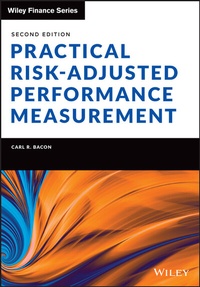
Practical Risk-Adjusted Performance Measurement
Description

In the newly revised Second Edition of Practical Risk-Adjusted Performance Measurement, accomplished risk and investment expert Carl R. Bacon delivers an insightful, accessible, and real-world guide to ex-post risk measurement. The author bridges the gap between theory and practice, showing you how to apply the former to the latter without introducing unnecessary mathematical complexity.
The book describes the fundamentals of risk in the asset management context and the descriptive statistics used to describe it. It builds on that foundation with detailed examinations of concepts like regression, drawdown, and partial moments, before moving on to topics like fixed income risk and Prospect Theory.
With helpful additions that include recently developed measures of risk, supplementary explanatory sections, and six brand-new chapters, this book also offers:
* A practical classification of all ex-post risk measures and how they connect to one another
* An explanation of how risk-adjusted performance measures impact performance fees
* A discussion of risk measure dashboard designs
* Instructions on how appraisal measures should be used for manager selection
Perfect for portfolio managers, asset owners, risk controllers, and investment performance analysts, Practical Risk-Adjusted Performance Measurement is an indispensable resource for anyone looking for a hands-on exploration of the buy-side, asset management perspective.
More details
Other editions
Additional editions
Person
CARL R. BACON, CIPM, is Chief Advisor to Confluence. He is a member of the Advisory Board of the Journal of Performance Measurement and Founder of The Freedom Index Company. He was formerly Chairman of StatPro Plc from 2000 to 2017.
Content
Chapter 1 Introduction 15
Definition of risk 15
Risk types 15
Risk management v Risk control 18
Risk aversion 19
Ex-post and ex-ante 19
Dispersion 20
Chapter 2 Descriptive statistics 21
Mean (or arithmetic mean) 21
Annualised return 22
Continuously compounded returns (or log returns) 22
Winsorised mean 23
Mean absolute deviation (or mean deviation) 24
Variance 25
Mean difference (absolute mean difference or Gini mean difference) 30
Relative mean difference 31
Bessel's correction (population or sample, n or n-1) 31
Sample variance 35
Standard deviation (variability or volatility) 36
Annualised risk (or time aggregation) 37
The Central Limit Theorem 38
Frequency and number of data points 38
Alternative risk annualisation methods 39
Normal (or Gaussian) distribution 40
Histograms 42
Skewness (Fisher's or moment skewness) 43
Sample skewness 44
Kurtosis (Pearson's kurtosis) 45
Excess kurtosis (or Fisher's kurtosis) 47
Sample kurtosis 47
Bera-Jarque statistic (or Jarque-Bera) 48
Covariance 53
Sample covariance 54
Correlation (¿¿¿¿) 54
Sample correlation 55
Autocovariance 55
Autocorrelation (or serial correlation) 57
Annualised variability if returns are autocorrelated 60
Chapter 3 APPRAISAL MEASURES 62
Performance appraisal 62
Sharpe ratio (reward to variability, Sharpe index) 63
Roy ratio 65
Risk-free rate 66
Alternative Sharpe ratio 66
Revised Sharpe ratio 67
Adjusted Sharpe Ratio 68
Skew-adjusted Sharpe Ratio 69
Skewness-Kurtosis ratio 74
Alternative adjusted Sharpe Ratios 74
Smoothing-adjusted Sharpe Ratio 75
MAD ratio 76
Gini ratio 76
Relative risk 77
Tracking error (or tracking risk, relative risk, active risk) 77
Relative skewness 78
Relative kurtosis 79
Information ratio 79
Geometric information ratio 80
Modified information ratio 87
Adjusted information ratio 88
Skew-adjusted information ratio 88
Chapter 4: Regression Analysis 94
Regression analysis 94
Regression equation 95
Regression alpha 95
Regression beta 95
Regression epsilon 95
Capital Asset Pricing Model (CAPM) 96
Beta (¿¿¿¿) (systematic risk or volatility) 97
Jensen's alpha (Jensen's measure or Jensen's differential return or ex-post alpha) 97
Annualised alpha 98
Bull beta (¿¿¿¿+) 106
Bear beta (¿¿¿¿-) 106
Beta timing ratio 106
Market timing 107
Systematic risk 115
Correlation 115
R2(or coefficient of determination) 116
Specific (or residual) risk 117
The Geometry of Risk 120
Treynor ratio (Reward to volatility) 124
Modified Treynor ratio 124
Appraisal ratio (or Treynor-Black ratio) 125
Modified Jensen 126
Fama decomposition 126
Selectivity 127
Diversification 127
Net selectivity 127
Fama-French three factor model 128
Three factor alpha (or Fama-French alpha) 129
Carhart four factor model 129
Four factor alpha (or Carhart's alpha) 130
Types of Alpha 130
Multi-factor Models 131
Chapter 5 Drawdown 132
Drawdown 132
Average drawdown 132
Maximum drawdown 133
Largest individual drawdown 133
Recovery time (or drawdown duration) 133
Drawdown deviation 134
Ulcer index 134
Pain index 135
Calmar ratio (or Drawdown ratio) 136
MAR ratio 136
Sterling ratio 136
Sterling-Calmar ratio 137
Burke ratio 138
Modified Burke ratio 138
Martin ratio (or Ulcer performance index) 138
Pain ratio 138
Active (or relative) Drawdown 143
Chapter 6 Partial Moments 148
Downside risk (or semi-standard deviation) 148
Downside potential 149
Pure downside risk 149
Half variance (or semi-variance) 149
Upside risk (or upside uncertainty) 150
Mean absolute moment 150
Omega ratio (O) 151
Bernardo & Ledoit (or gain-loss) ratio 151
d ratio 151
Omega-Sharpe ratio 152
Sortino ratio 153
Reward to half-variance 153
Downside risk Sharpe ratio 154
Downside information ratio 154
Sortino-Satchell ratio 155
Kappa ratio 155
Upside potential ratio 156
Volatility skewness 156
Variability skewness 157
Farinelli- Tibiletti Ratio 160
Gain-loss skewness 160
Downside Skewness & Kurtosis 161
Sortino Ratio with higher order moments 161
Chapter 7 Prospect Theory 165
Prospect ratio 165
New Prospect ratio 166
Omega-Prospect ratio 166
Chapter 8 Extreme Risk 170
Extreme events 170
Extreme value theory 170
Value at Risk (VaR) 170
Relative VaR 171
Ex-post VaR 171
Potential upside (gain at risk) 172
Percentile rank 172
VaR calculation methodology 175
Parametric VaR 175
Modified VaR 176
Historical simulation (or non-parametric) 177
Monte Carlo simulation 177
Which methodology for calculating VaR should be used? 178
VaR Interpretation 178
Frequency and time aggregation 180
Time horizon 180
Window length 181
Reward to VaR 181
Reward to relative VaR 182
Double VaR ratio 183
Conditional VaR (expected shortfall, tail loss, tail VaR or average VaR) 183
Upper CVaR or CVaR+ 184
Lower CVaR or CVaR- 184
Tail gain (expected gain or expected upside) 186
Conditional Sharpe ratio (STARR ratio or reward to conditional VaR) 191
Modified Sharpe ratio (reward to modified VaR) 191
Tail risk 191
Tail ratio 192
Rachev ratio (or R ratio) 192
Generalised Rachev ratio 194
Drawdown at risk 194
Conditional drawdown at risk 194
Reward to conditional drawdown 195
Generalised Z ratio 195
Chapter 9 Fixed Income Risk 197
Pricing fixed income instruments 197
Redemption yield (yield to maturity) 197
Weighted average cash flow 197
Duration (effective mean term, discounted mean term or volatility) 198
Macaulay duration 198
Macaulay-Weil duration 199
Modified duration 199
Portfolio duration 200
Effective duration (or option-adjusted duration) 202
Duration to worst 204
Convexity 204
Modified convexity 205
Effective convexity 205
Portfolio convexity 207
Bond returns 207
Duration beta 209
Reward to duration 209
Chapter 10 miscellaneous Risk Measures 210
Upside Capture Ratio (or up capture indicator) 210
Downside capture ratio (or down capture indicator) 210
Up/down capture (or Capture ratio) 211
Up number ratio 216
Down number ratio 216
Up percentage ratio 217
Down percentage ratio 217
Percentage gain ratio 217
Batting Average (or Relative Batting Average) 217
Hurst index (or Hurst exponent) 218
Relative Hurst Index (or Active Hurst) 225
Bias ratio 231
Active Share 237
K ratio 239
Chapter 11 Risk-adjusted Return 248
Risk-adjusted return 248
M2 248
M2 excess return 250
Differential return 250
GH1 (Graham & Harvey 1) 252
GH2 (Graham & Harvey 2) 252
Correlation and risk-adjusted return M3 253
Return adjusted for downside risk 253
Adjusted M2 257
Skew-adjusted M2 257
Omega excess return 258
Chapter 12: A Periodic Table of Risk Measures 259
A Periodic Table of Risk Measures 259
Periodic Table Design 260
Filling the Periodic Table 261
Notation 264
Chapter 13: Risk-adjusted Performance Fees 269
Performance Fees 269
Asymmetric or Symmetric 269
Performance Fees in Practice 273
Chapter 14: Performance Dashboards 276
Effective dashboards 276
Data visualisation tools 277
Chapter 15: Manager Selection 279
Asset Manager Selection 279
Manager Evaluation 280
Portfolio Evaluation 281
Monitoring and Control 282
Chapter 16: The Four Dimensions of Performance 284
Ex-post Return (The traditional dimension) 285
Ex-post Risk (The neglected dimension) 285
Ex-ante Return (The unknown dimension) 285
Ex-ante Risk (The "sexy" dimension) 286
Risk efficiency ratio 286
Performance efficiency 287
Ex-ante Risk Standards 287
Consistency in calculations and comparison 288
Disclosure 288
Recognition of adherence to best practice 288
More robust internal process and control 288
Chapter 17: Which Risk Measure to Use? 291
Why measure ex-post risk? 291
Which risk measures to use? 291
Hedge funds 295
Smoothing 296
Outliers 299
Data mining 300
Risk measures and the Global Investment Performance Standards (GIPS®) 300
Fund rating systems 303
Which measures are actually used? 304
Which risk measures should really be used? 309
Common Errors to avoid 310
Chapter 18: Risk Control 311
Regulations in the investment risk area 311
Risk control structure 312
Risk management 313
Glossary of Key Terms 318
Appendix A - Composite Internal Risk Measures 321
Bibliography 323
CHAPTER 1
Introduction
"Money is like muck, not good except it be spread."
Francis Bacon (1561-1626)
DEFINITION OF RISK
Risk means very different things to different audiences at different times; risk is truly in the eye of the beholder. In the context of asset management, the Oxford English Dictionary provides a surprisingly good definition of risk:
The potential impact of an event determined by combining the likelihood of the event occurring with the impact should it occur.
Risk is the combination of exposure and uncertainty. As Holton1 (2004) so eloquently points out it is not risky to jump out of an aircraft without a parachute because death is certain. Holton also points out that we can never operationally define risk; at best, we can operationally define our perception of risk.
Another common and effective, but broader definition of risk is exposure to uncertainty.
RISK TYPES
Within asset management firms there are many types of risk that should concern asset managers and senior management. For convenience I've chosen to classify risk into five main categories:
- Compliance Risk
- Operational Risk
- Liquidity Risk
- Counterparty Risk
- Portfolio Risk
These risks are ranked in my priority order of concern at the point in time I assumed the role of Director of Risk Control at an asset management firm in the late 1990s.2 What I didn't appreciate fully then, but appreciated much later, is that priorities will vary through time; during the credit crisis I'm sure counterparty risk became the number one priority for many firms.
Although a major concern of all asset managers, reputational risk does not warrant a separate category; a risk failure in any category can cause significant damage to a firm's reputation.
Compliance or regulatory risk is the risk of breaching a regulatory, client or internally imposed guideline, restriction or clear limit. I draw no distinction between internal or external limits; the breach of an internal limit indicates a control failure, which could just as easily have been a regulatory, or client mandated limit. Of course, the financial impact of breaching limits can be significant; in August 1996 Peter Young of Morgan Grenfell Asset Management allegedly cost Deutsche Bank £300 to £400 million in compensation payments to investors in highly regulated authorised unit trusts. Peter Young used Luxembourg listed shell companies to circumvent limits on unlisted and risky holdings.
Operational risk, often defined as a residual catch-all category to include risks not defined elsewhere, actually includes the risk of human error, fraud, system failure, poor controls, management failure and failed trades. Risks of this type are more common but usually less severe. Nevertheless, it is important to continuously monitor errors and near misses of all types, even those that do not result in financial loss. An increase in the frequency of errors regardless of size or sign may indicate a more serious problem that requires further investigation and corrective action. Although typically small in size, operational errors can lead to large losses. In December 2005 a trader at the Japanese brokerage firm Mizuho Securities made a typing error and tried to sell 610,000 shares at 1 yen apiece in recruiting company J-Com Co., which was debuting on the exchange, instead of an intended sale of one share at ¥610,000 - an example of fat-finger syndrome. Mizuho lost approximately ¥41 billion. In April 2007,3 a programmer at AXA Rosenberg incorrectly programmed a statistical model, leading to $217 million in losses for clients. A Securities and Exchange Commission (SEC) investigation found that senior management learned in June 2009 of a material error, but instead of disclosing and fixing the error a senior official directed others to keep quiet. The error was kept from senior management until November 2009 and from clients until April 2010. According to the SEC, the firm failed to disclose the error and its impact on client performance, attributed the model's underperformance to market volatility and misrepresented the model's ability to control risk. AXA Rosenberg paid an additional $25 million penalty fine.
Liquidity risk is the risk that assets cannot be traded quickly enough in a market to change asset and risk allocations, realise profits or prevent losses. Perhaps liquidity risk has received less attention than it should in the past but it is capable of causing significant damage. The demise of Long Term Capital Management (LCTM)4 in 1998 was really a liquidity issue compounded by massive leverage. In less than one year LTCM lost $4.4 billion of its $4.7 billion capital. LTCM was a hedge fund based in Greenwich, Connecticut that used absolute return strategies combined with high leverage. LTCM had been making losses throughout the summer of 1998 which were further compounded by the Russian Debt Crisis in August and September causing a flight to quality. This resulted in the bidding up of the price of the most liquid securities in which LTCM was short and depressing the price of less liquid securities of which LTCM was long. As rumours of LTCM's positions spread, market participants positioned themselves for forced liquidation; eventually LTCM was forced to liquidate at exactly the wrong time, increasing its losses.
A more recent, and extremely relevant, example in the context of today's markets is the liquidity crisis at the LF Woodford Equity Income Fund (WEIF).5 WEIF, an open-ended investment fund, was forced to suspend dealing in June 2019, to avoid a fire sale of unlisted assets, triggered by the attempted withdrawal of £250 million, or 4%, of the fund's assets by Kent County Council. In the preceding weeks, following a period of poor performance, investors had already withdrawn in excess of £500 million, increasing the already high percentage of unlisted, illiquid assets. The fund had previously circumvented a 10% limit on illiquid assets by bundling up the fund's unlisted assets and listing them on the Guernsey-headquartered International Stock Exchange which had barely any trading activity and was unable to provide sufficient liquidity.6 Extraordinarily, the Governor of the Bank of England said "These funds are built on a lie which is that you can have daily liquidity for assets that are fundamentally not liquid".7 WEIF might also be described as a compliance risk failure - for a better comprehension of regulatory arbitrage, pushing the envelope and overpowerful portfolio managers, Owen Walker's Built on a Lie8 is a remarkably good read. Understanding liquidity risk in both normal and turbulent markets is a crucial element of effective risk control; the relatively recently identified phenomenon of crowded exits is a characteristic of those turbulent markets.
Counterparty risk occurs when counterparties are unwilling or unable to fulfil their contractual obligations, at its most basic through corporate failure. Counterparty exposure could include profits on an OTC derivatives contract, unsettled transactions, cash management, administrators, custodians, prime brokers and - even with the comfort of appropriate collateral - the failure to return stock that has been used for stock lending. Perhaps the most obvious example of counterparty risk is the failure of Lehman Brothers9 in September 2008.
In the middle office of asset management firms, we are most concerned with portfolio risk, which I define as the uncertainty of meeting asset owner10 expectations. Is the portfolio of assets managed in line with the asset owner's investment objectives? The consequences of not meeting asset owner expectations can be quite severe. Early in 2001,11 the Unilever Superannuation Fund sued Merrill Lynch for damages of £130 million claiming negligence in that Merrill Lynch had not sufficiently considered the risk of underperformance. Ultimately the case was settled out of court for an undisclosed sum, believed to be £70 million, the perception to many being that Unilever won.
Credit risk (or issuer risk) as opposed to counterparty risk is a type of portfolio risk. Credit risk or default risk is the investor's risk of a borrower failing to meet their financial commitments in full. The higher the risk of default the higher the rate of interest investors will demand to lend their capital. Therefore, the reward or returns in terms of higher yields must offset the increased risk of default. Similarly, market, currency and interest rate risks taken by asset managers in the pursuit of asset owner objectives would constitute portfolio risks in this context.
I'm sure readers can quickly add to this brief list of risks and extend through various subdivisions, but I'm fairly certain any risk I've not mentioned so far can be allocated to one or more of the above categories.
RISK MANAGEMENT VERSUS RISK CONTROL
It is useful to distinguish between the ways portfolio managers12 and risk professionals see risk. For this purpose, let us refer to portfolio managers as "risk managers" and to risk professionals as "risk controllers". Then there is a clear distinction between risk management and risk control. As risk managers, portfolio managers are paid to take risk, they need to take risk in order to achieve higher returns. For the risk manager "Risk is...
