

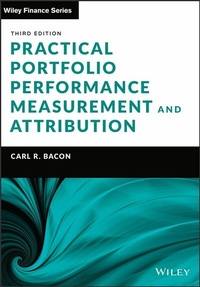
Practical Portfolio Performance Measurement and Attribution
Description

Practical Portfolio Performance Measurement and Attribution is a comprehensive reference and guide to the use and calculation of performance returns in the investment decision process. Focusing on real-world application rather than academic theory, this highly practical book helps asset managers and investors determine return on assets, analyse portfolio behaviour and improve performance. Author Carl R. Bacon clearly describes each of the methodologies used by performance analysts in today's financial environment whilst sharing valuable insights drawn from his experience as a Director of Performance Measurement & Risk Control.
The third edition is revised to reflect recent developments in performance attribution and presentation standards. Fully up-to-date chapters cover the entire performance measurement process, including return calculations, attribution methodologies, risk measures, manager selection and presentation of performance information.
* Written by an acknowledged leader in global investment performance standards, performance attribution technique and risk measurement
* Aligns with the publication of the 2020 Global Investment Performance Standards (GIPS®)
* Explains the mathematical aspects of performance measurement and attribution in a clear, easy-to-understand manner
* Provides numerous practical and worked examples of attribution analysis and risk calculations supported by Excel spreadsheets
* Includes signposts for the future development of performance measurement
Practical Portfolio Performance Measurement and Attribution, Third Edition, remains a must-have for performance analysts and risk controllers, portfolio managers, compliance professionals and all asset managers, owners, consultants and servicing firms.
More details
Other editions
Additional editions
Person
CARL R. BACON, CIPM, is Chief Advisor to Confluence. He is a member of the Advisory Board of the Journal of Performance Measurement and Founder of The Freedom Index Company. He is the former Chairman of StatPro plc, Director of Risk Control and Performance at Foreign & Colonial Management Ltd and Vice President Head of Performance (Europe) for JP Morgan Investment Management Inc.
Content
Contents
Acknowledgements
Contents
Chapter 1 Introduction
The Performance Measurement Process
Role of performance analysts
Book Structure
Chapter 2 The Asset Management Industry
Asset Classes
Public Equities
Bonds (or Fixed Income)
Cash (and near cash)
Private Assets
Real Estate
Private Equity
Private Debt
Infrastructure
Natural Resources
Commodities
Derivatives
Futures
Forwards
Swaps
Contracts for Difference (CFD)
Options
Overlay Strategies
Currency
Hedge Funds
Asset Allocation
Strategic asset allocation
Tactical asset allocation.
Chapter 3 The Mathematics of Portfolio Return
Simple Return
Continuously Compounded (or logarithmic) Returns
Money-weighted Returns (MWR)
Internal Rate of Return (IRR)
Ex-ante Internal Rate of Return
Simple Internal Rate of Return
Ex-post Internal Rate of Return
Simple Dietz
ICAA Method
Modified Dietz
Time-Weighted Returns (TWR)
True Time-Weighted
Unit Price Method
Unit Price Method with Distributions
Time-weighted versus Money-weighted Rates of Return
Approximations to the Time Weighted Return
Index Substitution
Regression Method (or b method)
Analyst's Test
Hybrid Methodologies
Linked Modified Dietz
BAI Method (or linked IRR)
Which method to use?
Late Trading and Market Timing
Self-selection
Large Cash Flow
Self-selection of methodologies
Annualised Returns
Since Inception Internal Rate of Return (SI-IRR)
Modified IRR (MIRR)
Return Hiatus
Gross and net of fee calculations
Estimating gross and net of fee returns
Initial Fees
Performance Fees
Asymmetric or Symmetric
Crystallisation
Performance Fees in Practice
Equalization
Reporting Hierarchy
Overlay Strategies
Overlay performance return calculations:
Base currency and local returns
Currency conversions
Hedged Returns
Currency Overlay Returns
Perfectly Hedged Returns
Portfolio Component Returns
Money-weighted Component Returns
End of day
Beginning of day
Intra-day weighted
Differentiated
Actual Time
Rule-based
Extremely large cash flows
Which timing assumption to use for time-weighted returns?
Carve Outs
Sub-portfolios
Cash Sectors
Individual security returns
Multi-period component returns
Abnormal Returns
Short Positions
Contribution to return
Composite returns
Chapter 4 Benchmarks
Benchmarks
Benchmark attributes
The Role of Benchmarks
Types of Benchmarks
Commercial Indexes
Calculation methodologies
Aggregate Price Index (Price-weighted Index or Carli type)
Geometric (or Jevons type) Index
Market Capitalisation Index
Laspeyres Index
Paasche Index
Marshall - Edgeworth Index
Fisher Index
Equal weighted Indexes
Fundamental Indexes
Optimised Indexes (efficient or minimum variance indexes)
Fixed Income Indexes
Index Providers
Choice of Index Provider
Benchmark Regulation
Choice of Index
Currency Effects in Benchmark
Hedged Indexes
Customised Indexes
Capped Indexes
Peer Groups and Universes
Percentile Rank
Random Portfolios
Exchange Traded Funds (ETFs)
Target Returns
Blended Benchmarks (or balanced benchmarks)
Fixed Weight & Dynamised Benchmarks
Spliced Indexes
Money-weighted Benchmarks (or public market equivalents)
Normal Portfolio
Benchmark Statistics
Index Turnover
Up-capture Indicator
Down-capture Indicator
Up-number Ratio
Down-number Ratio
Up-percentage Ratio
Down-percentage Ratio
Percentage Gain Ratio
Excess return
Arithmetic Excess Return
Geometric Excess Return
Chapter 5 Risk
Definition of Risk
Risk types
Risk management v Risk control
Risk aversion
Ex-post and ex-ante
Descriptive Statistics
Mean (or arithmetic mean)
Mean absolute deviation (or mean deviation)
Variance
Bessel's correction (population or sample, n or n-1)
Sample variance
Standard deviation (variability or volatility)
Annualised risk (or time aggregation)
The Central Limit Theorem
Frequency and number of data points
Normal (or Gaussian) distribution
Histograms
Skewness (Fisher's or moment skewness)
Sample skewness
Kurtosis (Pearson's kurtosis)
Excess kurtosis (or Fisher's kurtosis)
Sample kurtosis
Bera-Jarque statistic (or Jarque-Bera)
Covariance
Sample covariance
Correlation (r)
Sample correlation
Performance appraisal
Sharpe ratio (reward to variability, Sharpe index)
Roy ratio
Risk-free rate
Alternative Sharpe ratio
Revised Sharpe ratio
Adjusted Sharpe Ratio
Skew-adjusted Sharpe Ratio
Relative risk
Tracking error (or tracking risk, relative risk, active risk)
Information ratio
Geometric information ratio
Modified information ratio
Regression analysis
Regression equation
Regression alpha
Regression beta
Regression epsilon
Capital Asset Pricing Model (CAPM)
Beta (b) (systematic risk or volatility)
Jensen's alpha (Jensen's measure or Jensen's differential return or ex-post alpha)
Annualised alpha
Bull beta (b+)
Bear beta (b-)
Beta timing ratio
Market timing
Systematic risk
Correlation
R2(or coefficient of determination)
Specific (or residual) risk
Treynor ratio (Reward to volatility)
Appraisal ratio (or Treynor-Black ratio)
Factor Models
Fama decomposition
Selectivity
Diversification
Net selectivity
Fama-French three factor model
Three factor alpha (or Fama-French alpha)
Carhart four factor model
Four factor alpha (or Carhart's alpha)
Multi-factor Models
Drawdown
Average drawdown
Maximum drawdown
Largest individual drawdown
Recovery time (or drawdown duration)
Drawdown deviation
Ulcer index
Pain index
Calmar ratio (or Drawdown ratio)
MAR ratio
Sterling ratio
Sterling-Calmar ratio
Burke ratio
Modified Burke ratio
Martin ratio (or Ulcer performance index)
Pain ratio
Partial Moments
Downside risk (or semi-standard deviation)
Downside potential
Pure downside risk
Half variance (or semi-variance)
Upside risk (or upside uncertainty)
Mean absolute moment
Omega ratio (W)
Bernardo & Ledoit (or gain-loss) ratio
d ratio
Omega-Sharpe ratio
Sortino ratio
Reward to half-variance
Downside risk Sharpe ratio
Sortino-Satchell ratio
Kappa ratio
Upside potential ratio
Volatility skewness
Variability skewness
Farinelli-Tibiletti Ratio
Prospect ratio
Fixed Income Risk
Pricing fixed income instruments
Redemption yield (yield to maturity)
Weighted average cash flow
Duration (effective mean term, discounted mean term or volatility)
Macaulay duration
Macaulay-Weil duration
Modified duration
Portfolio duration
Effective duration (or option-adjusted duration)
Duration to worst
Convexity
Modified convexity
Effective convexity
Portfolio convexity
Bond returns
Duration beta
Reward to duration
Miscellaneous Risk Measures
Hurst index (or Hurst exponent)
Bias ratio
Active Share
Value at Risk (VaR)
Risk-adjusted return
M2
M2 excess return
Differential return
Adjusted M2
Skew-adjusted M2
Types of Excess Return (or Alpha)
A Periodic Table of Risk Measures
Periodic Table Design
Why measure ex-post risk?
Which risk measures to use?
Hedge funds
Smoothing
Outliers
Data mining
Time Period
Chapter 6 Return Attribution 280
What is Attribution?
Definition
Attribution as an asset management tool
Early Development
Types of Return Attribution
Returns-based (regression or factor) Attribution
Holdings-based (or buy/hold) Attribution
Transaction-based Attribution
Arithmetic Attribution
Brinson, Hood & Beebower
Asset Allocation
Security (or Stock) Selection
Interaction
Brinson & Fachler
Interaction
Geometric Excess Return Attribution
Asset allocation
Stock selection
Sector Weights
Frequency of Analysis
Security Level Attribution
Transaction costs
Off-benchmark (or zero weight sector) attribution
Attribution consistent with the Investment Decision Process
Market Neutral Attribution
Attribution for 130/30 funds (or extended short funds)
Leverage (or gearing)
Attribution including derivatives
Attribution including Equity Index Futures
Attribution Analysis using options
Multi-currency attribution
Ankrim & Hensel
Karnosky & Singer
Geometric Multi-Currency Attribution
Naïve Currency Attribution
Compounding effects
Geometric Currency Allocation
Currency Timing
Interest Rate Differentials
Revised Currency Allocation
Revised Country Allocation
Incorporating Forward Currency Contracts
Summarising
Other Currency Issues
Fixed Income Attribution
The Yield Curve
Yield curve analysis
Shift
Twist (or slope)
Curvature (or butterfly)
Carry
Credit (or spread)
Yield Curve Decomposition
Wagner & Tito
Weighted Duration Attribution
Geometric Fixed Income Attribution
Campisi Framework
Yield Curve Decomposition
Multi-period attribution
Smoothing Algorithms
Carino
Menchero
Linking Algorithms
GRAP Method
Frongello
Davies & Laker
Multi-period Geometric Attribution
Annualisation of Excess Return
Attribution Annualisation
Contribution Analysis (or absolute return attribution)
Risk-adjusted Attribution
Selectivity
Multi-level Attribution
Balanced attribution
Evolution of performance attribution methodologies
Chapter 7 Performance Presentation Standards
Why do we need performance presentation standards?
Global Investment Performance Standards (GIPS®) - A history
Advantages for Asset Managers
The GIPS Standards
Fundamentals of Compliance
Definition of the Firm
Maintaining Policies and Procedures
Providing GIPS Reports
Benchmark Selection
Correcting Errors in GIPS Reports
Composite Descriptions
Recordkeeping
Linking of theoretical and actual performance
Portability
Use of time-weighted or money-weighted returns
Claiming Compliance with the GIPS standards.
Input Data and Calculation Methodology
Firm Assets, Composite Assets and Pooled Fund Assets
Overlay Exposure
Returns
Valuation
Time-Weighted Returns
Money-weighted Returns
Net Returns
Composite Returns
Private Market Investments
Real Estate
Net-of-fee Carve-outs returns
Wrap fee, side pockets and subscription lines of credit
Composite and Pooled Fund Maintenance
Composite Maintenance
Carve-Outs
Presentation and Reporting
Composite Time-weighted Return Report
Returns, Dispersion & Risk
Unobservable inputs, gross or net-of-fees, multiple benchmarks, breaks in performance, carve-outs and non-fee-paying portfolios
Committed Capital and Advisory Assets
Reporting currency, carve-outs, overlay strategies, wrap fees and supplemental information
Composite Money-weighted Reports
Composite Cumulative Committed Capital
Total Value to Since-inception Paid in Capital (TVPI or Multiple of Investment Capital (MOIC) or Investment Multiple)
Since-inception Distributions to Since-inception Paid-in Capital (Realisation multiple or DPI)
Since-inception Paid-in Capital to cumulative Committed Capital (PIC Multiple)
Residual Value to since-Inception Paid-in Capital (Unrealised Multiple or RVPI)
Disclosures
Claim of Compliance
Firm, composite and benchmark definitions
Fee disclosures
Inception date, creation date, composite lists availability of policies and procedures, leverage and estimated transaction costs.
Significant events, redefinition, minimum asset levels and withholding tax
Conflicts with regulation, carve-out disclosures & sub-advisors.
Benchmark Disclosures
Significant cash flow disclosure and material errors.
Risk measures, overlay strategy, real estate valuation and theoretical performance disclosures.
Sample GIPS Composite Report
GIPS Advertising Guidelines
Fundamental requirements of the GIPS Advertising Guidelines
GIPS Advertisements that do not include performance.
GIPS advertisements for composites
GIPS Advertisements for a Broad Distribution Pooled Fund
Verification
Performance Examination
Achieving Compliance
Maintaining Compliance
GIPS Standards for Asset Owners
Chapter 8 Bringing it all together
Effective dashboards
Data visualisation tools
Manager Selection
Asset Manager Selection
Manager Evaluation
Portfolio Evaluation
Monitoring and Control
The Four Dimensions of Performance
Ex-post Return (The traditional dimension)
Ex-post Risk (The neglected dimension)
Ex-ante Return (The unknown dimension)
Ex-ante Risk (The "sexy" dimension)
Risk efficiency ratio
Performance efficiency
Risk control structure
Risk management
Glossary of Key Terms
Appendix A - Simple Attribution
Appendix B - Multi-Currency Attribution Methodology
Bibliography
Index
1
Introduction
We learn more by looking for the answer to a question and not finding it than we do from learning the answer itself.
Lloyd Alexander (1924-2007)
Who questions much, shall learn much, and retain much.
Francis Bacon (1561-1626)
WHY MEASURE PORTFOLIO PERFORMANCE?
Whether we manage our own investment assets or choose to hire others to manage the assets on our behalf we are keen to know "how well" our collection or portfolio of assets is performing.
The process of adding value via benchmarking, asset allocation, manager selection, security analysis, portfolio construction and executing transactions is collectively described as the investment decision process. The measurement of portfolio performance should be part of the investment decision process, not external to it.
Clearly there are many stakeholders in the investment decision process; this book focuses on the investors or owners of capital (asset owners) and the firms managing their assets (asset managers1 or individual portfolio managers). Other stakeholders in the investment decision process include asset consultants tasked with providing advice to asset owners, custodians, independent performance measurers and audit firms (asset servicing firms).
Portfolio performance measurement answers the three basic questions central to the relationship between asset managers and asset owners:
- What is the return on their assets?
- Why has the portfolio performed that way?
- How can we improve performance?
Portfolio performance measurement is the quality control of the investment decision process providing the necessary information to enable asset managers and asset owners to assess exactly how the money has been invested and the results of the process. The US Bank Administration Institute (BAI) laid down the foundations of the performance measurement process as early as 1968.2 The main conclusions of their study hold true today:
- Performance measurement returns should be based on asset values measured at market value, not at cost.
- Returns should be "total" returns, that is, they should include both income and changes in market value (realised and unrealised capital appreciation).
- Returns should be time weighted.
- Measurement should include risk as well as return.
THE PERFORMANCE MEASUREMENT PROCESS
Performance measurement is essentially a three-stage process:
- Measurement
Calculation of portfolio and benchmark returns
Distribution of information
- Analysis
Return attribution
Risk attribution (ex-post and ex-ante)
- Evaluation
Feedback
Control
Note
Performance is at the very least two dimensional - the combination of both risk and return.
THE PURPOSE OF THIS BOOK
The writing of any book is inevitably a selfish activity, taking precious time not only from family who suffer in silence but also work colleagues and friends, driven by the belief that you have something to contribute in your chosen subject.
The vocabulary and methodologies used by performance analysts worldwide are extremely varied and complex. Despite the development and global success of performance measurement standards there are considerable differences in terminology, methodology and attitude to performance measurement throughout the world.
The main aims of the first edition were to:
- Provide a reference of the available methodologies and to hopefully provide some consistency in their definition.
- Promote the role of performance measurers.
- Provide some insights into the tools available to performance measurers.
- Share my practical experience.
The motivation to write the first edition was simply to provide the book I most wanted to read as a performance analyst, which did not exist at the time. The motivation to write the second edition came from the readers of the first edition. Their praise, comments, corrections and requests encouraged me to expand and improve the material in the second edition. The gap between the first and second editions was a mere 4 years; 14 years later I write this third edition. The motivation for this third edition is more intense: I wish to share the invaluable experience gained from running performance measurement and risk control teams for an entire career, chairing a performance analytics company for 17 years, setting standards with the CFA Institute for 27 years, and above all teaching performance analytics worldwide for 25 years. That experience shouldn't go to waste.
Since the first edition I'm pleased to say that the CFA Institute have launched the Certificate in Investment Performance (CIPM)3 designation, which further reinforces the role of performance measurement and is a major step in developing performance measurement as a professional activity. I can certainly recommend the CIPM course of study, and I'm pleased to say I have successfully achieved the CIPM designation.
The CIPM curriculum has also to some degree influenced the content of this third edition.
With practical examples, this book should meet the needs of performance analysts, portfolio managers, senior management within asset management firms, custodians, verifiers and the ultimate asset owners. I'm particularly pleased that this third edition provides access to an Excel spreadsheet that includes all of the practical examples used throughout the book. Apologies to readers who believe there are slightly too many worked examples in this text, but I regard worked examples as an essential part of the learning and explanation process.
THE ROLE OF PERFORMANCE ANALYSTS
Performance measurement is a key function in an asset management firm; it deserves better than to be grouped with the back office. Performance analysts provide real added value, with feedback into the investment decision process and analysis of structural issues. Since their role is to understand in full and make transparent and communicate the sources of return and risk within portfolios, they are often the only independent source equipped to understand the performance of all the portfolios and strategies within the asset management firm.
Performance analysts are in effect alternative risk controllers able to protect the firm from rogue managers and the unfortunate impact of failing to meet client expectations.
My aim has been to present all approaches and methodologies as fairly as possible. It is not always possible to hide my preferences, prejudices and ignorance but in this edition, I've attempted to highlight my views as clearly identified notes, cautions and interpretations.
BOOK STRUCTURE
Chapter 2 is naturally a brief description of the asset management industry from the perspective of a performance analyst. The remaining chapters are structured in the same order as the performance measurement process itself, namely:
- Chapter 3: Calculation of portfolio returns
- Chapter 4: Comparison against an appropriate benchmark
- Chapter 5: Proper assessment of the reward received for the risk taken
- Chapter 6: Attribution of the sources of excess return
- Chapter 7: Global Investment Performance Standards
- Chapter 8: Bringing it all together, presentation and communication
In Chapter 3 the "what" of performance measurement is introduced, describing the many forms of return calculation including the relative merits of each method together with calculation examples. Performance gross and net of fees is discussed as well as performance fee structures.
Performance returns in isolation add little value; we must compare these returns against a suitable benchmark. Chapter 4 discusses the merits of good and bad benchmarks and examines the detailed calculation of commercial and customised indexes. Excess return is discussed in detail.
Chapter 5 is an attempt to catalogue and describe all the available ex-post risk measures used by performance analysts, including suggestions for consistent definitions where such definitions are lacking. The chapter concludes with an attempt to illustrate the relationship of risk measures to each other in terms of a periodic table of risk measures.
Together with Chapter 5, Chapter 6 is the core of this edition, attempting to answer the "why" of performance measurement. Attribution is a broad subject; the early development of return attribution is covered, leading to a fundamental examination of the Brinson model. With the foundations in place, security level attribution, off-benchmark attribution, attribution including derivative instruments, multi-currency attribution, fixed income attribution, multi-period attribution, multi-level attribution and balanced attribution are explained in detail with multiple worked examples.
Chapter 7 discusses the Global Investment Performance Standards (GIPS®) in detail. Focusing on GIPS for investment firms, the provisions are listed together with commentary providing the rationale and context for the provision (from my perspective), including tips and pitfalls to avoid.
Chapter 8 brings all the analytical tools together to address the "how" of performance measurement in the...
