

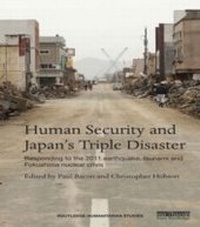
Human Security and Japan's Triple Disaster
Responding to the 2011 earthquake, tsunami and Fukushima nuclear crisis
1st Edition
Published on 27. June 2014
228 pages
978-1-317-74747-5 (ISBN)
Description

Japan has been one of the most important international sponsors of human security, yet the concept has hitherto not been considered relevant to the Japanese domestic context. This book applies the human security approach to the specific case of the earthquake, tsunami and nuclear accident that struck Japan on 11 March 2011, which has come to be known as Japan's 'triple disaster'. This left more than 15,000 people dead and was the most expensive natural disaster in recorded history.
The book identifies the many different forms of human insecurity that were produced or exacerbated within Japan by the triple disaster. Each chapter adds to the contemporary literature by identifying the vulnerability of Japanese social groups and communities, and examining how they collectively seek to prevent, respond to and recover from disaster. Emphasis is given to analysis of the more encouraging signs of human empowerment that have occurred. Contributors draw on a wide range of perspectives, from disciplines such as: disaster studies, environmental studies, gender studies, international relations, Japanese studies, philosophy and sociology.
In considering this Japanese case study in detail, the book demonstrates to researchers, postgraduate students, policy makers and practitioners how the concept of human security can be practically applied at a policy level to the domestic affairs of developed countries, countering the tendency to regard human security as exclusively for developing states.
The book identifies the many different forms of human insecurity that were produced or exacerbated within Japan by the triple disaster. Each chapter adds to the contemporary literature by identifying the vulnerability of Japanese social groups and communities, and examining how they collectively seek to prevent, respond to and recover from disaster. Emphasis is given to analysis of the more encouraging signs of human empowerment that have occurred. Contributors draw on a wide range of perspectives, from disciplines such as: disaster studies, environmental studies, gender studies, international relations, Japanese studies, philosophy and sociology.
In considering this Japanese case study in detail, the book demonstrates to researchers, postgraduate students, policy makers and practitioners how the concept of human security can be practically applied at a policy level to the domestic affairs of developed countries, countering the tendency to regard human security as exclusively for developing states.
Reviews / Votes
'Many practitioners, scholars and students, both within and beyond Japan, mistakenly imagine human security to be something that applies to 'others' in economically underdeveloped countries. Bacon and Hobson are therefore to be congratulated for refining and extending the human security approach, and demonstrating persuasively how it can be applied to the affairs of economically developed democracies in general, and more specifically to the 2011 'triple disaster', with which we are all still trying to come to terms here in Japan.' - Takashi Inoguchi, University of Tokyo, Japan'The concept of human security has rarely been used or practiced within Japan, as if there were no vulnerable people in the country. Bacon and Hobson remind us that human security is relevant for all countries, and show how it can fruitfully be applied to the variety of challenges that Japan continues to face in the wake of the 2011 'triple disaster''.- Yasushi Katsuma, Waseda University, Japan
'This well-researched and cogently argued volume exposes the facade of the Japanese state's commitment to Human Security in the light of the triple disasters of 3.11. It will be essential reading for anyone seeking to understand human insecurity in post-tsunami Japan.' -Giorgio Shani, the International Christian University, Japan
'This book provocatively shows how the concept of human security applies to one of the most important recent disasters-the earthquake tsunami and nuclear disaster in Japan. It causes us-as students, academics or officials- to reflect humbly on how we can better protect human security, close to home, and further afield.' - Mihir Bhatt, Director, All India Disaster Mitigation Institute, India
More details
Series
Language
English
Place of publication
London
United Kingdom
Publishing group
Taylor & Francis Ltd
Target group
College/higher education
Illustrations
11 s/w Abbildungen, 5 s/w Tabellen, 6 s/w Zeichnungen
5 Tables, black and white; 6 Line drawings, black and white; 11 Illustrations, black and white
File size
1,17 MB
ISBN-13
978-1-317-74747-5 (9781317747475)
Copyright in bibliographic data and cover images is held by Nielsen Book Services Limited or by the publishers or by their respective licensors: all rights reserved.
Schweitzer Classification
Other editions
Additional editions
Paul Bacon | Christopher Hobson
Human Security and Japan's Triple Disaster
Responding to the 2011 earthquake, tsunami and Fukushima nuclear crisis
Book
12/2015
1st Edition
Routledge
€81.10
Shipment within 10-20 days
Paul Bacon | Christopher Hobson
Human Security and Japan's Triple Disaster
Responding to the 2011 earthquake, tsunami and Fukushima nuclear crisis
Book
06/2014
1st Edition
Routledge
€233.10
Shipment within 10-20 days
Persons
Paul Bacon is Associate Professor, School of International Liberal Studies, and Deputy Director of the European Union Institute, Waseda University, Japan.
Chris Hobson is Assistant Professor, School of Political Science and Economics Waseda University, Japan, and Visiting Research Fellow, United Nations University, Japan.
Chris Hobson is Assistant Professor, School of Political Science and Economics Waseda University, Japan, and Visiting Research Fellow, United Nations University, Japan.
Content
1. Human Security Comes Home: Responding to Japan's Triple Disaster Paul Bacon and Christopher Hobson 2. The Politics of Human Security in Japan Paul Bacon 3. Mismanaging Risk and the Fukushima Nuclear Crisis Jeff Kingston 4. Hidden Insecurities: The Workers of Fukushima Dai-ichi Christopher Hobson 5. Human Security as a Military Security Left-Over, or as Part of the Human Condition? Paul James 6. Human Security and Life Recover: Lessons from the 1995 Kobe Earthquake and the 2011 Triple Disaster Mayumi Sakamoto 7. Towards a People-centred Housing Recover after the Triple Disaster Elizabeth Maly 8. An Ageing Society and Post-Disaster Community Security Junko Otani 9. Post-disaster Recovery and the Cultural Dimension of Human Security Akiko Fukushima 10. What Role for Nuclear Power in Japan after Fukushima? A Human Security Perspective Paul Bacon and Mai Sato 11. Towards Human Security: Climate Change and the Military Role in Humanitarian Assistance and Disaster Response Andrew DeWit 12. Life after the Triple Disaster: Human Security and the Future Christopher Hobson
