

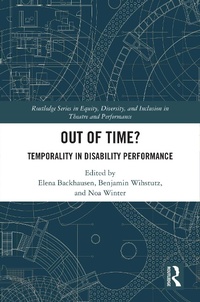
Out of Time?
Temporality In Disability Performance
1st Edition
Published on 10. July 2023
236 pages
978-1-000-88909-3 (ISBN)
Description

Out of Time? has many different meanings, amongst them outmoded, out of step, under time pressure, no time left, or simply delayed. In the disability context, it may also refer to resistant attitudes of living in "crip time" that contradict time as a linear process with a more or less predictable future. According to Alison Kafer, "crip time bends the clock to meet disabled bodies and minds." What does this mean in the disability arts? What new concepts of accessibility, crip futures, and crip resistance can be staged or created by disability performance? And how does the notion of "out of time" connect crip time with pandemic time in disability performance?
The collective volume seeks to respond to these questions by exploring crip time in disability performance as both a concept and a phenomenon. The book tackles the topic from two angles: on the one hand from a theoretical point of view that connects performance analysis with crip and performance theory, on the other hand from a practice-based perspective of disability artists who develop new concepts and dramaturgies of crip time based on their own lived experiences and observations in the field of the performing and disability arts.
The book gathers different types of text genres, forms, and styles that mirror the diversity of their authors. Besides theoretical and academic chapters on disability performance, the book also includes essays, poems, dramatic texts, and choreographic concepts that ref lect upon the alternative knowledge in the disability arts.
The collective volume seeks to respond to these questions by exploring crip time in disability performance as both a concept and a phenomenon. The book tackles the topic from two angles: on the one hand from a theoretical point of view that connects performance analysis with crip and performance theory, on the other hand from a practice-based perspective of disability artists who develop new concepts and dramaturgies of crip time based on their own lived experiences and observations in the field of the performing and disability arts.
The book gathers different types of text genres, forms, and styles that mirror the diversity of their authors. Besides theoretical and academic chapters on disability performance, the book also includes essays, poems, dramatic texts, and choreographic concepts that ref lect upon the alternative knowledge in the disability arts.
More details
Series
Edition
1. Auflage
Language
English
Place of publication
London
United Kingdom
Publishing group
Taylor & Francis Ltd
Target group
College/higher education
Professional and scholarly
Illustrations
18 Halftones, black and white; 18 Illustrations, black and white
ISBN-13
978-1-000-88909-3 (9781000889093)
Copyright in bibliographic data and cover images is held by Nielsen Book Services Limited or by the publishers or by their respective licensors: all rights reserved.
Schweitzer Classification
Other editions
Additional editions
Book
11/2024
1st Edition
Routledge
€80.70
Shipment within 10-20 days
Book
07/2023
1st Edition
Routledge
€206.40
Shipment within 10-20 days
Persons
Elena Backhausen is a research assistant at the Institute of Film, Theatre, Media, and Cultural Studies at the Johannes Gutenberg University of Mainz.
Benjamin Wihstutz is an Assistant Professor (Junorprofessor) of Theatre and Performance Studies at the University of Mainz, Germany. He is principal investigator within the Collaborative Research Centre (CRC 1482) "Humandifferenzierung" with a project on disability performance history, funded by the German Research Association.
Noa Winter is a curator and dramaturg with a focus on disability arts and anti-ableism, based in Berlin, Germany.
Benjamin Wihstutz is an Assistant Professor (Junorprofessor) of Theatre and Performance Studies at the University of Mainz, Germany. He is principal investigator within the Collaborative Research Centre (CRC 1482) "Humandifferenzierung" with a project on disability performance history, funded by the German Research Association.
Noa Winter is a curator and dramaturg with a focus on disability arts and anti-ableism, based in Berlin, Germany.
Content
Acknowledgements
Contributors Bio
Introduction
Part I: Crip Time in Pandemic Time
Chapter 1. Our Bodies Are the Archive: Crip Time in Pandemic Time and the Materiality of Disability Performance
Carrie Sandahl
Chapter 2. Disability Culture in a Time of Pandemic
Jess Thom
Chapter 3. On imperfect flow: dis/ability performance in times of pandemic
Benjamin Wihstutz
Chapter 4. Crip Time
Petra Kuppers
Part II: Dramaturgies of Crip Time
Chapter 5. Dance, Disability and Keeping 'In Time' on Strictly
Sarah Whatley
Chapter 6. Off-beat bodies. Crip Choreography's Temporal Politicality
Michael Turinsky
Chapter 7. Imposed Tactlessness. Cursory Considerations on the Beyond of Normative Time
Sandra Umathum
Chapter 8. Kairos Reconfigured: The Rhetoric of Actors with Intellectual Disabilities Stepping In and Out of Theatrical Time
Tony McCaffrey
Chapter 9. On the temporality of stuttering
Elena Backhausen
Chapter 10. Time-Bound Yet Time-Less: Performing Crip Time at Blind Opera and Anyadesh
Rajdeep Konar
Chapter 11. I Fall To Pieces
Kaite O'Reilly
Part III: Crip Time and Futurity
Chapter 12. Future Clinic for Critical Care: MOTHER - Exploring crip maternal time in the theatre
Nina Muehlemann
Chapter 13. As Stiff Grew Stiffer: Theoretical and Practical Applications of Theatrical Crip Time and Four-Dimensional Dramaturgy
John Michael Sefel and Rachael Herren
Chapter 14. Crip Time and the Creative Process - Choreography and Performance as Sites for Exploring 'Normative' and 'Crip' Time and the Disabled Dance-maker
Kate Marsh
Chapter 15. The Potential and Poetics of Rest
Raquel Meseguer Zafe
Index
Contributors Bio
Introduction
Part I: Crip Time in Pandemic Time
Chapter 1. Our Bodies Are the Archive: Crip Time in Pandemic Time and the Materiality of Disability Performance
Carrie Sandahl
Chapter 2. Disability Culture in a Time of Pandemic
Jess Thom
Chapter 3. On imperfect flow: dis/ability performance in times of pandemic
Benjamin Wihstutz
Chapter 4. Crip Time
Petra Kuppers
Part II: Dramaturgies of Crip Time
Chapter 5. Dance, Disability and Keeping 'In Time' on Strictly
Sarah Whatley
Chapter 6. Off-beat bodies. Crip Choreography's Temporal Politicality
Michael Turinsky
Chapter 7. Imposed Tactlessness. Cursory Considerations on the Beyond of Normative Time
Sandra Umathum
Chapter 8. Kairos Reconfigured: The Rhetoric of Actors with Intellectual Disabilities Stepping In and Out of Theatrical Time
Tony McCaffrey
Chapter 9. On the temporality of stuttering
Elena Backhausen
Chapter 10. Time-Bound Yet Time-Less: Performing Crip Time at Blind Opera and Anyadesh
Rajdeep Konar
Chapter 11. I Fall To Pieces
Kaite O'Reilly
Part III: Crip Time and Futurity
Chapter 12. Future Clinic for Critical Care: MOTHER - Exploring crip maternal time in the theatre
Nina Muehlemann
Chapter 13. As Stiff Grew Stiffer: Theoretical and Practical Applications of Theatrical Crip Time and Four-Dimensional Dramaturgy
John Michael Sefel and Rachael Herren
Chapter 14. Crip Time and the Creative Process - Choreography and Performance as Sites for Exploring 'Normative' and 'Crip' Time and the Disabled Dance-maker
Kate Marsh
Chapter 15. The Potential and Poetics of Rest
Raquel Meseguer Zafe
Index
