

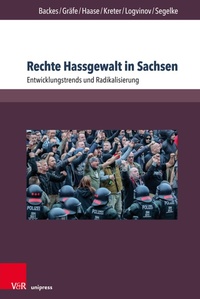
Rechte Hassgewalt in Sachsen
Entwicklungstrends und Radikalisierung
1st Edition
Published on 12. August 2019
279 pages
978-3-8470-1029-6 (ISBN)
Description

Ist der Freistaat Sachsen eine »Hochburg rechtsextremer Hassgewalt«? Diese Leitfrage steht im Zentrum der Studie des Hannah-Arendt-Instituts. Sie erfasst die Periode vor und kurz nach der »Flüchtlingskrise« (2011-2016), zeichnet die Veränderungen im Zeitablauf nach und zieht Vergleiche zu anderen Bundesländern. Der Fokus liegt dabei auf den rechtskräftig verurteilten Gewalttätern und deren Taten. Besondere Berücksichtigung finden herausragende Gewaltakteure wie die »Gruppe Freital« und die »Freie Kameradschaft Dresden«, die maßgeblich zur Eskalation beitrugen. Detaillierte Untersuchungen sind den ideologischen Hintergründen und Kommunikationsformen vor allem in sozialen Medien und der Rechtsrock-Musikszene gewidmet. Is the Free State of Saxony a 'stronghold of extreme right-wing Hate Crime'? This key question is central for the study by the Hannah-Arendt-Institute. The study includes the period of time before and after the 'refugee crisis' (2011-2016), analyses change during this time and compares Saxony with other federal states in Germany. The central research objects are convicted perpetrators of violence and their crimes. Particular consideration was given to prominent violent groups like 'Gruppe Freital' and 'Freie Kameradschaft Dresden', which contributed significantly to the escalation of violence in Saxony. In-depth analysis about ideological backgrounds and forms of communication via social media and the White Power Music Scene are also provided within this study.
Prof. Dr. Uwe Backes ist Stellvertretender Direktor des Hannah- Arendt-Instituts für Totalitarismusforschung e. V. und lehrt an der Technischen Universität Dresden.
Prof. Dr. Uwe Backes ist Stellvertretender Direktor des Hannah- Arendt-Instituts für Totalitarismusforschung e. V. und lehrt an der Technischen Universität Dresden.
More details
Other editions
Additional editions
Uwe Backes | Sebastian Gräfe | Anna-Maria Haase
Rechte Hassgewalt in Sachsen
Entwicklungstrends und Radikalisierung
Book
08/2019
1st Edition
Brill Deutschland
€49.00
Shipment within 7-9 days
Persons
Prof. Dr. Uwe Backes ist Stellvertretender Direktor des Hannah-
Arendt-Instituts für Totalitarismusforschung e. V. und lehrt an der
Technischen Universität Dresden. Er ist Mitglied der Deutschen Vereinigung für Politikwissenschaft und der Deutschen Gesellschaft für Politikwissenschaft.Dr. Sebastian Gräfe arbeitet im Sächsischen Staatsministerium des Innern in Dresden.Anna-Maria Haase ist Politikwissenschaftlerin, B.A.Maximilian Kreter, M.A., ist Doktorand am Hannah-Arendt-Institut für Totalitarismusforschung e.V. an der TU Dresden.Dr. Dr. Michail Logvinov ist Wissenschaftlicher Mitarbeiter am ZDK Gesellschaft Demokratische Kultur in Berlin.Sven Segelke ist Politikwissenschaftler, M.A.
Content
- Intro
- Title Page
- Copyright
- Table of Contents
- Body
- 1. Einleitung
- 2. Rechte Gewalt in Sachsen, 1990 bis 2010
- 3. Rechte Hassgewalt in Sachsen, 2011 bis 2016
- 4. Vergleich
- 5. Ideologien und Kommunikationsformen
- 6. Dynamiken der Radikalisierung und Logik der Gewalt
- 7. Schluss
- 8. Anhang
