

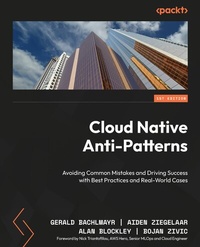
Cloud Native Anti-Patterns
Description

Key Features
Identify common anti-patterns in agile cloud-native delivery and learn to adopt good habits
Learn high-performing cloud-native delivery with expert strategies and real-world examples
Get prescriptive guidance on how to spot and remediate anti-patterns in your organization
Purchase of the print or Kindle book includes a free PDF eBook
Book DescriptionSuccessfully transitioning to a cloud-native architecture demands more than just new tools-it requires a change in mindset. Written by cloud transformation experts Gerald Bachlmayr, Aiden Ziegelaar, Alan Blockley, and Bojan Zivic-this guide shows you how to identify and remediate cloud anti-patterns, manage FinOps, meet security goals, and understand cloud storage, thus steering your organization to become truly cloud native. You will develop the skills necessary to navigate the cloud native landscape, irrespective of the platform: AWS. Azure or GCP! You'll start by exploring the events that shaped our understanding of the modern cloud-native stack. Through practical examples, you'll learn how to implement a suitable governance model, adopt FinOps and DevSecOps best practices, and create an effective cloud native roadmap. You will identify common anti-patterns and refactor them into best practices. The book examines potential pitfalls and suggests solutions that enhance business agility. You'll also gain expert insights into observability, migrations, and testing of cloud native solutions.What you will learn
Get to grips with the common anti-patterns of building on and migrating to the cloud
Identify security pitfalls before they become insurmountable
Acknowledge governance challenges before they become problematic
Drive cultural change in your organization for cloud adoption
Explore examples across the SDLC phases and technology layers
Minimize the operational risk of releases using powerful deployment strategies
Refactor or migrate a solution from an anti-pattern to a best practice design
Effectively adopt supply chain security practices
Who this book is forThis book is for cloud professionals with any level of experience who want to deepen their knowledge and guide their organization toward cloud-native success. It is Ideal for cloud architects, engineers (cloud, software, data, or network), cloud security experts, technical leaders, and cloud operations personnel. While no specific expertise is required, a background in architecture, software development, data, networks, operations, or governance will be helpful.
All prices
More details
Other editions
Additional editions
Persons
Gerald Bachlmayr has worked in IT for over 25 years. He started as a web developer and spent many years as a Java software engineer for professional service organizations for various industries, including financial services, aviation, tertiary education, government, and telecommunications. He moved into technical leadership and architecture roles while staying hands-on with coding languages such as Python, NodeJS, and CI/CD tooling, including Terraform Cloud and GitHub. Gerald has been specializing in cloud native solutions since 2015 and is a passionate AWS Community Builder. As an author and public speaker, he is keen on sharing his insights and learnings with the community to make the cloud an even better place.Ziegelaar Aiden :
Aiden Ziegelaar is an experienced multidisciplinary engineer with a focus on cloud transformation, cloud native software development, and electrical engineering. With a strong background in various industries, including Telcos, Edutech, Industry 4.0 and utilities at scales from startups to enterprises, he has gained a wealth of knowledge and expertise in delivering innovative and effective solutions to complex problems. Transforming clients to effectively leverage cloud technologies has been a cornerstone of his career.Blockley Alan :
Alan Blockley is a Domain Specialist with over 25 years of IT experience, specializing in AWS cloud technology. Based in Brisbane, he has conducted hundreds of AWS Well-Architected Framework Reviews and has extensive experience in presales, cloud operations, and engineering. As a recognized leader, Alan has driven technical validations and mentored teams in DevOps practices. He holds multiple AWS certifications and was named the top AWS Ambassador for ANZ in 2023 and 2024. Alan is also an AWS Serverless Community Builder and an Associate Certification Subject Matter Expert, demonstrating his deep commitment to the AWS community, speaking at localized user groups and conferences on cloud native topics.Zivic Bojan :
Bojan Zivic is an AWS Ambassador, Serverless AWS Community Builder, and Principal Consultant, with a passion for cloud technology and a dedication to fostering community; Bojan hosts and organizes the Brisbane Serverless User Group and the Sydney GitHub User Group. With nine years of experience in IT, Bojan is an enthusiastic advocate for serverless and container computing. His expertise extends to AWS advisory work and comprehensive Kubernetes projects. He has implemented GitOps with ArgoCD, built Istio service meshes, and provided extensive support across the Kubernetes spectrum, not just serverless. His work and community efforts solidified his reputation as a leader in the cloud and DevOps communities.
Content
The Benefits of Cloud Native and Common Misunderstandings
Strategizing Your Shift to Cloud Native
Rethinking Governance in a Cloud-Native Paradigm
How to Avoid a Bill Shock
Deliver Rapidly and Continuously without Compromising Security
How to Meet Your Security and Compliance Goals
Expressing Your Business Goals in Application Code
Don't Get Lost in the Data Jungle
Connecting It All
Observing Your Architecture
Running It without Breaking It
Migrating from Old to New
How Do You Know It All Works?
How to Get Started with Your Cloud Native Improvement Journey
Transitioning
Preface
A sound cloud native adoption approach can be a significant business enabler. It can accelerate innovation cycles, improve our time to market, increase resilience, improve security posture, and enable observability and flexible integrations for data, APIs, and connectivity. Despite all the potential that cloud native brings, the authors of this book have seen many things go wrong, were involved in the remediation steps across the software development life cycle, and had opportunities to start building new capabilities from scratch. A cloud native journey is not only about technology and tools. It starts with a cultural transformation, leveraging the right ways of working and transforming our company into a learning organization. The adoption also requires a shift in governance, security, ownership, and continuous improvement of our architecture and skills. With great power comes great responsibility. This book provides insights into where cloud initiatives tend to go wrong, how to spot those anti-patterns while they are starting to unfold, and how to remediate them to drive successful cloud adoption. By reading this book, you will learn about the following:
- How to identify common anti-patterns encountered when shifting to agile cloud native delivery
- What high-performing cloud native delivery looks like
- How to spot anti-patterns in your organization and analyze their long-term impacts
- Prescriptive guidance on how to remediate anti-patterns
Who this book is for
This book is intended for the following audience that has fundamental knowledge of information technology solutions and wants to improve their cloud native knowledge:
- Cloud platform engineers and software engineers
- Cloud or solution architects
- Quality and test engineers
- Enterprise architects
- Technical team leads
- Engineering managers
What this book covers
Chapter 1, Benefits of Cloud Native and Common Misunderstandings, explores benefits, DevOps culture and CI/CD, observability, and resilience, and clarifies some common misunderstandings.
Chapter 2, The Cost of Unclear Objectives and Strategy, discusses common strategy mistakes, such as outsourcing knowledge or lacking roadmaps and partnership strategies, and how to transition into good practice.
Chapter 3, Rethinking Governance in a Cloud Native Paradigm, steps through common governance anti-patterns, such as underestimating cultural impact and learning effort, and discusses how to develop good habits.
Chapter 4, FinOps - How to Avoid a Bill Shock, discusses mistakes including lacking tagging enforcement, focusing on cost savings instead of value optimization, and others. For each area, we will also explain what good looks like and how to achieve it.
Chapter 5, Delivering Rapidly and Continuously Without Compromising Security, analyzes problem spaces including cultural impacts, guardrails, and shifting left. Of course, we will also examine how to improve our organization.
Chapter 6, How to Meet Your Security and Compliance Goals, discusses pitfalls such as permission mismanagement, supply chain challenges, and reliance on penetration tests. We will step through transitioning into good habits.
Chapter 7, Expressing Your Business Goals in Application Code, explores application-related anti-patterns, such as tight coupling and stateful applications, and how to transition into good habits.
Chapter 8, Don't Get Lost in the Data Jungle, covers data-related anti-patterns, including manual data ingestion and a lack of data observability, and we will help you adopt good practices.
Chapter 9, Connecting It All, covers adopting future-proof network architectures after discussing network-related pitfalls, such as ignoring latency or bandwidth and not having a DNS strategy.
Chapter 10, Observing Our Architecture, explores observability-related anti-patterns, such as capturing everything or ignoring ML and AI capabilities, which can burden our organization, and we will explore how to improve our observability.
Chapter 11, Running It Without Breaking It, discusses operational-related pitfalls, such as underestimating the learning curve and considering cloud service provider (CSP) SLAs. We will also discuss the adoption of good operational practices.
Chapter 12, Migrating from Legacy Systems to Cloud Native Solutions, looks at migration anti-patterns, such as a lack of planning and stakeholder commitment or sticking to on-premises security controls, which will prevent successful cloud adoption, and we will discuss how to avoid these bad practices.
Chapter 13, How Do You Know It All Works?, explores test-related pitfalls, such as ignoring non-functional requirements upfront or relying on manual testing, which do not scale and will slow us down. We will explore how to avoid these anti-patterns.
Chapter 14, How to Get Started with Your Cloud Native Improvement Journey, discusses how to prepare ourselves and our organization for a successful cloud adoption journey. We will summarize how to spot anti-patterns and define the best outcome.
Chapter 15, Transitioning to Cloud Native Good Habits, dives deeper into stakeholder alignment, enhancing our roadmap, and setting our organization up for continuous improvement.
To get the most out of this book
To get the most out of this book, you will have some fundamental information technology knowledge, no matter whether your background is development, operations, testing, technical leadership, governance, security, or strategy. The book doesn't require you to install software. To follow along with some of the hands-on examples, you can optionally create a free-tier account for AWS, Azure, or GCP.
Conventions used
There are a number of text conventions used throughout this book.
Code in text: Indicates code words in text, database table names, folder names, filenames, file extensions, pathnames, dummy URLs, user input, and Twitter handles. Here is an example: " WARN: When a transient issue arises, such as a timeout during a payment request to AWS RDS, a WARN log is generated:"
A block of code is set as follows:
WARN: Payment service timeout - user_id=12345, transaction_id=txn001, retry_attempt=1When we wish to draw your attention to a particular part of a code block, the relevant lines or items are set in bold:
INFO: Payment initiated - user_id=12345, session_id=abc987, transaction_id=txn001, amount=49.99Any command-line input or output is written as follows:
gcloud services enable cloudasset.googleapis.comBold: Indicates a new term, an important word, or words that you see onscreen. For instance, words in menus or dialog boxes appear in bold. Here is an example: " Aggregate and Centralize Logs: Logs from each service are centralized using AWS CloudWatch Logs."
Tips or important notes
Appear like this.
Get in touch
Feedback from our readers is always welcome.
General feedback: If you have questions about any aspect of this book, email us at customercare@packtpub.com and mention the book title in the subject of your message.
Errata: Although we have taken every care to ensure the accuracy of our content, mistakes do happen. If you have found a mistake in this book, we would be grateful if you would report this to us. Please visit www.packtpub.com/support/errata and fill in the form.
Piracy: If you come across any illegal copies of our works in any form on the internet, we would be grateful if you would provide us with the location address or website name. Please contact us at copyright@packt.com with a link to the material.
If you are interested in becoming an author: If there is a topic that you have expertise in and you are interested in either writing or contributing to a book, please visit authors.packtpub.com.
Share Your Thoughts
Once you've read Cloud Native Anti-Patterns, we'd love to hear your thoughts! Please click here to go straight to the Amazon review page for this book and share your feedback.
Your review is important to us and the tech community and will help us make sure we're delivering excellent quality content.
