

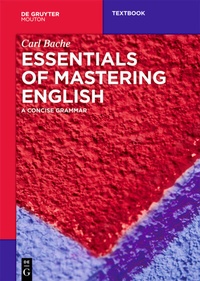
Essentials of Mastering English
A Concise Grammar
1st Edition
Published on 6. February 2013
XII, 328 pages
978-3-11-082598-5 (ISBN)
Description

Essentials of Mastering English: A Concise Grammar is both an ideal companion for undergraduate students wishing to acquire a high level of grammatical proficiency and a readily accessible reference work for teachers of English at all levels. It provides an introduction to basic grammatical terms and to elementary syntactic description, enabling students to analyse sentences and utterances down to word level with a specification of both the form and the function of all constituents.
Reviews / Votes
"[...] this grammar presents a clear and coherent description of central parts of English grammar. It offers a wealth of information to the serious student."Knud Sorensen in: English Studies, Nijmegen 1/2001More details
Series
Language
English
Place of publication
Berlin/Boston
Germany
Publishing group
de Gruyter Mouton
Target group
Professional and scholarly
US School Grade: College Graduate Student
Illustrations
Zahlr. Abb.
Zahlr. Abb.
File size
9,64 MB
ISBN-13
978-3-11-082598-5 (9783110825985)
Schweitzer Classification
Other editions
Additional editions
Book
01/2000
1st Edition
De Gruyter Mouton
€29.95
Shipment within 5-7 days
Person
Content
- Intro
- Part I
- 1. Grammatical description: getting started
- 1.1. Grammar: syntax, morphology and semantics
- 1.2. The form and function distinction
- 1.3. Sentence functions introduced
- 1.4. Four form types
- 1.5. Word classes
- 1.6. Discontinuity
- 1.7. Basic sentence structures
- 1.8. More sentence functions and structures
- 1.9. Summary of sentence functions and structures
- 2. Sentence functions
- 2.1. The predicator
- 2.2. The subject
- 2.3. The direct object
- 2.4. The indirect object
- 2.5. The subject complement
- 2.6. The object complement
- 2.7. Adverbials
- 2.8. Predicates and predications
- 3. Complex forms
- 3.1. Groups
- 3.2. Types of subordination in groups
- 3.3. The preposition group
- 3.4. The compound unit
- 3.5. Types of coordination
- 3.6. Coordinating conjunctions
- 3.7. Clauses
- 3.8. The functions of subclauses
- 3.9. Markers of clausal subordination
- 3.10. Embedding and recursiveness
- 4. Clause types and utterance functions
- 4.1. Major types of clause
- 4.2. Communicative functions
- 4.3. The forms of communicative functions
- 5. Missing constituents, ellipsis and pro-forms
- 5.1. The zero convention
- 5.2. Types of ellipsis
- 5.3. Pro-forms
- 6. Vocatives, interjections and dislocation
- Part II
- 7. Constituent Order
- 7.1. Functions of constituent order
- 7.2. Inversion
- 7.3. Constituent order in subclauses
- 7.4. Position and order of adverbials
- 8. Situations and participants
- 8.1. Actionality: dynamic versus stative situations
- 8.2. Subtypes of dynamic situations
- 8.3. Subtypes of stative situations
- 8.4. General participant roles
- 8.5. Specific participant roles
- 8.6. A few points in connection with participant roles
- 9. Voice: active versus passive
- 9.1. Functions of the passive
- 9.2. Voice restrictions
- 9.3. Nonfinite passives
- 9.4. GET-passives
- 9.5. Notional 'passives'
- 9.6. Passives versus adjectival non-passives
- 10. Polarity
- 10.1. Standard negation and rules of contraction
- 10.2. Domain of negation: global versus local
- 10.3. Syntactic field of negation: clausal versus limited
- 10.4. Semantic scope of negation: complete versus incomplete
- 10.5. Overview
- 10.6. Polarity in non-declarative sentences
- 11. Subject-predicator concord
- 11.1. The basic rule
- 11.2. Singular or plural subject realization?
- 11.3. Notional concord
- 11.4. Attraction
- 12. The complex sentence
- 12.1. Definition and classifications
- 12.2. Additional points
- 12.3. Clausal complementation
- 12.4. Discontinuous subject clauses
- 12.5. The subject function in subclauses
- 12.6. Conditional clauses
- 12.7. Clausally realized disjuncts
- 12.8. Transferred negation
- 12.9. Cleft sentences
- Part III
- 13. Verbals
- 13.1. Introduction
- 13.2. Complex predicators
- 13.3. Tense and aspect
- 13.4. Mood
- 13.5. Modality
- 14. Nominals
- 14.1. Introduction
- 14.2. Categorization
- 14.3. Determination
- 14.4. Quantification: the number category
- 15. Pronominals
- 15.1. Introduction
- 15.2. Central pronouns
- 15.3. Pronouns without a person distinction
- 16. Adjectivals and adverbals
- 16.1. Preliminary discussion of adjectivals
- 16.2. Adjectival modification and positional ordering
- 16.3. Comparison of adjectives
- 16.4. The substantival use of adjectives
- 16.5. Adverbals
- Appendix: tips on pronunciation and spelling
- A.1. Verbs
- A.2. Nouns
- A.3. Adjectives: comparison
- A.4. Adverbs
- Select bibliography
- Glossary
- Subject index
- Word index
