

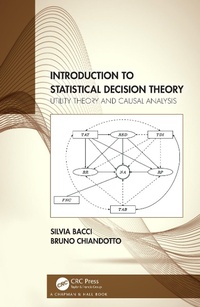
Introduction to Statistical Decision Theory
Utility Theory and Causal Analysis
1st Edition
Published on 11. July 2019
303 pages
978-1-351-62138-0 (ISBN)
Description

Introduction to Statistical Decision Theory: Utility Theory and Causal Analysis provides the theoretical background to approach decision theory from a statistical perspective. It covers both traditional approaches, in terms of value theory and expected utility theory, and recent developments, in terms of causal inference. The book is specifically designed to appeal to students and researchers that intend to acquire a knowledge of statistical science based on decision theory.
Features
Covers approaches for making decisions under certainty, risk, and uncertainty
Illustrates expected utility theory and its extensions
Describes approaches to elicit the utility function
Reviews classical and Bayesian approaches to statistical inference based on decision theory
Discusses the role of causal analysis in statistical decision theory
Features
Covers approaches for making decisions under certainty, risk, and uncertainty
Illustrates expected utility theory and its extensions
Describes approaches to elicit the utility function
Reviews classical and Bayesian approaches to statistical inference based on decision theory
Discusses the role of causal analysis in statistical decision theory
Reviews / Votes
"A major strength of the book is its linking of decision theory to real-world examples and behaviors, outlining the limitations and alternatives to normative decision theory, while also stressing its strengths and appropriateness in a vast array of situations. Such discussion is particularly valuable in the context of practical applications that imply utility elicitation from individuals. A second major strength is the presence of detailed worked out examples, as well as case studies from either the authors' experience or the literature. As core probability and statistical concepts are reviewed in the earlier chapters, the book is suitable for both students and graduates with a quantitative, although not necessarily statistical, background. The balance between the theoretical exposition and the practical applicability of the concepts makes this book particularly appealing to readers aiming to gain insight into the decision theoretic field for both personal and professional purposes."- Silvia Calderazzo, Appeared in Biometrical Journal, July 2020
More details
Edition
1. Auflage
Language
English
Place of publication
London
United Kingdom
Publishing group
Taylor & Francis Ltd
Target group
Professional and scholarly
Illustrations
50 Tables, black and white; 45 Illustrations, black and white
ISBN-13
978-1-351-62138-0 (9781351621380)
Copyright in bibliographic data and cover images is held by Nielsen Book Services Limited or by the publishers or by their respective licensors: all rights reserved.
Schweitzer Classification
Other editions
Additional editions
Silvia Bacci | Bruno Chiandotto
Introduction to Statistical Decision Theory
Utility Theory and Causal Analysis
Book
06/2021
1st Edition
Chapman & Hall/CRC
€74.80
Shipment within 10-20 days
Silvia Bacci | Bruno Chiandotto
Introduction to Statistical Decision Theory
Utility Theory and Causal Analysis
Book
07/2019
1st Edition
CRC Press
€185.70
Shipment within 10-20 days
Persons
Silvia Bacci is Assistant Professor of Statistics at the Department of Statistics, Computer Science and Applications "G. Parenti", University of Florence (Italy). Her research interests are addressed to statistical decision theory, with focus on utility theory, and latent variable models, with focus on item response theory models, latent class models, and models for longitudinal and multilevel data.
Bruno Chiandotto is adjunct Full Professor of Statistics at the Department of Statistics, Computer Science and Applications "G. Parenti", University of Florence (Italy). He is mainly interested in the definition and estimation of linear and nonlinear statistical models, multivariate data analysis, customer satisfaction, causal analysis, statistical decision theory and utility theory. A large part of his research activity has been carried out under projects funded by international, national and local institutions.
Bruno Chiandotto is adjunct Full Professor of Statistics at the Department of Statistics, Computer Science and Applications "G. Parenti", University of Florence (Italy). He is mainly interested in the definition and estimation of linear and nonlinear statistical models, multivariate data analysis, customer satisfaction, causal analysis, statistical decision theory and utility theory. A large part of his research activity has been carried out under projects funded by international, national and local institutions.
Content
1. Statistics and decisions 2. Probability and statistical inference 3. Utility theory 4. Utility function elicitation 5. Classical and bayesian statistical decision theory 6. Statistics, causality, and decisions
