

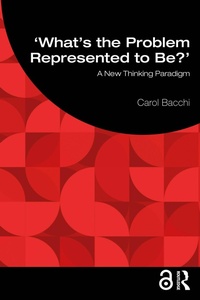
What's the Problem Represented to Be?
A New Thinking Paradigm
Published on 22. October 2025
308 pages
978-1-040-51631-7 (ISBN)
Description

Originally developed as a mode of critical policy analysis, 'What's the Problem Represented to Be?': A New Thinking Paradigm extends the thinking behind the innovative 'What's the problem represented to be?' (WPR) approach to new areas of investigation. It poses a challenge to problem-solving as the dominant way of thinking about human existence and human endeavours and offers a fresh alternative that turns attention to the contours of designated 'problems'.
By focusing on proposed 'solutions' to conditions labelled 'problems', the WPR approach produces a dynamic form of analysis and critique targeting how 'problems' are represented. This critical analytic posture is extended from 'problems' to a wide range of putative conditions, including 'indeterminate situations', 'issues', 'controversies' and 'matters of concern'. In this new thinking paradigm, items, such as buildings and maps, are analysed as proposals for change and hence as problematisations, with important political implications. The book brings together the theoretical resources underpinning the WPR approach and considers important methodological ramifications. A table of WPR questions incorporates changes to the approach signalled in the book.
This book will be of interest to undergraduate and postgraduate students, early career researchers and academics in a wide range of fields, including public policy, education, law, international relations and disability, Indigenous and feminists' studies.
The Introduction and Chapters 1 and 2 of this book are freely available as a downloadable Open Access PDF at http://www.taylorfrancis.com under a Creative Commons Attribution-Non Commercial-No Derivatives (CC BY-NC-ND) 4.0 license.
By focusing on proposed 'solutions' to conditions labelled 'problems', the WPR approach produces a dynamic form of analysis and critique targeting how 'problems' are represented. This critical analytic posture is extended from 'problems' to a wide range of putative conditions, including 'indeterminate situations', 'issues', 'controversies' and 'matters of concern'. In this new thinking paradigm, items, such as buildings and maps, are analysed as proposals for change and hence as problematisations, with important political implications. The book brings together the theoretical resources underpinning the WPR approach and considers important methodological ramifications. A table of WPR questions incorporates changes to the approach signalled in the book.
This book will be of interest to undergraduate and postgraduate students, early career researchers and academics in a wide range of fields, including public policy, education, law, international relations and disability, Indigenous and feminists' studies.
The Introduction and Chapters 1 and 2 of this book are freely available as a downloadable Open Access PDF at http://www.taylorfrancis.com under a Creative Commons Attribution-Non Commercial-No Derivatives (CC BY-NC-ND) 4.0 license.
More details
Language
English
Place of publication
London
United Kingdom
Publishing group
Taylor & Francis Ltd
Target group
College/higher education
Professional and scholarly
File size
4,50 MB
ISBN-13
978-1-040-51631-7 (9781040516317)
Copyright in bibliographic data and cover images is held by Nielsen Book Services Limited or by the publishers or by their respective licensors: all rights reserved.
Schweitzer Classification
Other editions
Additional editions
Book
10/2025
1st Edition
Routledge
€206.90
Shipment within 10-20 days
Book
10/2025
1st Edition
Routledge
€65.40
Shipment within 10-20 days
Person
Carol Bacchi is Professor Emerita of Politics, Adelaide University, Australia. She researches and writes in the fields of politics, policy theory and feminists' theories.
Content
Introduction: A new thinking paradigm-beyond problem-solving; Part I: Introducing a WPR Approach 1. Initiating a WPR Analysis: key premises 2. Widening the scope of application 3. Troubling 'problems': Challenges for researchers; Part II: Theoretical Elaborations 4. What is a 'subject'? Who is a 'subject'? 5. The turn to 'practice': What are 'practices'? 6. Moving from 'being reflexive' to practising 'self'-problematisation 7. Governmentality and WPR: Exploring governing practices 8. Cultivating a genealogical sensibility 9. The politics of change: 'Resistance', 'counter-conducts' and 'subjugated knowledges'; Part III: Theoretical Engagements 10. Strategic interventions: Feminisms, problem representations and gendering practices; 11. Analysing differencing practices: Racialising, colonising, disabling, heteronorming, classing, caste-ing; 12. Problematising (in) a material world: Empiricism, description, affectivity and social flesh; 13. Critical questions: From 'ideology critique' to 'postcritique'; 14. Questioning performativity: What's at stake?; Part IV: The Thorny Issue of 'Mixed Methods' 15. Problematising (with) paradigms: 'Reality', 'problems' and 'mixed methods'; 16. Analysing discourse/s as knowledge practices; 17. How to deal with 'data'; 18. The use of ethnography; Part V: WPR and Governing in the Time of COVID-19 19. 'Governing through experimenting': A political rationality; 20. Researching a pandemic; 21. Applying WPR to concepts: Questioning 'risk', 'crisis' and 'uncertainty'; 22. Making mortality 'social': How death certificates undermine the social determinants of health; Conclusion: Why we need a new thinking paradigm
