

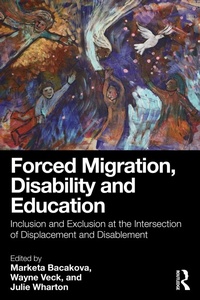
Forced Migration, Disability and Education
Inclusion and Exclusion at the Intersection of Displacement and Disablement
Published on 21. November 2025
294 pages
978-1-040-66461-2 (ISBN)
Description

Offering the first book-length analysis of the ways in which exclusion affects the lives and educational experiences of refugees with disabilities, this book examines the right to inclusive education for displaced persons with disabilities, arguing for an intersectional approach to advancing social justice in education globally.
Effectively encountering twice the amount of discrimination, exclusion and inequality usually faced by those with either a disability or with refugee status, refugees with disabilities face particular challenges in accessing education. In looking to tackle these challenges and give voice to those at the centre of such experiences, this book offers cutting-edge and fundamentally global insights and practicable solutions on how schools and their communities might become more inclusive spaces for currently marginalized disabled refugees. Chapters theorize current language and terminology, and discuss concrete examples of inclusive practice along with tangible guidance for educators and professionals towards the development of inclusive educational practices, policies and cultures within educational institutions. Exclusion and inclusion are understood at the intersection of disability, forced displacement and education.
Featuring an international team of thought leaders, researchers, practitioners, and refugee and disability activists, the book will be of interest to scholars, practitioners and policymakers in the fields of inclusive and special education, migration, and social work and education more broadly. Undergraduate students engaged in studies that consider aspects of educational, social and global justice will also benefit from the volume.
Effectively encountering twice the amount of discrimination, exclusion and inequality usually faced by those with either a disability or with refugee status, refugees with disabilities face particular challenges in accessing education. In looking to tackle these challenges and give voice to those at the centre of such experiences, this book offers cutting-edge and fundamentally global insights and practicable solutions on how schools and their communities might become more inclusive spaces for currently marginalized disabled refugees. Chapters theorize current language and terminology, and discuss concrete examples of inclusive practice along with tangible guidance for educators and professionals towards the development of inclusive educational practices, policies and cultures within educational institutions. Exclusion and inclusion are understood at the intersection of disability, forced displacement and education.
Featuring an international team of thought leaders, researchers, practitioners, and refugee and disability activists, the book will be of interest to scholars, practitioners and policymakers in the fields of inclusive and special education, migration, and social work and education more broadly. Undergraduate students engaged in studies that consider aspects of educational, social and global justice will also benefit from the volume.
More details
Language
English
Place of publication
London
United Kingdom
Publishing group
Taylor & Francis Ltd
Target group
College/higher education
Professional and scholarly
Illustrations
3 Tables, black and white; 4 Line drawings, black and white; 4 Illustrations, black and white
File size
1,11 MB
ISBN-13
978-1-040-66461-2 (9781040664612)
Copyright in bibliographic data and cover images is held by Nielsen Book Services Limited or by the publishers or by their respective licensors: all rights reserved.
Schweitzer Classification
Other editions
Additional editions
Marketa Bacakova | Wayne Veck | Julie Wharton
Forced Migration, Disability and Education
Inclusion and Exclusion at the Intersection of Displacement and Disablement
Book
approx. 11/2025
1st Edition
Routledge
€202.90
Not yet published
Marketa Bacakova | Wayne Veck | Julie Wharton
Forced Migration, Disability and Education
Inclusion and Exclusion at the Intersection of Displacement and Disablement
Book
approx. 11/2025
1st Edition
Routledge
€61.10
Not yet published
Persons
Marketa Bacakova is Professor of Early Childhood Education, IU International University of Applied Sciences, Leipzig, Germany.
Wayne Veck is Professor of Education, University of Winchester, UK.
Julie Wharton is Senior Lecturer and part of the Additional Needs team, Institute of Education, University of Winchester, UK.
Wayne Veck is Professor of Education, University of Winchester, UK.
Julie Wharton is Senior Lecturer and part of the Additional Needs team, Institute of Education, University of Winchester, UK.
Content
Introduction
Part I. Theorising Intersectional Possibilities
1. Attentive intersectionality and the inclusion of disabled refugees in education
2. Displacement and Disability: young people seeking sanctuary at the intersection
3. The right to inclusive education in situations of emergencies and forced migration: A legal analysis
4. Educational participation and outcomes of refugees with disabilities: Evidence from UNCHR household surveys
5. The apparatus of integration and the entanglement of racism and ableism in the context of forced migration. Impulses from Dis/ability Critical Race Studies in Education
Part II. Policies
6. 'Neoliberal inclusion' and the structural exclusion of Syrian refugee children with disabilities from humanitarian education in Lebanon (Giada Constantini)
7. Educational trajectories of refugee children with disabilities: The unique case of the Turkish Context (Sultan Kilinc & Elif Karsli-Calamak)
8. Exploring Education Access for Refugees with Disabilities in the United States: A Social Determinants of Health Perspective
9. The right to inclusive education of refugees with disabilities within an integration system: Lessons learned from Europe
10. Displacement and Educational Disability: Basic Educational challenges for Internally Displaced Persons (IDPs) in Nigeria
11. Students with migration background and special educational needs vs. their rights to and in education: The Polish context
12. Leveraging intersectionality for the educational inclusion of refugees with disabilities in Europe
Part III. Practices
13. Resistance and hope: How blind Syrian refugees experience education in Lebanon
14. Social Inclusion and World Making: A Narrative Inquiry Study into the Experiences of Syrian Refugee Families with Children Living with Disabilities
15. Disability and displacement: the unmet rights of refugees in Technical Vocational Training
16. Neither here nor there. Patterns of educational integration of Ukrainian young refugees with disability to Warsaw and Bucharest
17. Forced to Leave My Home Behind with (In) visible Scars: Examining the case of Displaced Rural Women in Post Conflict Angola.
18. Families in England at the Intersection of Disability and Sanctury
Conclusion
Part I. Theorising Intersectional Possibilities
1. Attentive intersectionality and the inclusion of disabled refugees in education
2. Displacement and Disability: young people seeking sanctuary at the intersection
3. The right to inclusive education in situations of emergencies and forced migration: A legal analysis
4. Educational participation and outcomes of refugees with disabilities: Evidence from UNCHR household surveys
5. The apparatus of integration and the entanglement of racism and ableism in the context of forced migration. Impulses from Dis/ability Critical Race Studies in Education
Part II. Policies
6. 'Neoliberal inclusion' and the structural exclusion of Syrian refugee children with disabilities from humanitarian education in Lebanon (Giada Constantini)
7. Educational trajectories of refugee children with disabilities: The unique case of the Turkish Context (Sultan Kilinc & Elif Karsli-Calamak)
8. Exploring Education Access for Refugees with Disabilities in the United States: A Social Determinants of Health Perspective
9. The right to inclusive education of refugees with disabilities within an integration system: Lessons learned from Europe
10. Displacement and Educational Disability: Basic Educational challenges for Internally Displaced Persons (IDPs) in Nigeria
11. Students with migration background and special educational needs vs. their rights to and in education: The Polish context
12. Leveraging intersectionality for the educational inclusion of refugees with disabilities in Europe
Part III. Practices
13. Resistance and hope: How blind Syrian refugees experience education in Lebanon
14. Social Inclusion and World Making: A Narrative Inquiry Study into the Experiences of Syrian Refugee Families with Children Living with Disabilities
15. Disability and displacement: the unmet rights of refugees in Technical Vocational Training
16. Neither here nor there. Patterns of educational integration of Ukrainian young refugees with disability to Warsaw and Bucharest
17. Forced to Leave My Home Behind with (In) visible Scars: Examining the case of Displaced Rural Women in Post Conflict Angola.
18. Families in England at the Intersection of Disability and Sanctury
Conclusion
