

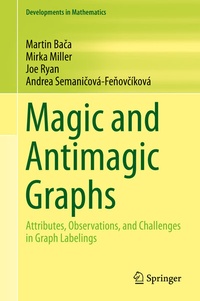
Magic and Antimagic Graphs
Description

Magic and antimagic labelings are among the oldest labeling schemes in graph theory. This book takes readers on a journey through these labelings, from early beginnings with magic squares up to the latest results and beyond.
Starting from the very basics, the book offers a detailed account of all magic and antimagic type labelings of undirected graphs. Long-standing problems are surveyed and presented along with recent results in classical labelings. In addition, the book covers an assortment of variations on the labeling theme, all in one self-contained monograph.
Assuming only basic familiarity with graphs, this book, complete with carefully written proofs of most results, is an ideal introduction to graph labeling for students learning the subject. More than 150 open problems and conjectures make it an invaluable guide for postgraduate and early career researchers, as well as an excellent reference for established graph theorists.
Reviews / Votes
"This book is especially relevant for senior undergraduate or postgraduate students with an interest in discrete mathematical structures or a major in graph labeling . . a valuable guide for postgraduate and early career researchers, as well as an excellent reference for graph theorists." (Ioan Tomescu, zbMATH 1429.05001, 2020)More details
Other editions
Additional editions
Persons
Emeritus Professor Mirka Miller completed her PhD from the University of New South Wales in 1990 under the supervision of Jenny Seberry. She has written over 200 academic articles and conference presentations, many on different aspects of graph labeling. Professor Miller launched the successful conference series IWOGL (International Workshop on Graph Labelings). She was part of various teams that introduced such graph labeling schemes as Vertex Antimagic Total Labeling (VATL), Edge Antimagic Total Labeling (EATL), Edge Irregular Total Labeling and Vertex Irregular Total Labeling. It is a testament to her work that articles are still being published under her name more than 3 years since she sadly passed away.
Dr Joe Ryan received his PhD from the University of Newcastle, Australia in 2004. Since then he has authored over 100 journal and refereed conference publications with almost half of these being in the field of graph labeling. Dr Ryan has been on the supervisory team of 11 successful PhD completions with 3 of those being related to graph labeling. He is a member of the IWOGL Steering Committee.
Associate Professor Andrea Semanicová-Fenovcíková received her PhD from Pavol Jozef Safárik University in 2006. Her scientific interest covers graph labeling and metric dimension of graphs where she has published over 60 journal papers. Three PhD students are working under her supervision. She is a member of the editorial board of two scientific journals.
