

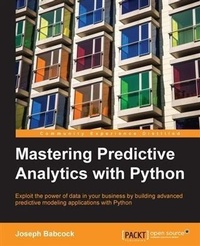
Mastering Predictive Analytics with Python
Exploit the power of data in your business by building advanced predictive modeling applications with Python
Published on 8. July 2025
334 pages
978-1-78588-982-0 (ISBN)
Description

Exploit the power of data in your business by building advanced predictive modeling applications with Python
Key Features
[*] Master open source Python tools to build sophisticated predictive models
[*] Learn to identify the right machine learning algorithm for your problem with this forward-thinking guide
[*] Grasp the major methods of predictive modeling and move beyond the basics to a deeper level of understanding
Book DescriptionThe volume, diversity, and speed of data available has never been greater. Powerful machine learning methods can unlock the value in this information by finding complex relationships and unanticipated trends. Using the Python programming language, analysts can use these sophisticated methods to build scalable analytic applications to deliver insights that are of tremendous value to their organizations. In Mastering Predictive Analytics with Python, you will learn the process of turning raw data into powerful insights. Through case studies and code examples using popular open-source Python libraries, this book illustrates the complete development process for analytic applications and how to quickly apply these methods to your own data to create robust and scalable prediction services. Covering a wide range of algorithms for classification, regression, clustering, as well as cutting-edge techniques such as deep learning, this book illustrates not only how these methods work, but how to implement them in practice. You will learn to choose the right approach for your problem and how to develop engaging visualizations to bring the insights of predictive modeling to life What you will learn
[*] Gain an insight into components and design decisions for an analytical application
[*] Master the use Python notebooks for exploratory data analysis and rapid prototyping
[*] Get to grips with applying regression, classification, clustering, and deep learning algorithms
[*] Discover the advanced methods to analyze structured and unstructured data
[*] Find out how to deploy a machine learning model in a production environment
[*] Visualize the performance of models and the insights they produce
[*] Scale your solutions as your data grows using Python
[*] Ensure the robustness of your analytic applications by mastering the best practices of predictive analysis
Who this book is forThis book is designed for business analysts, BI analysts, data scientists, or junior level data analysts who are ready to move from a conceptual understanding of advanced analytics to an expert in designing and building advanced analytics solutions using Python. You're expected to have basic development experience with Python.
Key Features
[*] Master open source Python tools to build sophisticated predictive models
[*] Learn to identify the right machine learning algorithm for your problem with this forward-thinking guide
[*] Grasp the major methods of predictive modeling and move beyond the basics to a deeper level of understanding
Book DescriptionThe volume, diversity, and speed of data available has never been greater. Powerful machine learning methods can unlock the value in this information by finding complex relationships and unanticipated trends. Using the Python programming language, analysts can use these sophisticated methods to build scalable analytic applications to deliver insights that are of tremendous value to their organizations. In Mastering Predictive Analytics with Python, you will learn the process of turning raw data into powerful insights. Through case studies and code examples using popular open-source Python libraries, this book illustrates the complete development process for analytic applications and how to quickly apply these methods to your own data to create robust and scalable prediction services. Covering a wide range of algorithms for classification, regression, clustering, as well as cutting-edge techniques such as deep learning, this book illustrates not only how these methods work, but how to implement them in practice. You will learn to choose the right approach for your problem and how to develop engaging visualizations to bring the insights of predictive modeling to life What you will learn
[*] Gain an insight into components and design decisions for an analytical application
[*] Master the use Python notebooks for exploratory data analysis and rapid prototyping
[*] Get to grips with applying regression, classification, clustering, and deep learning algorithms
[*] Discover the advanced methods to analyze structured and unstructured data
[*] Find out how to deploy a machine learning model in a production environment
[*] Visualize the performance of models and the insights they produce
[*] Scale your solutions as your data grows using Python
[*] Ensure the robustness of your analytic applications by mastering the best practices of predictive analysis
Who this book is forThis book is designed for business analysts, BI analysts, data scientists, or junior level data analysts who are ready to move from a conceptual understanding of advanced analytics to an expert in designing and building advanced analytics solutions using Python. You're expected to have basic development experience with Python.
More details
Edition
Digital original
Language
English
Place of publication
Birmingham
United Kingdom
Target group
Professional and scholarly
US School Grade: College Graduate Student
Edition type
Digital original
File size
7,68 MB
ISBN-13
978-1-78588-982-0 (9781785889820)
Copyright in bibliographic data and cover images is held by Nielsen Book Services Limited or by the publishers or by their respective licensors: all rights reserved.
Schweitzer Classification
Other editions
Additional editions
Joseph Babcock
Mastering Predictive Analytics with Python
Exploit the power of data in your business by building advanced predictive modeling applications with Python
Book
08/2016
Packt Publishing
€63.30
Shipment within 3-4 weeks
Person
Babcock Joseph :
Joseph Babcock has spent over a decade working with big data and AI in the e-commerce, digital streaming, and quantitative finance domains. Throughout his career, he has worked on recommender systems, petabyte-scale cloud data pipelines, A/B testing, causal inference, and time series analysis. He completed his PhD studies at Johns Hopkins University, applying machine learning to drug discovery and genomics.
Joseph Babcock has spent over a decade working with big data and AI in the e-commerce, digital streaming, and quantitative finance domains. Throughout his career, he has worked on recommender systems, petabyte-scale cloud data pipelines, A/B testing, causal inference, and time series analysis. He completed his PhD studies at Johns Hopkins University, applying machine learning to drug discovery and genomics.
Content
Table of Contents
From Data to Decisions: Getting Started with Advanced Analytic Pipelines
Exploratory Data Analysis
Unsupervised Learning
Regression Methods
Putting Data in its Place: Classification Methods & Analysis
Unstructured Data
Learning from the Bottom Up: Deep Networks and Unsupervised Features
Creating Prediction Services
Reporting & Testing: Iterating on Analytic Systems
From Data to Decisions: Getting Started with Advanced Analytic Pipelines
Exploratory Data Analysis
Unsupervised Learning
Regression Methods
Putting Data in its Place: Classification Methods & Analysis
Unstructured Data
Learning from the Bottom Up: Deep Networks and Unsupervised Features
Creating Prediction Services
Reporting & Testing: Iterating on Analytic Systems
