

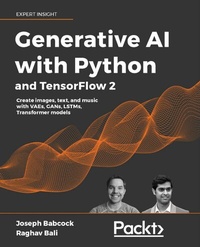
Generative AI with Python and TensorFlow 2
Create images, text, and music with VAEs, GANs, LSTMs, Transformer models
1st Edition
Published on 3. June 2024
488 pages
978-1-80020-850-6 (ISBN)
Description

This edition is heavily outdated and we have a new edition with PyTorch examples published!Key Features - Code examples are in TensorFlow 2, which make it easy for PyTorch users to follow along
- Look inside the most famous deep generative models, from GPT to MuseGAN
- Learn to build and adapt your own models in TensorFlow 2.x
- Explore exciting, cutting-edge use cases for deep generative AI
Book DescriptionMachines are excelling at creative human skills such as painting, writing, and composing music. Could you be more creative than generative AI? In this book, you'll explore the evolution of generative models, from restricted Boltzmann machines and deep belief networks to VAEs and GANs. You'll learn how to implement models yourself in TensorFlow and get to grips with the latest research on deep neural networks. There's been an explosion in potential use cases for generative models. You'll look at Open AI's news generator, deepfakes, and training deep learning agents to navigate a simulated environment. Recreate the code that's under the hood and uncover surprising links between text, image, and music generation.What you will learn - Export the code from GitHub into Google Colab to see how everything works for yourself
- Compose music using LSTM models, simple GANs, and MuseGAN
- Create deepfakes using facial landmarks, autoencoders, and pix2pix GAN
- Learn how attention and transformers have changed NLP
- Build several text generation pipelines based on LSTMs, BERT, and GPT-2
- Implement paired and unpaired style transfer with networks like StyleGAN
- Discover emerging applications of generative AI like folding proteins and creating videos from images
Who this book is forThis is a book for Python programmers who are keen to create and have some fun using generative models. To make the most out of this book, you should have a basic familiarity with math and statistics for machine learning.
- Look inside the most famous deep generative models, from GPT to MuseGAN
- Learn to build and adapt your own models in TensorFlow 2.x
- Explore exciting, cutting-edge use cases for deep generative AI
Book DescriptionMachines are excelling at creative human skills such as painting, writing, and composing music. Could you be more creative than generative AI? In this book, you'll explore the evolution of generative models, from restricted Boltzmann machines and deep belief networks to VAEs and GANs. You'll learn how to implement models yourself in TensorFlow and get to grips with the latest research on deep neural networks. There's been an explosion in potential use cases for generative models. You'll look at Open AI's news generator, deepfakes, and training deep learning agents to navigate a simulated environment. Recreate the code that's under the hood and uncover surprising links between text, image, and music generation.What you will learn - Export the code from GitHub into Google Colab to see how everything works for yourself
- Compose music using LSTM models, simple GANs, and MuseGAN
- Create deepfakes using facial landmarks, autoencoders, and pix2pix GAN
- Learn how attention and transformers have changed NLP
- Build several text generation pipelines based on LSTMs, BERT, and GPT-2
- Implement paired and unpaired style transfer with networks like StyleGAN
- Discover emerging applications of generative AI like folding proteins and creating videos from images
Who this book is forThis is a book for Python programmers who are keen to create and have some fun using generative models. To make the most out of this book, you should have a basic familiarity with math and statistics for machine learning.
All prices
More details
Other editions
Additional editions
Joseph Babcock | Raghav Bali
Generative AI with Python and TensorFlow 2
Create images, text, and music with VAEs, GANs, LSTMs, Transformer models
Book
04/2021
Packt Publishing
€75.30
Shipment within 3-4 weeks
Content
Table of Contents - An Introduction to Generative AI: "Drawing" Data from Models
- Setting Up a TensorFlow Lab
- Building Blocks of Deep Neural Networks
- Teaching Networks to Generate Digits
- Painting Pictures with Neural Networks Using VAEs
- Image Generation with GANs
- Style Transfer with GANs
- Deepfakes with GANs
- The Rise of Methods for Text Generation
- NLP 2.0: Using Transformers to Generate Text
- Composing Music with Generative Models
- Play Video Games with Generative AI: GAIL
- Emerging Applications in Generative AI
- Setting Up a TensorFlow Lab
- Building Blocks of Deep Neural Networks
- Teaching Networks to Generate Digits
- Painting Pictures with Neural Networks Using VAEs
- Image Generation with GANs
- Style Transfer with GANs
- Deepfakes with GANs
- The Rise of Methods for Text Generation
- NLP 2.0: Using Transformers to Generate Text
- Composing Music with Generative Models
- Play Video Games with Generative AI: GAIL
- Emerging Applications in Generative AI
