

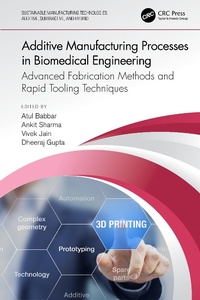
Additive Manufacturing Processes in Biomedical Engineering
Advanced Fabrication Methods and Rapid Tooling Techniques
1st Edition
Published on 29. July 2022
242 pages
978-1-000-62295-9 (ISBN)
Description

This book covers innovative breakthroughs in additive manufacturing processes used for biomedical engineering. More and more, 3D printing is selected over traditional manufacturing processes, especially for complex designs, because of the many advantages such as fewer restrictions, better production cost savings, higher quality control, and accuracy.
Current challenges and opportunities regarding material, design, cost savings, and efficiency are covered along with an outline of the most recent fabrication methods used for converting biomaterials into integrated structures that can fit best in anatomy while still obtaining the necessary architecture, mechanical reliability, biocompatibility, and anti-bacterial characteristics needed. Additional chapters will also focus on selected areas of applications such as bionics, affordable prostheses, implants, medical devices, rapid tooling, and drug delivery.
Additive Manufacturing Processes in Biomedical Engineering: Advanced Fabrication Methods and Rapid Tooling Techniques acts as a first-hand reference for commercial manufacturing organizations which are mimicking tissue organs by using additive manufacturing techniques. By capturing the current trends of today's manufacturing practices this book becomes a one-stop resource for manufacturing professionals, engineers in related disciplines, and academic researchers.
Current challenges and opportunities regarding material, design, cost savings, and efficiency are covered along with an outline of the most recent fabrication methods used for converting biomaterials into integrated structures that can fit best in anatomy while still obtaining the necessary architecture, mechanical reliability, biocompatibility, and anti-bacterial characteristics needed. Additional chapters will also focus on selected areas of applications such as bionics, affordable prostheses, implants, medical devices, rapid tooling, and drug delivery.
Additive Manufacturing Processes in Biomedical Engineering: Advanced Fabrication Methods and Rapid Tooling Techniques acts as a first-hand reference for commercial manufacturing organizations which are mimicking tissue organs by using additive manufacturing techniques. By capturing the current trends of today's manufacturing practices this book becomes a one-stop resource for manufacturing professionals, engineers in related disciplines, and academic researchers.
More details
Series
Edition
1. Auflage
Language
English
Place of publication
London
United Kingdom
Publishing group
Taylor & Francis Ltd
Target group
College/higher education
Professional and scholarly
Product notice
Reflowable
Illustrations
13 Tables, black and white; 68 Line drawings, black and white; 80 Halftones, black and white; 148 Illustrations, black and white
ISBN-13
978-1-000-62295-9 (9781000622959)
Copyright in bibliographic data and cover images is held by Nielsen Book Services Limited or by the publishers or by their respective licensors: all rights reserved.
Schweitzer Classification
Other editions
Additional editions
Atul Babbar | Ankit Sharma | Vivek Jain
Additive Manufacturing Processes in Biomedical Engineering
Advanced Fabrication Methods and Rapid Tooling Techniques
Book
10/2024
1st Edition
CRC Press
€71.40
Shipment within 10-20 days
Atul Babbar | Ankit Sharma | Vivek Jain
Additive Manufacturing Processes in Biomedical Engineering
Advanced Fabrication Methods and Rapid Tooling Techniques
Book
07/2022
1st Edition
CRC Press
€186.10
Shipment within 10-20 days
Persons
Dr. Atul Babbar is working as Assistant Professor at Mechanical Engineering Department of SGT University, Gurugram. He has been teaching students in academics and research field. He is a Level 2 Non-Destructive Testing Engineer certified by American Society of Non-Destructive Testing (ASNT). His research interests include Biomedical, 3D and 4D printing, Conventional/Non-Conventional Machining and not limited to that. He has authored several research articles and book chapters in various international/national Web of Science and Scopus journals. He has been granted with numerous national and international patents. He has been reviewing research articles of various peer reviewed SCI and Scopus indexed journals.
Dr. Ankit Sharma is currently working as Assistant Professor at Chitkara College of Applied Engineerin of Chitkara University. He has completed his doctoral from thapar institute of engineering and technology. He has authored numerous national and international publication in scopus and web of science indexed journal. His research interest includes hybrid machining, additive manufacturing etc. He has vast experience in industry as well as academics. He has been granted with numerous national and international patents.
Dr. Vivek Jain received his Ph.D. in 2012 from IIT Roorkee, India, M.Tech. in 2009 from Guru Nanak Dev Engineering College, Ludhiana, India with first class. He graduated in 1998 from Rajiv Gandhi College of Engineering, Research and Technology, Nagpur Univ., India with first class. At present, he works as Associate Professor at Mechanical Engineering Department of Thapar Institute of Engineering & Technology, Patiala. He has vast experience of 14 years of teaching and 02 years of Industrial experience. His research interests include Biomedical, Machining, Composites, Surface Engineering and not limited to that. He has published in various international/national journals. He has also filed three Indian patents. He is also handling one research project funded by DST (India).
Dr. Dheeraj Gupta, currently Associate Professor in the Department of Mechanical Engineering at the Thapar Institute of Engineering & Technology, Patiala, India. He obtained his B.E. in Mechanical Engineering from Shri Govindram Seksaria Institute of Technology and Science, Indore, India, and Master's & Doctoral Degrees from Indian Institute of Technology Roorkee, Roorkee, India. He has more than ten years of teaching and Research Experience. He has worked on European Union Funded Project, In Lisbon, Portugal. He has published more than 70 articles in journals and conferences. He has filed two Indian Patents on microwave processing of metals. Currently, he is a Principal Investigator for Indian government funded project.
Dr. Ankit Sharma is currently working as Assistant Professor at Chitkara College of Applied Engineerin of Chitkara University. He has completed his doctoral from thapar institute of engineering and technology. He has authored numerous national and international publication in scopus and web of science indexed journal. His research interest includes hybrid machining, additive manufacturing etc. He has vast experience in industry as well as academics. He has been granted with numerous national and international patents.
Dr. Vivek Jain received his Ph.D. in 2012 from IIT Roorkee, India, M.Tech. in 2009 from Guru Nanak Dev Engineering College, Ludhiana, India with first class. He graduated in 1998 from Rajiv Gandhi College of Engineering, Research and Technology, Nagpur Univ., India with first class. At present, he works as Associate Professor at Mechanical Engineering Department of Thapar Institute of Engineering & Technology, Patiala. He has vast experience of 14 years of teaching and 02 years of Industrial experience. His research interests include Biomedical, Machining, Composites, Surface Engineering and not limited to that. He has published in various international/national journals. He has also filed three Indian patents. He is also handling one research project funded by DST (India).
Dr. Dheeraj Gupta, currently Associate Professor in the Department of Mechanical Engineering at the Thapar Institute of Engineering & Technology, Patiala, India. He obtained his B.E. in Mechanical Engineering from Shri Govindram Seksaria Institute of Technology and Science, Indore, India, and Master's & Doctoral Degrees from Indian Institute of Technology Roorkee, Roorkee, India. He has more than ten years of teaching and Research Experience. He has worked on European Union Funded Project, In Lisbon, Portugal. He has published more than 70 articles in journals and conferences. He has filed two Indian Patents on microwave processing of metals. Currently, he is a Principal Investigator for Indian government funded project.
Content
1. Recent Advancement of Additive Manufacturing for Patient-Specific Drug Delivery. 2. Additive Manufacturing for the Development of Biological Implants, Scaffolds and Prosthetics. 3. Additive Manufacturing Process for the Development of Orthosis of Foot. 4. The application of additive manufacturing technology in the era of COVID-19 pandemic: A state-of-the-art review. 5. Relevance of Bio inks for 3D-Bioprinting. 6. Additive Manufacturing of Polymers for Biomedical Applications. 7. Additive manufacturing for pre-surgical and post-surgical planning: A state of the art review. 8. Additive Manufacturing in Biomedical Engineering: Present and Future Applications. 9. Additive manufacturing of biomaterials: classification, techniques, and application. 10. Role of 3D printing and Chitosan hydrogel-based modifiers in Drug Delivery.
