

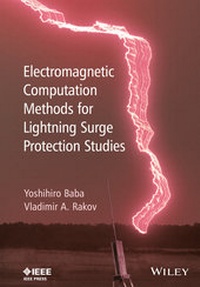
Electromagnetic Computation Methods for Lightning Surge Protection Studies
Description

Presents current research into electromagnetic computation theories with particular emphasis on Finite-Difference Time-Domain Method
This book is the first to consolidate current research and to examine the theories of electromagnetic computation methods in relation to lightning surge protection. The authors introduce and compare existing electromagnetic computation methods such as the method of moments (MOM), the partial element equivalent circuit (PEEC), the finite element method (FEM), the transmission-line modeling (TLM) method, and the finite-difference time-domain (FDTD) method. The application of FDTD method to lightning protection studies is a topic that has matured through many practical applications in the past decade, and the authors explain the derivation of Maxwell's equations required by the FDTD, and modeling of various electrical components needed in computing lightning electromagnetic fields and surges with the FDTD method. The book describes the application of FDTD method to current and emerging problems of lightning surge protection of continuously more complex installations, particularly in critical infrastructures of energy and information, such as overhead power lines, air-insulated sub-stations, wind turbine generator towers and telecommunication towers.
- Both authors are internationally recognized experts in the area of lightning study and this is the first book to present current research in lightning surge protection
- Examines in detail why lightning surges occur and what can be done to protect against them
- Includes theories of electromagnetic computation methods and many examples of their application
- Accompanied by a sample printed program based on the finite-difference time-domain (FDTD) method written in C++ program
Professor Yoshihiro Baba, Associate Professor, Department of Electrical Engineering, Doshisha University, Kyoto, Japan
Professor Baba received his PhD from the University of Tokyo. He was Visiting Scholar at the Lightning Laboratory at the University of Florida, USA, and is currently Editor of the IEEE Transactions on Power Delivery. His areas of interest include computational electromagnetics, electromagnetic compatibility and lightning protection.
Professor Vladimir A. Rakov, Department of Electrical and Computer Engineering, University of Florida, USA
Professor Rakov studied for his PhD at Tomsk University in Russia and has written extensively on the subject of lightning in numerous international journals and conference proceedings. He is A Fellow of the IEEE and a Fellow of the American Meteorological Society, amongst others, and his areas of interest cover lightning, lightning protection and atmospheric electricity.
More details
Other editions
Additional editions
Content
- Intro
- Title Page
- Copyright Page
- Contents
- Preface
- Chapter 1 Introduction
- 1.1 Historical Overview of Lightning Electromagnetic-Field and Surge Computations
- 1.2 Overview of Existing Electromagnetic Computation Methods
- 1.2.1 Method of Moments
- 1.2.2 Partial-Element Equivalent-Circuit Method
- 1.2.3 Finite-Element Method
- 1.2.4 Transmission Line Modeling Method
- 1.2.5 Constrained Interpolation Profile Method
- 1.2.6 Finite-Difference Time Domain Method
- 1.3 Summary
- References
- Chapter 2 Lightning
- 2.1 Introduction
- 2.2 Thundercloud
- 2.2.1 Formation of Thunderclouds
- 2.2.2 Mechanism of Cloud Electrification
- 2.3 Lightning Discharges
- 2.3.1 Categories of Lightning Discharges
- 2.3.2 Classification of Cloud-to-Ground Lightning Discharges
- 2.3.3 Downward Negative Lightning Discharges to Ground
- 2.3.4 Positive Lightning Discharges
- 2.3.5 Upward Lightning Discharges
- 2.3.6 Rocket-Triggered Lightning Discharges
- 2.4 Lightning Electromagnetic Fields
- 2.4.1 Measured Lightning Return-Stroke Electromagnetic Fields
- 2.4.2 Mathematical Expressions for Calculating Electric and Magnetic Fields
- 2.5 Lightning Surges
- 2.5.1 Surges Due to Direct Lightning Strike
- 2.5.2 Surges Induced by a Nearby Lightning Strike
- 2.5.3 Surges Coming from Grounding Due to Its Potential Rise
- 2.6 Lightning Surge Protection
- 2.6.1 Insulation Coordination
- 2.6.2 Protection against Direct Lightning Strikes
- 2.6.3 Back-Flashover Phenomena
- 2.6.4 Lightning Surge Protection Measures
- 2.7 Summary
- References
- Chapter 3 The Finite-Difference Time Domain Method for Solving Maxwell´s Equations
- 3.1 Introduction
- 3.2 Finite-Difference Expressions of Maxwell´s Equations
- 3.2.1 3D Cartesian Coordinate System
- 3.2.2 2D Cylindrical Coordinate System
- 3.3 Subgridding Technique
- 3.4 Absorbing Boundary Conditions
- 3.5 Representation of Lumped Sources and Lumped Circuit Elements
- 3.5.1 Lumped Voltage Source
- 3.5.2 Lumped Current Source
- 3.5.3 Lumped Resistance
- 3.5.4 Lumped Inductance
- 3.5.5 Lumped Capacitance
- 3.6 Representation of Thin Wire
- 3.7 Representation of Lightning Return-Stroke Channel
- 3.7.1 Lightning Return-Stroke Channel
- 3.7.2 Excitations
- 3.8 Representation of Surge Arresters
- 3.9 Summary
- References
- Chapter 4 Applications to Lightning Surge Protection Studies
- 4.1 Introduction
- 4.1.1 Overview
- 4.1.2 Lightning Electromagnetic Fields at Close and Far Distances
- 4.1.3 Lightning Surges on Overhead Power TL Conductors and Towers
- 4.1.4 Lightning Surges on Overhead Distribution and Telecommunication Lines
- 4.1.5 Lightning Electromagnetic Environment in Power Substations
- 4.1.6 Lightning Surges in Wind-Turbine-Generator Towers
- 4.1.7 Lightning Surges in Photovoltaic Arrays
- 4.1.8 Lightning Electromagnetic Environment in Electric Vehicles
- 4.1.9 Lightning Electromagnetic Environment in Airborne Vehicles
- 4.1.10 Lightning Surges and the Electromagnetic Environment in Buildings
- 4.1.11 Surges on Grounding Electrodes
- 4.2 Electromagnetic Fields at the Top of a Tall Building Associated with Nearby Lightning Return Strokes
- 4.2.1 Introduction
- 4.2.2 Methodology
- 4.2.3 Analysis and Results
- 4.2.4 Summary
- 4.2.5 Appendix: Comparison of Fields in the Absence of a Building Computed Using the FDTD Method and Thottappillil et al.´s (2001) Analytical Expressions
- 4.2.6 Appendix: Enhancement Factors Due to the Presence of Hemisphere or Rectangular Building in a Uniform Static Electric Field
- 4.3 Influence of Strike Object Grounding on Close Lightning Electric Fields
- 4.3.1 Introduction
- 4.3.2 Methodology
- 4.3.3 Analysis and Results
- 4.3.4 Discussion
- 4.3.5 Summary
- 4.3.6 Appendix: Comparison of Fields Due to a Lightning Strike to Flat Ground Calculated Using the FDTD Method in the 2D Cylindrical Coordinate System and Thottappillil et al.'s (2001) Analytical Expressions
- 4.4 Simulation of Corona at Lightning-Triggering Wire: Current, Charge Transfer, and Field Reduction Effect
- 4.4.1 Introduction
- 4.4.2 General Approach
- 4.4.3 Model
- 4.4.4 Analysis and Results
- 4.4.5 Discussion
- 4.4.6 Summary
- 4.4.7 Appendix: Geometry of a Wire Corona Sheath
- 4.5 On the Interpretation of Ground Reflections Observed in Small-Scale Experiments Simulating Lightning Strikes to Towers
- 4.5.1 Introduction
- 4.5.2 Current Pulses Propagating along a Conical Conductor Excited at Its Apex or Base
- 4.5.3 FDTD Simulation of Small-Scale Experiments
- 4.5.4 Interpretation of Ground Reflections Arriving at the Tower Top
- 4.5.5 TL Representation of a Tall Object on the Ground Plane
- 4.5.6 Summary
- 4.5.7 Appendix: FDTD Representation of Tower Models
- 4.6 On the Mechanism of Attenuation of Current Waves Propagating along a Vertical Perfectly Conducting Wire above Ground: Application to Lightning
- 4.6.1 Introduction
- 4.6.2 Incident Current (Iinc), Incident E-field (Einc): Analytical Solution
- 4.6.3 Total Current (Itot), Total E-field (Etot): Numerical Solution
- 4.6.4 Scattered Current (Iscat), Scattered E-field (Escat): Iscat = Itot - Iinc, Escat = -Einc
- 4.6.5 Dependences of Current Attenuation on the Source Length, Conductor Thickness, and Frequency
- 4.6.6 Nonuniform TL Approximation
- 4.6.7 Summary
- 4.6.8 Appendix: Incident E-field for Two Parallel Vertical Phased Current Source Arrays-Analytical Solution
- 4.6.9 Appendix: Total Current for Horizontal Configurations-Numerical Solution
- 4.6.10 Appendix: Comparison of FDTD Simulation with an Analytical Solution
- 4.6.11 Appendix: E-field Structure around a Vertical Nonzero-Thickness Perfect Conductor
- 4.6.12 Appendix: Vertical E-field Produced by an Electrically-Short Vertical Dipole
- 4.7 FDTD Simulation of Lightning Surges on Overhead Wires in the Presence of Corona Discharge
- 4.7.1 Introduction
- 4.7.2 Modeling
- 4.7.3 Results and Discussion
- 4.7.4 Summary
- 4.8 FDTD Simulation of Insulator Voltages at a Lightning-Struck Tower Considering the Ground-Wire Corona
- 4.8.1 Introduction
- 4.8.2 Methodology
- 4.8.3 Analysis and Results
- 4.8.4 Summary
- 4.9 Voltages Induced on an Overhead Wire by Lightning Strikes to a Nearby Tall Grounded Object
- 4.9.1 Introduction
- 4.9.2 Methodology
- 4.9.3 Analysis and Results
- 4.9.4 Discussion
- 4.9.5 Summary
- 4.9.6 Appendix: Testing the Validity of the FDTD Calculations against Experimental Data (Strikes to Flat Ground)
- 4.9.7 Appendix: Comparison with Rusck´s Formula (Strikes to Flat Ground)
- 4.9.8 Appendix: Testing the Validity of the FDTD Calculations against Experimental Data (Strikes to a Tall Object)
- 4.10 3D-FDTD Computation of Lightning-Induced Voltages on an Overhead Two-Wire Distribution Line
- 4.10.1 Introduction
- 4.10.2 Methodology
- 4.10.3 Analysis and Results
- 4.10.4 Summary
- 4.11 FDTD Simulations of the Corona Effect on Lightning-Induced Voltages
- 4.11.1 Introduction
- 4.11.2 Methodology
- 4.11.3 Analysis and Results
- 4.11.4 Discussion
- 4.11.5 Summary
- 4.12 FDTD Simulation of Surges on Grounding Electrodes Considering Soil Ionization
- 4.12.1 Introduction
- 4.12.2 Representation of Soil Ionization and De-ionization
- 4.12.3 Analysis and Results
- 4.12.4 Conclusions
- 4.13 Summary
- References
- Appendix 3D-FDTD Program in C++
- Index
- EULA
