

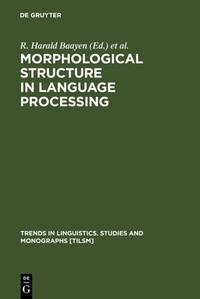
Morphological Structure in Language Processing
1st Edition
Published on 20. July 2011
VIII, 521 pages
978-3-11-091018-6 (ISBN)
Description

This volume brings together a series of studies of morphological processing in Germanic (English, German, Dutch), Romance (French, Italian), and Slavic (Polish, Serbian) languages. The question of how morphologically complex words are organized and processed in the mental lexicon is addressed from different theoretical perspectives (single and dual route models), for different modalities (auditory and visual comprehension, writing), and for language development. Experimental work is reported, as well as computational and statistical modeling. Thus, this volume provides a useful overview of the range of issues currently attracting reseach at the intersection of morphology and psycholinguistics.
More details
Series
Edition
Reprint 2011
Language
English
Place of publication
Berlin/Boston
Germany
Publishing group
de Gruyter Mouton
Target group
Professional and scholarly
US School Grade: College Graduate Student
Illustrations
Num. fig.
Num. fig.
File size
17,56 MB
ISBN-13
978-3-11-091018-6 (9783110910186)
Schweitzer Classification
Other editions
Additional editions

R. Harald Baayen | Robert Schreuder
Morphological Structure in Language Processing
Book
12/2003
1st Edition
De Gruyter Mouton
€159.95
Shipment within 7-9 days
R. Harald Baayen | Robert Schreuder
Morphological Structure in Language Processing
Book
01/2003
1st Edition
De Gruyter Mouton
€229.00
Article exhausted; check different version
Persons
R. Harald Baayen teaches at the University of Nijmegen, The
Netherlands.
Robert Schreuder is Professor at the University of Nijmegen,
The Netherlands.
Content
- Intro
- Preface
- Inflectional morphology and word meaning: Orthogonal or co-implicative cognitive domains?
- Visual processing of Italian verbs and adjectives: The role of the inflectional family size
- Morphological resonance in the mental lexicon
- Morphology and frequency: Contrasting methodologies
- Derivational morphology in the German mental lexicon: A dual mechanism account
- The interplay of root, suffix and whole-word frequency in processing derived words
- On the role of derivational affixes in recognizing complex words: Evidence from masked priming
- Morphological facilitation: The role of semantic transparency and family size
- Recognition of spoken prefixed words: The role of early conditional root uniqueness points
- Lexical representation of morphologically complex words: Evidence from Polish
- Identification of spoken prefixed words in French
- Frequency effects in regular inflectional morphology: Revisiting Dutch plurals
- How does a child detect morphology? Evidence from production
- Frequency effects in processing inflected Dutch nouns: A distributed connectionist account
- When word frequencies do not regress towards the mean
- Spelling errors with a view on the mental lexicon: Frequency and proximity effects in misspelling homophonous regular verb forms in Dutch and French
- List of contributors
- Subject index
