

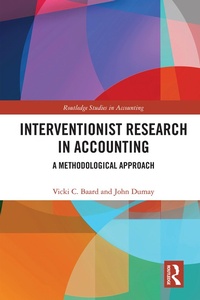
Interventionist Research in Accounting
A Methodological Approach
1st Edition
Published on 8. October 2020
320 pages
978-1-351-26263-7 (ISBN)
Description

This book is the first comprehensive methodological guide for accounting researchers on Interventionist Research (IVR). It provides all the fundamental components needed for understanding what IVR is, and how to plan, design, and conduct legitimate intervention studies, which can endure the scrutiny of institutions and peer review. This text systematically opens the 'black box' of an alternative research paradigm seeking to contribute simultaneously to theory and practice, through direct and collaborative engagement with organisations, practitioners, managers and professionals. It mobilises the production of innovative and theoretically grounded research for academe, and of practical relevance or usefulness and interest to the field of practice.
Interventionist Research in Accounting: A Methodological Approach unpacks current thinking on IVR to forge a confident path ahead for IVR through adopting a forward-thinking approach. This book recognises the remedial potential of IVR to address the research-practice-relevance gap in accounting research and deliberates the challenges of IVR in accounting. It addresses the design, development, and implementation of interventions, critical to solving real-world problems as well as guiding readers in planning the IVR project including budgetary and ethical aspects, utilising suitable research methods and data collection techniques, and establishing validity and reliability. Further, it offers guidance on selecting and managing the research team and recruiting, accessing, and retaining intervention participants; these two components are crucial to creating collaborative relationships required for effective intervention.
This book is a guide serving as a valuable resource for accounting researchers conducting intervention studies, for doctoral and other research students undertaking accounting research, and academics working in universities and business schools or teaching courses in accounting and research methodology.
Interventionist Research in Accounting: A Methodological Approach unpacks current thinking on IVR to forge a confident path ahead for IVR through adopting a forward-thinking approach. This book recognises the remedial potential of IVR to address the research-practice-relevance gap in accounting research and deliberates the challenges of IVR in accounting. It addresses the design, development, and implementation of interventions, critical to solving real-world problems as well as guiding readers in planning the IVR project including budgetary and ethical aspects, utilising suitable research methods and data collection techniques, and establishing validity and reliability. Further, it offers guidance on selecting and managing the research team and recruiting, accessing, and retaining intervention participants; these two components are crucial to creating collaborative relationships required for effective intervention.
This book is a guide serving as a valuable resource for accounting researchers conducting intervention studies, for doctoral and other research students undertaking accounting research, and academics working in universities and business schools or teaching courses in accounting and research methodology.
More details
Series
Edition
1. Auflage
Language
English
Place of publication
London
United Kingdom
Publishing group
Taylor & Francis Ltd
Target group
College/higher education
Illustrations
35 Tables, black and white; 7 Line drawings, black and white
ISBN-13
978-1-351-26263-7 (9781351262637)
Copyright in bibliographic data and cover images is held by Nielsen Book Services Limited or by the publishers or by their respective licensors: all rights reserved.
Schweitzer Classification
Other editions
Additional editions
Book
04/2022
1st Edition
Routledge
€66.20
Shipment within 15-20 days
Book
10/2020
1st Edition
Routledge
€206.90
Shipment within 10-20 days
Book
10/2020
Routledge
Unfortunately, price unknown
Available (delivery time upon request)
Persons
Vicki C. Baard is Senior Lecturer in the Department of Accounting and Corporate Governance at Macquarie University, Australia. Previously, she has held senior managerial roles as a practicing management accountant in Banking, Entertainment, and other related global service organisations. Vicki's doctoral thesis centered on interdisciplinary interventionist research, considered as pioneering doctoral work, which ultimately led to her joining academe. Dr Baard is a qualitative and quantitative interdisciplinary researcher in interventionist research, management control systems, and teams.
Johannes Dumay is an Associate Professor in the Department of Accounting and Corporate Governance at Macquarie University, Australia" Formerly a business consultant, he joined academia after completing his PhD in 2008. His thesis won the European Fund for Management Development and Emerald Journals Outstanding Doctoral Research Award for Knowledge Management. John researches, intellectual capital, knowledge management, accounting, corporate reporting and disclosure, research methodologies, and academic writing. John is a highly cited scholar who has published over 100 peer-reviewed articles, book chapters, and books. He is the Associate Editor of the highly regarded Accounting, Auditing and Accountability Journal, and Meditari Accountancy Research, and Deputy Editor Accounting & Finance.
Johannes Dumay is an Associate Professor in the Department of Accounting and Corporate Governance at Macquarie University, Australia" Formerly a business consultant, he joined academia after completing his PhD in 2008. His thesis won the European Fund for Management Development and Emerald Journals Outstanding Doctoral Research Award for Knowledge Management. John researches, intellectual capital, knowledge management, accounting, corporate reporting and disclosure, research methodologies, and academic writing. John is a highly cited scholar who has published over 100 peer-reviewed articles, book chapters, and books. He is the Associate Editor of the highly regarded Accounting, Auditing and Accountability Journal, and Meditari Accountancy Research, and Deputy Editor Accounting & Finance.
Content
PART I INTERVENTIONIST RESEARCH - WHY IT MATTERS AND WHY YOU SHOULD CARE
Chapter 1: An Introduction to Interventionist Research
Chapter 2: The 'Good' of IVR - Relevance and Remedy
Chapter 3: The 'Bad' and the 'Ugly' of IVR
PART 2 METHODOLOGICAL FOUNDATIONS AND DESIGN - THE PILLARS OF AUTHENTICITY
Chapter 4: To Intervene - Integrating Philosophy and Theory
Chapter 5: An Interventionist Research Framework
Chapter 6: Planning and Protecting Your IVR Project
Chapter 7: Methods for Collecting, Storing and Analysing IVR Data
Chapter 8: IVR Reliability, Validity and Generalisations
PART 3 PEOPLE, SOCIAL SYSTEMS AND INTERVENTIONS - PUTTING IT TOGETHER
Chapter 9: Recruiting, Approaching and Retaining Participants
Chapter 10: Selecting and Managing the Intervention Team
Chapter 11: Intervention Design and Construction
PART 4 INTERVENTION IMPLEMENTATION AND DISSEMINATION - IN TOUCH WITH REALITY
Chapter 12: Intervention Implementation
Chapter 13: Disseminating Your Intervention Research
Chapter 1: An Introduction to Interventionist Research
Chapter 2: The 'Good' of IVR - Relevance and Remedy
Chapter 3: The 'Bad' and the 'Ugly' of IVR
PART 2 METHODOLOGICAL FOUNDATIONS AND DESIGN - THE PILLARS OF AUTHENTICITY
Chapter 4: To Intervene - Integrating Philosophy and Theory
Chapter 5: An Interventionist Research Framework
Chapter 6: Planning and Protecting Your IVR Project
Chapter 7: Methods for Collecting, Storing and Analysing IVR Data
Chapter 8: IVR Reliability, Validity and Generalisations
PART 3 PEOPLE, SOCIAL SYSTEMS AND INTERVENTIONS - PUTTING IT TOGETHER
Chapter 9: Recruiting, Approaching and Retaining Participants
Chapter 10: Selecting and Managing the Intervention Team
Chapter 11: Intervention Design and Construction
PART 4 INTERVENTION IMPLEMENTATION AND DISSEMINATION - IN TOUCH WITH REALITY
Chapter 12: Intervention Implementation
Chapter 13: Disseminating Your Intervention Research
