

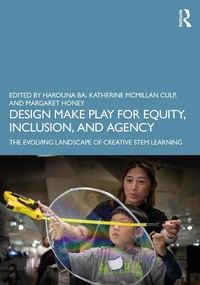
Design Make Play for Equity, Inclusion, and Agency
The Evolving Landscape of Creative STEM Learning
1st Edition
Published on 16. August 2021
252 pages
978-1-351-33315-3 (ISBN)
Description

This pioneering book offers a resource for educators, policymakers, researchers, exhibit designers, and program developers that illuminates creative, cutting-edge ways to inspire, engage, and motivate young people about STEM learning in both informal and formal education settings.
A follow-up to the popular book Design, Make, Play (2013), this volume combines new research, innovative case studies, and practical advice from the New York Hall of Science (NYSCI) to define and illustrate a vision for creative and immersive learning, focusing on STEM learning experiences that are truly equitable and inclusive, and that foster learners' agency.
Featuring contributions from program developers, facilitators, educators, exhibit designers, and researchers, the book provides real-world examples from informal and formal settings that fill the need for high-quality STEM learning opportunities that are accessible to all learners, including groups underrepresented in STEM education and careers. Chapters of the book describe strategies such as using narratives to make engineering learning more inclusive, engaging English language learners in digital design, focusing on whole-family learning, and introducing underserved students to computational thinking through an immersive computer game.
This book offers both a challenge and a guide to all STEM educators in museums, science centers, and other informal and formal education settings who are seeking out ambitious and more equitable forms of engagement. With leading-edge research and practical advice, the book provides appealing and accessible forms of engagement that will support a diverse range of audiences and deepen their approach to creative STEM learning.
A follow-up to the popular book Design, Make, Play (2013), this volume combines new research, innovative case studies, and practical advice from the New York Hall of Science (NYSCI) to define and illustrate a vision for creative and immersive learning, focusing on STEM learning experiences that are truly equitable and inclusive, and that foster learners' agency.
Featuring contributions from program developers, facilitators, educators, exhibit designers, and researchers, the book provides real-world examples from informal and formal settings that fill the need for high-quality STEM learning opportunities that are accessible to all learners, including groups underrepresented in STEM education and careers. Chapters of the book describe strategies such as using narratives to make engineering learning more inclusive, engaging English language learners in digital design, focusing on whole-family learning, and introducing underserved students to computational thinking through an immersive computer game.
This book offers both a challenge and a guide to all STEM educators in museums, science centers, and other informal and formal education settings who are seeking out ambitious and more equitable forms of engagement. With leading-edge research and practical advice, the book provides appealing and accessible forms of engagement that will support a diverse range of audiences and deepen their approach to creative STEM learning.
More details
Edition
1. Auflage
Language
English
Place of publication
London
United Kingdom
Publishing group
Taylor & Francis Ltd
Target group
Professional and scholarly
Illustrations
8 Tables, black and white; 4 Line drawings, black and white; 33 Halftones, black and white; 37 Illustrations, black and white
ISBN-13
978-1-351-33315-3 (9781351333153)
Copyright in bibliographic data and cover images is held by Nielsen Book Services Limited or by the publishers or by their respective licensors: all rights reserved.
Schweitzer Classification
Other editions
Additional editions
Harouna Ba | Katherine McMillan Culp | Margaret Honey
Design Make Play for Equity, Inclusion, and Agency
The Evolving Landscape of Creative STEM Learning
Book
08/2021
1st Edition
Routledge
€205.00
Shipment within 10-20 days
Harouna Ba | Katherine McMillan Culp | Margaret Honey
Design Make Play for Equity, Inclusion, and Agency
The Evolving Landscape of Creative STEM Learning
Book
08/2021
1st Edition
Routledge
€46.50
Shipment within 10-20 days
Persons
Harouna Ba is Director of the Sara Lee Schupf Family Center for Play, Science, and Technology Learning at the New York Hall of Science (NYSCI), as well as a senior research scientist specializing in children's STEM learning across formal and informal educational settings.
Katherine McMillan Culp is Chief Learning Officer at the New York Hall of Science (NYSCI), where she oversees research, exhibition, and program development; educational and community outreach; and youth development programs.
Margaret Honey is President and CEO of the New York Hall of Science (NYSCI) and leads the museum's commitment to nurturing a generation of creative and collaborative problem solvers in STEM.
Katherine McMillan Culp is Chief Learning Officer at the New York Hall of Science (NYSCI), where she oversees research, exhibition, and program development; educational and community outreach; and youth development programs.
Margaret Honey is President and CEO of the New York Hall of Science (NYSCI) and leads the museum's commitment to nurturing a generation of creative and collaborative problem solvers in STEM.
Content
Introduction: Design Make Play for Equity, Inclusion, and Agency
Harouna Ba, Katherine McMillan Culp, and Margaret Honey
Part I Designing for Visitors' Agency
Chapter 1 Designing for Agency in Informal STEM Learning Environments
Susan M. Letourneau
Chapter 2 From Explaining to Engaging Visitors: Transforming the Facilitator's Role
Priya Mohabir, Dorothy Bennett, C. James Liu, and Daisy Tetecatl
Chapter 3 Narratives, Empathy, and Engineering: Creating Inclusive Engineering Activities
Susan M. Letourneau, Dorothy Bennett, Amelia Merker, Satbir Multani, C. James Liu, Yessenia Argudo, and Dana Schloss
Chapter 4 Co-Designing Learning Dashboards for Informal Educators
Elham Beheshti, Leilah Lyons, Aditi Mallavarapu, Wren Thompson, Betty Wallingford, and Stephen Uzzo
Part II Relinquishing Power and Authority in Informal Settings
Chapter 5 Museum-Community Engagement to Support STEM Learning
Andres Henriquez and Marcia Bueno
Chapter 6 Big Data for Little Kids: Developing an Inclusive Program for Young Learners and Their Families
C. James Liu, Kate Maschak, Delia Meza, Susan M. Letourneau, and Yessenia Argudo
Chapter 7 Designing Maker Programs for Family Engagement
David Wells, Susan M. Letourneau, and Samantha Tumolo
Chapter 8 Innovation Institute: Follow the Youth
David Wells, Elham Beheshti, and Danny Kirk
Part III Playing and Learning Across Settings
Chapter 9 See, Touch, and Feel Math: Digital Design for English Language Learners
Dorothy Bennett, Tara Chudoba, Xiomara Flowers, and Heidi Slouffman
Chapter 10 Learning Physics through Embodied Play in a School Setting
Harouna Ba, Christina O'Malley, Yessenia Argudo, and Laycca Umer
Chapter 11 Integrating Computational Thinking Across the Elementary Curriculum: A Professional Development Approach
Anthony Negron
Chapter 12 The Pack: Playfully Embodying Computational and Systems Thinking
Leilah Lyons, Stephen Uzzo, Harouna Ba, and Wren Thompson
Harouna Ba, Katherine McMillan Culp, and Margaret Honey
Part I Designing for Visitors' Agency
Chapter 1 Designing for Agency in Informal STEM Learning Environments
Susan M. Letourneau
Chapter 2 From Explaining to Engaging Visitors: Transforming the Facilitator's Role
Priya Mohabir, Dorothy Bennett, C. James Liu, and Daisy Tetecatl
Chapter 3 Narratives, Empathy, and Engineering: Creating Inclusive Engineering Activities
Susan M. Letourneau, Dorothy Bennett, Amelia Merker, Satbir Multani, C. James Liu, Yessenia Argudo, and Dana Schloss
Chapter 4 Co-Designing Learning Dashboards for Informal Educators
Elham Beheshti, Leilah Lyons, Aditi Mallavarapu, Wren Thompson, Betty Wallingford, and Stephen Uzzo
Part II Relinquishing Power and Authority in Informal Settings
Chapter 5 Museum-Community Engagement to Support STEM Learning
Andres Henriquez and Marcia Bueno
Chapter 6 Big Data for Little Kids: Developing an Inclusive Program for Young Learners and Their Families
C. James Liu, Kate Maschak, Delia Meza, Susan M. Letourneau, and Yessenia Argudo
Chapter 7 Designing Maker Programs for Family Engagement
David Wells, Susan M. Letourneau, and Samantha Tumolo
Chapter 8 Innovation Institute: Follow the Youth
David Wells, Elham Beheshti, and Danny Kirk
Part III Playing and Learning Across Settings
Chapter 9 See, Touch, and Feel Math: Digital Design for English Language Learners
Dorothy Bennett, Tara Chudoba, Xiomara Flowers, and Heidi Slouffman
Chapter 10 Learning Physics through Embodied Play in a School Setting
Harouna Ba, Christina O'Malley, Yessenia Argudo, and Laycca Umer
Chapter 11 Integrating Computational Thinking Across the Elementary Curriculum: A Professional Development Approach
Anthony Negron
Chapter 12 The Pack: Playfully Embodying Computational and Systems Thinking
Leilah Lyons, Stephen Uzzo, Harouna Ba, and Wren Thompson
