

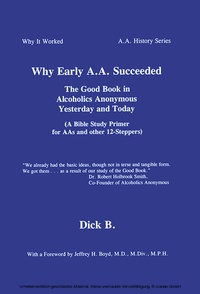
Why Early A.A. Succeeded
Description

More details
Content
Chapter One - The Way Out
So, if you think you are standing firm, be careful that you don't fall! No temptation has seized you except what is common to man. And God is faithful; he will not let you be tempted beyond what you can bear. But when you are tempted, he will also provide a way out so that you can stand up under it. (1 Cor. 10:12-13; New International Version)
The Beginning
A noble experiment began in Akron, Ohio, on June 10, 1935. There was an attempt by Bill W. and Dr. Bob to solve the seemingly hopeless problem of alcoholism by spiritual means. By 1938, these two founders of the program counted noses and found they had 40 men who had recovered with what A.A. then called "divine aid." Bill W. was commissioned to write a textbook which would describe the steps the pioneers took on their path to a right relationship with our Creator. In the Spring of 1939, Bill's manuscript was ready for publication. But a name was required. Concerning the selection of the name, Bill wrote:
After endless voting on a title for the new work, we had decided to call it The Way Out. But inquiry by Fitz M., our Maryland alcoholic, at the Library of Congress disclosed the fact that twelve books already bore that title. Surely we couldn't make our book the thirteenth. So we named it Alcoholics Anonymous instead! Though we didn't know it, our movement then got its name -a name which because of the implication of humility and modesty had given us our treasured spiritual principle of anonymity (The Language of the Heart, p. 107).
Hurrah for Bill's mentioning the principles of humility and modesty and anonymity. They have served a great purpose in A.A. But they were not the heart of "the way out" that A.A. 's pioneers had relied upon. The "way out" for the real alcoholic did not begin with a humble, modest, anonymous fellowship. The real way out began with the Creator they had relied upon. They had relied upon the power of God Almighty for relief from their alcoholism. They did that because will-power, self-knowledge, self-reliance, fear, and all human power had completely failed this afflicted crowd. And the way-the way out-was found in the Bible, which they affectionately called "The Good Book. " That was their guide!
This book will provide a guide to what they studied, learned, and applied from the Bible. It will also provide an opportunity for you to do likewise, should you believe what Dr. Bob said when he wrote: "Your Heavenly Father will never let you down!" (Alcoholics Anonymous, 3rd ed., p. 181).
A guidebook is not an encyclopedia. It does not purport to contain all the information or answers on a subject. It can, however, point the way to something one wishes to find or learn. That, then, is the purpose of this book.
A.A. pioneers wanted something very special. They didn't want to be just "dry. " They didn't want to be "dry" alcoholics who were merely "on the wagon," yet still wanted to drink, needed to drink, but had sworn not to drink. They also were looking for much more than a fellowship of kindred souls who had survived a common peril; and their basic text said so. Moreover, they wanted something more than mere sanity when it came to their uncontrolled and uncontrollable drinking. Believe it or not, they even wanted more than a "cure" for alcoholism though this was zealously sought.
The Relationship They Sought
A.A. 's founders said quite clearly what they needed, wanted, and sought:
The central fact of our lives today is the absolute certainty that our Creator has entered into our hearts and lives in a way which is indeed miraculous. He has commenced to accomplish those things for us which we could never do by ourselves (Alcoholics Anonymous, pI ed., 1939, pp, 35-36).
If what we have learned, and felt, and seen, means anything at all, it means that all of us, whatever our race, creed, or color, are children of a living Creator, with whom we may form a relationship upon simple and understandable terms as soon as we are willing and honest enough to try (Alcoholics Anonymous, pI ed., 1939, p. 39).
Each individual, in the personal stories, describes in his own language, and from his own point of view the way he established his relationship with God (Alcoholics Anonymous, 151 ed., 1939, p. 39).
Early A.A. members wanted, and eagerly sought, a relationship with God, their Creator. Their Big Book said this many times. They wanted to "enter upon a new relationship with their Creator . . . [which] would have the elements of a way of living that answered all [their] problems;" and their basic text said this as well (Alcoholics Anonymous, pi ed., 1939, p. 23, italics added). These pioneers wanted the Divine power and help that would insure relief from their "cunning, baffling, powerful" foe, which they called alcohol. They specifically indicated they wanted to "find" or "rediscover" God (See the Multilith Copy of the Original Manuscript of the Big Book, p. 13). They wanted a solution that would produce "deep and effective spiritual experiences, which [would revolutionize their] whole attitude toward life, toward [their] fellows, and toward God's universe" (Alcoholics Anonymous, pI ed., 1939, p. 35). And, though many in 12 Step fellowships today would deny the foregoing points, you can readily confirm them by simply reading the first two chapters of Alcoholics Anonymous, the First Edition of their text, which was published in 1939.
The alcoholics found their real solution. They found a way out consistent with the promise of 1 Cor. 10: 12-13 quoted above. Their Creator provided the way. And their founders said so.
Suddenly the ceiling went up. We no longer flew blind. A beacon had been lighted. God had shown alcoholics how it might be passed from hand to hand (RHS, Memorial Issue of the AA Grapevine, issued in January, 1951, on the occasion of Dr. Bob's death, p. 8).
They proposed calling their handbook (their text-book to be) The Way Out, though it is not clear whether their favored title's language came from the Bible or from their own deliverance. How strange it is, therefore, that so many addicted and afflicted people today have forgotten that real and early way out. Instead, they have seemingly focused their attention on a fellowship of anonymous well-doers-a fellowship in which the "power" can be that of the "group" or an "it" or just, plain, nothing at all. Many in today's fellowship have followed suit by saying today's A.A. creed is nothing more than: "Just don't drink, and go to meetings." Some add: your "higher power" can be whatever you want "it" to be. In fact, you need not believe in anything at all! You can find this language in many ofthe pamphlets emanating from A.A. today (See examples quoted in Dick B., Turning Point, pp. 5-6).
My People Are Destroyed for Lack of Knowledge
Let's consider from God's perspective the prevalent trend toward abandoning the original "way out." :
My people are destroyed for lack of knowledge: because thou hast rejected knowledge, I will also reject thee, that thou shalt be no priest to me: seeing thou hast forgotten the law of thy God, I will also forget thy children (Hos. 4:6).
The priests said not, Where is the LORD? and they that handle the law knew me not; the pastors also transgressed against me, and the prophets prophesied by Baal, and walked after things that do not profit Hath a nation changed their gods, which are yet not gods? but my people have changed their glory for that which doth not profit. Be astonished, 0 ye heavens at this, and be horribly afraid, be ye very desolate, saith the LORD. For my people have committed two evils; they have forsaken me the fountain of living waters, and hewed them out cisterns, broken cisterns, that can hold no water (Jer. 2:8, 11-13).
Worse, the abandonment of God's way by some groups has, not surprisingly, spawned a host of new theories about the supposed nature of A.A. 's own spiritual program of recovery. There is today a strong group of revisionists who would change the whole program. To some extent, they already have. Some claim A.A. is no longer about "God;" it is, they say, about "not-god." (See Kurtz, Not-God, 1979, p. 109).
Even worse yet, there is an assertion that A.A. itself is "not God" and has, these same analysts believe, now achieved "its profound not-God-ness," whatever that means (See Kurtz, supra, pp.135, 159, 185). Others claim A.A. is no longer about the Creator, but about some nebulous "higher power" which, they say, can be a "something," a "light bulb," some other god (perhaps even a "goddess"), or just plain nothing at all. "Salvation," they insist, "is accepting reality," not accepting Christ (Kurtz, supra, pp. 184¬85). Still others have claimed, and persist in claiming today, that when the word "God" is mentioned in A.A. 's basic text, the three letter word has somehow acquired a manufactured meaning and refers to a "convenient" or "expedient" god (Wally P., Back to Basics, pp.38-39). A god which, or who, can be whatever expedience or convenience or sometimes just plain stupidity suggests to you that "it" can be (Compare Dick B., By the Power o/God, pp. 14-15).
This book is not about any of the foregoing gods, idols, "not gods," "somethings," or "nothings." It does not accept, describe, endorse, or discuss, as part of its subject matter, the revisionist program-a group of concepts that seeks to "universalize" or "homogenize" the 12 Steps and otherwise "pluralize" the program. Nor does it embrace the idea that 12 Step recovery must somehow satisfy, mollify, and include the theories of each and every religion, of humanism, of agnosticism, of New Age thinking, of pantheism, or of atheism, by changing the Creator to a creature or statue,...
