

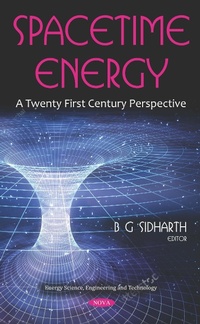
Spacetime Energy: A Twenty First Century Perspective
Published on 8. July 2019
266 pages
978-1-5361-5586-0 (ISBN)
Description

The anthology titled "Spacetime Energy: A Twenty First Century Perspective" encompasses novel and avant garde ideas that delineate the intrinsic nature of spacetime and several of its aspects. The collection of papers epitomizes the fundamental aspects of the physical world. For instance, the authors have considered the affine connection between gravitation and electromagnetism. The noncommutative nature of spacetime has also been elaborated in connection with gravitation and electromagnetism and also in terms of monopoles. On the other hand, the rudimentary nature of the zero point field or the field of the vacuum has also been considered to describe the 2-state asymmetries that are found in nature. Several interesting models have been considered to get a novel perspective on the nature of the universe we live in; the importance of dark energy has been implied therein. The authors have also considered the phenomenon of photoelectric effect in case of grapheme and other similar crystals. A new formula has also been found for the conductance in case of carbon nano tubes. Ultra-high energy fermionic behavior has been elaborately discussed from a novel perspective and the anomalous gyromagnetic ratio of the electron has also been elucidated on the pedestal of the noncommutative nature of spacetime. Resorting to an altogether different approach, the nature of symmetry breaking and the details related to the relevant Lie algebras has also been discussed. Essentially, the collection of works provides a broad range of conceptual understanding of the universe, both in the macroscopic and the microscopic scale. Nevertheless, the reader should find the works to broaden their view of the physical world that exists around us.
More details
Other editions
Additional editions
Book
08/2019
Nova Science Publishers Inc
€210.94
Shipment within 15-20 days
Content
- Intro
- SPACETIME ENERGYA TWENTY FIRST CENTURYPERSPECTIVE
- SPACETIME ENERGYA TWENTY FIRST CENTURYPERSPECTIVE
- CONTENTS
- PREFACE
- Chapter 12-STATE ASYMMETRIES:PHASE TRANSITIONS
- Abstract
- 1. Introduction
- 2. An Analogue of the Ising Model
- 3. Mean Field Theoretic Approach
- 4. The Prevalent Scale
- 5. Applications
- References
- Chapter 2A NOVEL SPACETIME MODEL
- Abstract
- 1. Introduction
- 2. Theory
- 3. Applications
- 4. Discussion
- References
- Chapter 3 DARK MATTER ANOMALY AND ALTERNATIVES
- Abstract
- 1. Introduction
- 2. Theory
- 3. Alternative to the Dark Matter Paradigm
- Conclusion
- References
- Chapter 4THE CHARGE SYMMETRY GROUPAND SYMMETRY BREAKING PHENOMENA
- Abstract
- 1. Introduction
- 2. Charge Symmetry Group
- 2.1. Symmetry
- 3. Lie Algebra of C
- 3.1. Casimir Operator of C
- 4. Symmetry Breaking
- 4.1. Higgs Field and Symmetry Breaking
- Acknowledgments
- Conclusion
- References
- Chapter 5GRAVITATION AND ELECTROMAGNETISM
- Abstract
- 1. Introduction
- 2. The Total Lagrangian
- 3. The Fundamental Length Scaling Factor (FLSF)
- 4. Discussion
- References
- Chapter 6 A UNIFICATION FORMALISM FOR GRAVITATION AND ELECTROMAGNETISM
- Abstract
- 1. Introduction
- 2. Theory
- 3. Discussion
- References
- Chapter 7MANIPULATING DECAY RATES
- Abstract
- 1. Introduction
- 2. A Hypothetical Scenario
- 3. Discussion
- References
- Chapter 8TRANSFORMATION OF METRIC SPACESIN THE CONTEXT OF GRAVITATIONALWAVES
- Abstract
- 1. Introduction
- 2. Theory
- Conclusion
- References
- Chapter 9BALLISTIC TRANSPORT IN CARBONNANOTUBES
- Abstract
- 1. Introduction
- 2. Conductance and Transmission
- 3. Discussion
- References
- Chapter 10NONCOMMUTATIVE SPACETIME GEOMETRY
- Abstract
- 1. Introduction
- 2. The Extended Noncommutative Relations
- 3. Representation of the ExtendedNoncommutative Algebra
- 4. The Harmonic Oscillator in Terms of the ModifiedRepresentation
- 5. Applications
- 6. Monopoles
- Conclusion
- References
- Chapter 11UNIDIRECTIONAL BEAMSAND THE VIRIAL THEOREM
- Abstract
- 1. Introduction
- 2. Theory
- 3. Boson-Fermion Transmutation
- References
- Chapter 12THE HIGHER DIMENSIONAL UNIVERSE
- Abstract
- 1. Introduction
- 2. Noncommutativity
- 3. Discussion
- References
- Chapter 13A CANONICAL FORMULATIONFOR THE UNIVERSE
- Abstract
- 1. Introduction
- 2. Theory
- 3. The Hamiltonian
- 4. The Hubble Parameter
- 5. Discussion
- References
- Chapter 14 A NOTE ON THE LAMB SHIFT
- Abstract
- 1. Introduction
- 2. The Modified Dirac EquationThe Hamiltonian
- 3. Energy Levels from the Modified Dirac Equation
- 4. The Lamb Shift
- 5. Discussion
- Conclusion
- References
- Chapter 15THE GYROMAGNETIC RATIOOF THE ELECTRON
- Abstract
- 1. Introduction
- 2. The Electromagnetic Field and ZPF
- 3. Discussion
- Conclusion
- References
- Chapter 16 ULTRA HIGH ENERGY DECAYING FERMIONS
- Abstract
- 1. Introduction
- 2. The High Energy Equation
- 3. Possible Consequences
- References
- Chapter 17COSMOLOGICAL CONSTANTAND THE VACUUM STABILITYIN THE STANDARD MODEL
- Abstract
- 1. Introduction
- 2. LHC: Search for the Resonances in pp CollisionDataat ps = 13 TeV
- 3. Multiple Point Principle
- 4. Cosmological Constant
- 4.1. Sidharth's Theory of Cosmological Constant (Dark Energy)
- 4.2. What is the Universe Vacuum?
- 5. Phase Transition(s) in the Universe
- 6. Vacuum Stability and the Multiple Point Principle
- 6.1. Could the Multiple Point Principle be Exact Dueto Corrections from the New Bound State 6t + 6¯t?
- 6.2. The Higgs Effective Potential
- 7. Stability Phase Diagram
- 7.1. Two-Loop Corrections to the Higgs Mass from the EffectivePotential
- 7.2. The Effect from the New Bound States 6t+6¯t on the MeasuredHiggs Mass
- 7.3. The Effect from the New Bound States 6t + 6¯ton the Measured Higgs Mass. The Main DiagramsCorrecting the Effective Higgs Self-InteractionCoupling Constant
- Summary and Conclusion
- References
- Appendix A Resonance 750 GeV
- References
- Appendix B Multiple Point Principle, Literature
- References
- Appendix C Non-Commutativity, the Main Articles
- References
- Appendix D The Vacuum Stability Problem Hasa Long History
- References
- Appendix E Theory of the New Bound State 6t + 6¯
- References
- Chapter 18COMMENT ON THE PAPER:SPACE-TIME GEOMETRYAND THE VELOCITY OF LIGHT
- Abstract
- References
- Chapter 19A CLASSICAL TREATMENT OF THE PHONONWAVE EQUATION IN TERMS OF A DELTAFUNCTION
- Abstract
- 1. Introduction
- 2. Theory
- References
- Chapter 20 PHOTOELECTRIC EFFECT IN 2D & 3D CRYSTALS
- Abstract
- 1. Introduction
- 2. 2D Crystals
- 3. 3D Crystals
- 4. Discussion
- References
- Chapter 21ENTANGLEMENT AND IT'S MANIPULATION
- Abstract
- 1. Introduction
- 2. Entanglement at a Particular Temperature
- 3. Manipulation of Entanglement
- 4. Discussion
- References
- EDITOR CONTACT INFORMATION
- INDEX
- Blank Page
