

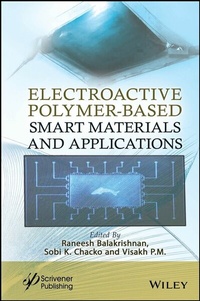
Electroactive Polymer-Based Smart Materials, and Applications
Description

Explore the future of smart materials with this guide to mastering the advanced fabrication techniques and molecular design strategies essential for developing high-performance, self-powered sensors and next-generation soft actuators.
Electroactive polymers are revolutionizing materials science with their unique ability to convert electrical energy into mechanical motion and vice versa. These smart materials are shaping the future of energy harvesting, flexible electronics, biomedical applications, and electromagnetic interference shielding. This book provides a thorough exploration of electroactive polymer composites, from their fundamental properties to advanced fabrication techniques. Covering key aspects such as dielectric behavior, thermal stability, and mechanical flexibility, it highlights how these materials are being integrated into emerging technologies like self-powered sensors, soft actuators, and next-generation medical devices. Designed for both researchers and industry professionals, this book bridges the gap between theory and application, delving into practical fabrication techniques, including electrospinning, solvent casting, and polymeric coatings to optimize material properties for specific applications. Additionally, it explores the latest advancements in nanocomposite reinforcements, doping strategies, and multifunctional coatings that enhance the performance of electroactive polymer-based devices. A resource for academics, engineers, and innovators in materials science, this book offers a comprehensive guide to the evolving landscape of electroactive polymers and their vast potential in modern technology.
Readers will find the volume:
- Comprehensively covers the physics, chemistry, and thermal behavior of electroactive polymers;
- Explores applications in energy harvesting, storage, and self-powered devices;
- Discusses electromagnetic shielding, sensors, actuators, and wearable electronics;
- Highlights emerging trends in the biomedical, aerospace, and flexible electronics industries.
Audience
Materials scientists, polymer chemists, electrical engineers, and nanotechnology researchers working in energy harvesting, flexible electronics, biomedical devices, and electromagnetic shielding technologies.
More details
Other editions
Additional editions
Persons
Raneesh Balakrishnan, PhD is an Assistant Professor in the Department of Physics at Catholicate College, Kerala, India. He has published more than 35 international research articles, co-edited eight books, and authored ten book chapters. His research areas primarily focus on multiferroics, nanoelectronics, polymer nanocomposites, electron microscopy, and nanobiotechnology.
Sobi K. Chacko, PhD is a researcher in the Department of Physics at Catholicate College, Kerala, India, specializing in materials science, with a focus in electroactive polymers, nanomaterials, and polymer-based composites. With extensive experience in designing multifunctional materials for energy harvesting and biomedical applications, she has contributed to various research projects in academia. She has also served as a guest faculty member in physics and mentored students in advanced materials science and nanotechnology.
Visakh P.M., PhD is working in the Natural Bioactive Materials Laboratory, Department of Bioengineering, Ege University, Turkey. He has edited 50 books, authored more than 25 books, published 23 journal articles, and 55 book chapters. His research interests include nanoparticle synthesis, material characterization, and nanostructured materials.
Content
- Cover
- Series Page
- Title Page
- Copyright Page
- Contents
- Preface
- Chapter 1 An Introduction to Electroactive Polymers
- 1.1 Introduction
- 1.2 Types of EAPs
- 1.2.1 Piezoelectric Polymers
- 1.2.2 Conducting Polymers
- 1.2.3 Ionic Polymers
- 1.2.4 Dielectric Elastomers
- 1.3 Properties of EAPs
- 1.3.1 Mechanical Properties
- 1.3.2 Electrical Properties
- 1.3.3 Thermal Properties
- 1.3.4 Chemical Properties
- 1.4 Applications of EAPs
- 1.5 Conclusion
- References
- Chapter 2 Structural, Chemical, and Electrical Properties of Dielectric Polymers
- 2.1 Introduction
- 2.2 Preparation Methods for Dielectric Polymers
- 2.2.1 Blending
- 2.2.2 Copolymerization
- 2.2.3 Cross-Linking of Polymers
- 2.3 Structural Properties
- 2.3.1 Crosslinking
- 2.3.2 Polar Groups
- 2.4 Chemical Properties
- 2.5 Electrical Properties
- 2.5.1 Dielectric Constant
- 2.5.2 Dielectric Strength
- 2.5.3 Power Factor or Power Coefficient (Alternating Current)
- 2.5.4 Tracking and Arc Resistance (Direct Current)
- 2.6 Summary
- Acknowledgments
- References
- Chapter 3 Biodegradable PLA: Synthesis, Properties and PLA-Based Nanocomposite Applications
- 3.1 Introduction
- 3.2 Polylactic Acid
- 3.3 Structure of PLA
- 3.4 Solubility of PLA
- 3.5 Degradability of PLA
- 3.6 Synthesis Methods of PLA
- 3.6.1 Direct Condensation Polymerization
- 3.6.2 Azeotropic Dehydration Condensation
- 3.6.3 Lactide Ring-Opening Polymerization
- 3.6.4 Enzymatic Polymerization
- 3.7 Properties of PLA
- 3.8 Advantages and Disadvantages of PLA
- 3.9 Applications of PLA
- 3.9.1 Packaging
- 3.9.2 Single-Use Products
- 3.9.3 Automotives
- 3.9.4 Textile
- 3.9.5 Agricultural Use
- 3.9.6 Electronics
- 3.9.7 Construction
- 3.10 Biomedical Applications of PLA
- 3.10.1 Tissue Engineering
- 3.10.2 Wound Healing
- 3.10.3 Drug Delivery
- 3.10.4 Medical Implants
- 3.10.5 Biosensors
- 3.11 Conclusions and Future Perspectives
- References
- Chapter 4 Optical, Dielectric, and Electrical Properties of Poly(2-Ethyl- 2-Oxazoline)-Polyvinylpyrrolidone-Graphene Nanocomposites
- 4.1 Introduction
- 4.1.1 Polymer Blends and Its Types
- 4.1.1.1 Completely Miscible Blend
- 4.1.1.2 Partially Miscible Blend
- 4.1.1.3 Completely Immiscible Blend
- 4.1.2 Methods of Preparation of Polymer Blends
- 4.1.2.1 Mechanical-Melt Mixing
- 4.1.2.2 Solution Cast Technique
- 4.1.2.3 Fine Powder Mixing
- 4.1.2.4 In Situ Polymerization
- 4.1.3 Processing of Polymer Nanocomposites
- 4.1.3.1 Solution Casting Method
- 4.1.3.2 Melt Blending or Melt Intercalation Method
- 4.1.3.3 In-Situ Polymerization
- 4.2 Poly(2-Ethyl-2-Oxazoline)
- 4.3 Polyvinylpyrrolidone
- 4.3.1 Medical Applications
- 4.3.2 Technological Applications
- 4.3.3 Other Applications
- 4.4 Poly(2-Ethyl-2-Oxazoline)-Polyvinylpyrrolidone Systems
- 4.4.1 Poly(2-Ethyl-2-Oxazoline)-Polyvinylpyrrolidone Blends
- 4.4.2 PEOX-PVP-Graphene Nanocomposites
- 4.5 Optical, Electrical, and Dielectric Properties
- 4.5.1 PEOX-PVP Blends
- 4.5.2 PEOX-PVP-Graphene Nanocomposites
- 4.6 Conclusion
- References
- Chapter 5 Piezoelectric Polymer Composites for Tribo and Piezoelectric Energy Harvesting Applications
- 5.1 Introduction
- 5.2 Piezoelectric Polymers and Their Properties
- 5.2.1 Semi-Crystalline Polymers
- 5.2.1.1 Polyvinylidene Fluoride Polymer
- 5.2.1.2 Polyvinylidene Fluoride Copolymer
- 5.2.1.3 Polyureas
- 5.2.1.4 Polyamides
- 5.2.1.5 Liquid-Crystalline Polymers
- 5.2.1.6 Biopolymers
- 5.2.2 Amorphous Polymer
- 5.2.2.1 Blends
- 5.2.3 Composites
- 5.2.3.1 0-3 Piezocomposites
- 5.2.3.2 3-3 Piezocomposites
- 5.3 Energy Harvesting Using Piezoelectricity
- 5.4 Triboelectric Energy Harvesting Using Electroactive Polymer-Based Composites
- 5.4.1 Working Modes of TENG
- 5.4.1.1 Contact Separation Mode
- 5.4.1.2 Linear Sliding Mode
- 5.4.1.3 Single Electrode Mode
- 5.4.1.4 Free Standing Mode
- 5.4.2 Fabrication of TENG
- 5.4.3 Applications of TENGs
- 5.4.3.1 TENGs as a Source of Sustainable Micropower
- 5.4.3.2 TENG as an Active and Self-Powered Sensor
- 5.4.3.3 TENG as a Blue Energy Harvester
- 5.4.3.4 TENG as a Direct High Voltage Power Source
- 5.5 Summary
- Acknowledgments
- References
- Chapter 6 Advancing Piezoelectric and Triboelectric Energy Harvesting Using Piezoelectric Polymer Composites
- 6.1 Introduction
- 6.2 Piezoelectric Polymers and Their Properties
- 6.2.1 Principles of Piezoelectricity
- 6.2.2 Commonly Used Piezoelectric Polymers
- 6.2.3 Enhancing Piezoelectric Performance
- 6.3 Energy Harvesting Using Piezoelectricity
- 6.3.1 Working Principles of Piezoelectric Energy Harvesting Systems
- 6.3.2 Techniques and Designs for Efficient Energy Harvesting
- 6.3.3 Challenges and Limitations of Piezoelectric Energy Harvesting
- 6.3.4 Applications of Piezoelectric Energy Harvesting
- 6.3.5 Future Perspectives
- 6.4 Triboelectric Energy Harvesting Using Electroactive Polymer-Based Composites
- 6.4.1 Advantages of Electroactive Polymer-Based Composites for Triboelectric Energy Harvesting
- 6.4.2 Challenges of Electroactive Polymer-Based Composites for Triboelectric Energy Harvesting
- 6.4.3 Strategies to Enhance Triboelectric Performance
- 6.4.4 Integration of Piezoelectric and Triboelectric Effects in Hybrid Energy Harvesting Systems
- 6.5 Conclusion
- References
- Chapter 7 Fluorinated Electroactive Polymers as Electrolytes in Cells and Battery Applications
- 7.1 Introduction
- 7.1.1 What are Polymers?
- 7.1.2 Electroactive Polymers
- 7.2 Fluorinated Electroactive Polymers
- 7.2.1 Origin of Fluorinated Electroactive Polymers
- 7.2.2 FEPs-Properties and Characteristics
- 7.3 PVDF and Its Copolymers-The Next-Generation FEP
- 7.3.1 Polar Properties of PVDF
- 7.3.2 Physical Properties of PVDF
- 7.3.3 Chemical Properties of PVDF
- 7.3.4 PVDF and Its Copolymers
- 7.4 Polymer Membranes as Electrolytes
- 7.4.1 Polymer Membranes
- 7.4.2 Applications for Polymer Membranes
- 7.4.3 Electrolytes Composed of Polymer Membranes
- 7.4.4 Electrospun Polymer Membranes as Electrolytes
- 7.4.5 Polymer Membranes as Electrolytes
- 7.4.5.1 Polymer Membranes as Fuel Cell Electrolytes
- 7.4.5.2 Polymer Membranes as Battery Electrolytes
- 7.5 Conclusion
- Acknowledgments
- References
- Chapter 8 Electrospun Fiber Mats of Fluoropolymer Composites for Wound Healing and Drug Delivery Applications
- 8.1 Introduction
- 8.1.1 Electrospun Fiber Mats
- 8.1.2 Fluoropolymers in Biomaterials
- 8.2 Electrospinning Technique
- 8.2.1 Characterization of Electrospun Fiber Mats
- 8.2.2 Drug Delivery: Precision Medicine at its Core
- 8.2.3 Wound Healing: A Vital Biological Process
- 8.3 The Mergence of Medication Administration and Wound Healing
- 8.3.1 Wound Healing Applications
- 8.4 Drug Delivery Applications
- 8.5 Biocompatibility and Toxicity Assessment
- 8.6 Future Trends and Challenges
- 8.7 Conclusion
- References
- Chapter 9 Exploring the Potential of PEDOT:PSS: From Fundamental Properties to Diverse Applications
- 9.1 Introduction
- 9.2 Structure of PEDOT:PSS
- 9.3 Synthesis of PEDOT:PSS
- 9.4 Properties of PEDOT:PSS
- 9.4.1 Conductivity
- 9.4.2 Work Function
- 9.4.3 Electrochemical Stability
- 9.4.4 Biocompatibility
- 9.4.5 Morphological Adaptability
- 9.5 Applications of PEDOT:PSS
- 9.5.1 Energy Harvesting and Storage
- 9.5.1.1 Solar Cells
- 9.5.1.2 Thermoelectric Modules
- 9.5.1.3 Batteries
- 9.5.1.4 Supercapacitors
- 9.5.2 Electrochemistry
- 9.5.2.1 Gas Sensing
- 9.5.2.2 Ionic Sensing
- 9.5.3 Biomedical Applications
- 9.5.3.1 Biosensing
- 9.5.3.2 Drug Delivery
- 9.5.3.3 Tissue Engineering
- 9.5.4 Coating
- 9.5.4.1 EMI Shielding
- 9.5.4.2 Anticorrosive Coating
- 9.5.5 Flexible Electronics
- 9.5.5.1 OLED
- 9.5.5.2 Displays
- 9.5.6 Physical Sensing
- 9.5.6.1 Strain Sensing
- 9.5.6.2 Humidity Sensing
- 9.5.6.3 Temperature Sensing
- 9.5.6.4 Pressure Sensing
- 9.6 Conclusions
- References
- Chapter 10 EAPs and Environmental Impact
- 10.1 Introduction
- 10.1.1 Ionic EAPs
- 10.1.2 Electronic Polymer
- 10.2 Challenges in EAPs
- 10.3 Applications of EAPs
- 10.3.1 Challenges in Artificial Muscle
- 10.3.2 Challenge in Soft Robotics
- 10.3.3 Challenges in Prosthetic
- 10.3.4 Challenges in Biomedical Devices
- 10.3.5 Challenges in Energy Harvesting
- 10.3.6 Material Used to Overcome these Challenges
- 10.3.7 Challenges in Conducting Polymers
- 10.4 Sustainability of EAPs Material
- 10.4.1 Platinum
- 10.4.2 Graphite
- 10.4.3 Graphene
- 10.4.4 Conducting Polymer
- 10.4.5 Heteroatom (N and S)-Doped Carbon (ATC) from Aesculus Turbinata
- 10.4.6 Ionic Gel Polymers
- 10.4.7 Nitinol and Magneto
- 10.4.8 Organic Electroactive Materials for Aqueous Redox Flow Batteries
- 10.5 Conclusion
- References
- Index
- EULA
