

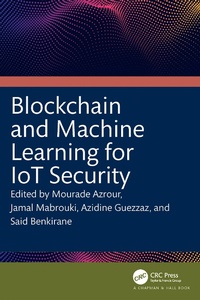
Blockchain and Machine Learning for IoT Security
1st Edition
Published on 9. February 2024
164 pages
978-1-003-84488-4 (ISBN)
Description

The Internet of Things (IoT) involves physical devices, cars, household appliances, and any other physical appliance equipped with sensors, software, and network connections to gather and communicate data. Nowadays, this technology is embedded in everything from simple smart devices, to wearable equipment, to complex industrial machinery and transportation infrastructures. On the other hand, IoT equipment has been designed without considering security issues. Consequently, there are many challenges in terms of protection against IoT threats, which can lead to distressing situations. In fact, unlike other technological solutions, there are few standards and guidelines governing the protection of IoT technology. Moreover, few users are aware of the risks associated with IoT systems.
Hence, Blockchain and Machine Learning for IoT Security discusses various recent techniques and solutions related to IoT deployment, especially security and privacy. This book addresses a variety of subjects, including a comprehensive overview of the IoT, and covers in detail the security challenges at each layer by considering how both the architecture and underlying technologies are employed. As acknowledged experts in the field, the authors provide remediation solutions for impaired security, as well as mitigation methods, and offer both prevention and improvement suggestions.
Key Features:
Offers a unique perspective on IoT security by introducing Machine Learning and Blockchain solutions
Presents a well-rounded overview of the most recent advances in IoT security and privacy
Discusses practical solutions and real-world cases for IoT solutions in various areas
Provides solutions for securing IoT against various threats
Discusses Blockchain technology as a solution for IoT
This book is designed to provide all the necessary knowledge for young researchers, academics, and industry professionals who want to understand the advantages of artificial intelligence technology, machine learning, data analysis methodology, and Blockchain for securing IoT technologies.
Hence, Blockchain and Machine Learning for IoT Security discusses various recent techniques and solutions related to IoT deployment, especially security and privacy. This book addresses a variety of subjects, including a comprehensive overview of the IoT, and covers in detail the security challenges at each layer by considering how both the architecture and underlying technologies are employed. As acknowledged experts in the field, the authors provide remediation solutions for impaired security, as well as mitigation methods, and offer both prevention and improvement suggestions.
Key Features:
Offers a unique perspective on IoT security by introducing Machine Learning and Blockchain solutions
Presents a well-rounded overview of the most recent advances in IoT security and privacy
Discusses practical solutions and real-world cases for IoT solutions in various areas
Provides solutions for securing IoT against various threats
Discusses Blockchain technology as a solution for IoT
This book is designed to provide all the necessary knowledge for young researchers, academics, and industry professionals who want to understand the advantages of artificial intelligence technology, machine learning, data analysis methodology, and Blockchain for securing IoT technologies.
More details
Edition
1. Auflage
Language
English
Place of publication
London
United Kingdom
Publishing group
Taylor & Francis Ebooks
Target group
College/higher education
Professional and scholarly
Illustrations
16 Tables, black and white; 27 Line drawings, black and white; 27 Illustrations, black and white
ISBN-13
978-1-003-84488-4 (9781003844884)
Copyright in bibliographic data and cover images is held by Nielsen Book Services Limited or by the publishers or by their respective licensors: all rights reserved.
Schweitzer Classification
Other editions
Additional editions
Mourade Azrour | Jamal Mabrouki | Azidine Guezzaz
Blockchain and Machine Learning for IoT Security
Book
12/2025
1st Edition
Chapman & Hall/CRC
€77.70
Shipment within 10-20 days

Mourade Azrour | Jamal Mabrouki | Azidine Guezzaz
Blockchain and Machine Learning for Iot Security
Book
04/2024
CRC Press
Unfortunately, price unknown
Available (delivery time upon request)
Mourade Azrour | Jamal Mabrouki | Azidine Guezzaz
Blockchain and Machine Learning for IoT Security
Book
02/2024
1st Edition
Chapman & Hall/CRC
€147.20
Shipment within 10-20 days
Persons
Prof. Mourade Azrour received his PhD from Faculty of sciences and Techniques, Moulay Ismail University of Meknes, Morocco. He has received his MS in computer and distributed systems from Faculty of Sciences, Ibn Zouhr University, Agadir, Morocco in 2014. Mourade currently works as computer sciences professor at the Department of Computer Science, Faculty of Sciences and Techniques, Moulay Ismail University of Meknes. His research interests include Authentication protocol, Computer Security, Internet of things, Smart systems, Machine learning and so ones.
Prof. Jamal Mabrouki received his PhD in Process and Environmental Engineering at Mohammed V University in Rabat, specializing in artificial intelligence and smart automatic systems. He completed the Bachelor of Science in Physics and Chemistry with honors from Hassan II University in Casablanca, Morocco and the engineer in Environment and smart system. His research is on intelligent monitoring, control, and management systems and more particularly on sensing and supervising remote intoxication systems, smart self-supervised systems and recurrent neural networks.
Prof. Azidine Guezzaz received his Ph.D from Ibn Zohr University Agadir, Morocco in 2018. He obtained his Master in computer and distributed systems from Faculty of Sciences, Ibn Zouhr University, Agadir, Morocco in 2013. He is currently an associate professor of computer science and mathematics at Cadi Ayyad University Marrakech, Morocco. His main field of research interest is computer security, cryptography, artificial intelligence, intrusion detection and smart cities.
Prof. Said Benkirane obtained his Engineering Degree in Networks and Telecommunications in 2004 from INPT in Rabat, Morocco. He obtained his Master degree in Computer and Network Engineering in 2006 at the USMBA University of Fez and his PhD in Computer Science in 2013 at the UCD University of El-JadidaMorocco. He worked as Professor from 2014 at ESTE Cadi Ayyad University. His areas of research are Artificial Intelligence, Multi Agents, and Systems Security.
Prof. Jamal Mabrouki received his PhD in Process and Environmental Engineering at Mohammed V University in Rabat, specializing in artificial intelligence and smart automatic systems. He completed the Bachelor of Science in Physics and Chemistry with honors from Hassan II University in Casablanca, Morocco and the engineer in Environment and smart system. His research is on intelligent monitoring, control, and management systems and more particularly on sensing and supervising remote intoxication systems, smart self-supervised systems and recurrent neural networks.
Prof. Azidine Guezzaz received his Ph.D from Ibn Zohr University Agadir, Morocco in 2018. He obtained his Master in computer and distributed systems from Faculty of Sciences, Ibn Zouhr University, Agadir, Morocco in 2013. He is currently an associate professor of computer science and mathematics at Cadi Ayyad University Marrakech, Morocco. His main field of research interest is computer security, cryptography, artificial intelligence, intrusion detection and smart cities.
Prof. Said Benkirane obtained his Engineering Degree in Networks and Telecommunications in 2004 from INPT in Rabat, Morocco. He obtained his Master degree in Computer and Network Engineering in 2006 at the USMBA University of Fez and his PhD in Computer Science in 2013 at the UCD University of El-JadidaMorocco. He worked as Professor from 2014 at ESTE Cadi Ayyad University. His areas of research are Artificial Intelligence, Multi Agents, and Systems Security.
Content
1. Google trend analysis of airport passenger throughputs: case study of Murtala Muhammed International Airpor 2. Blockchain Technology Overview: Architecture, proposed and Future Trends 3. Innovative Approach for Optimized IoT Security based on Spatial Network 4. The combination of blockchain and Internet of Things (IoT) Applications, Opportunities and Challenges for Industry 5. Security Issues in Internet of Medical Things 6. Intrusion detection Framework using AdaBoost algorithm and Chi-squared technique 7. A Collaborative Intrusion Detection Approach Based on Deep Learning and Blockchain 8. GVGB-IDS: An Intrusion Detection System using Graphic Visualization and Gradient Boosting for cloud Monitoring 9. Design and Implementation of Intrusion Detection Model with Machine Learning Techniques for IoT Security
