

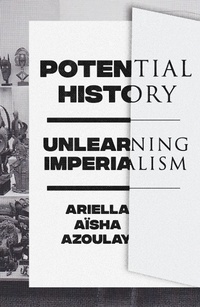
Potential History
Unlearning Imperialism
Published on 19. November 2019
656 pages
978-1-78873-572-8 (ISBN)
Description

In this theoretical tour-de-force, renowned scholar Ariella A¿sha Azoulay calls on us to recognize the imperial foundations of knowledge and to refuse its strictures and its many violences.
Azoulay argues that the institutions that make our world, from archives and museums to ideas of sovereignty and human rights to history itself, are all dependent on imperial modes of thinking. Imperialism has segmented populations into differentially governed groups, continually emphasised the possibility of progress while trying to destroy what came before, and voraciously sought out the new by sealing the past away in dusty archival boxes and the glass vitrines of museums.
By practising what she calls potential history, Azoulay argues that we can still refuse the imperial violence that shattered communities, lives, and worlds, from native peoples in the Americas to the Congo ruled by Belgium's brutal King L¿opold II, from dispossessed Palestinians in 1948 to displaced refugees in our own day. In Potential History, Azoulay travels alongside historical companions - an old Palestinian man who refused to leave his village in 1948, an anonymous woman in war-ravaged Berlin, looted objects and documents torn from their worlds and now housed in archives and museums - to chart the ways imperialism has sought to order time, space, and politics.
Rather than looking for a new future, Azoulay calls upon us to rewind history and unlearn our imperial rights, to continue to refuse imperial violence by making present what was invented as "past" and making the repair of torn worlds the substance of politics.
Azoulay argues that the institutions that make our world, from archives and museums to ideas of sovereignty and human rights to history itself, are all dependent on imperial modes of thinking. Imperialism has segmented populations into differentially governed groups, continually emphasised the possibility of progress while trying to destroy what came before, and voraciously sought out the new by sealing the past away in dusty archival boxes and the glass vitrines of museums.
By practising what she calls potential history, Azoulay argues that we can still refuse the imperial violence that shattered communities, lives, and worlds, from native peoples in the Americas to the Congo ruled by Belgium's brutal King L¿opold II, from dispossessed Palestinians in 1948 to displaced refugees in our own day. In Potential History, Azoulay travels alongside historical companions - an old Palestinian man who refused to leave his village in 1948, an anonymous woman in war-ravaged Berlin, looted objects and documents torn from their worlds and now housed in archives and museums - to chart the ways imperialism has sought to order time, space, and politics.
Rather than looking for a new future, Azoulay calls upon us to rewind history and unlearn our imperial rights, to continue to refuse imperial violence by making present what was invented as "past" and making the repair of torn worlds the substance of politics.
More details
Edition
Ebook UK & RoW
Language
English
Place of publication
London
United Kingdom
Product notice
Reflowable
ISBN-13
978-1-78873-572-8 (9781788735728)
Copyright in bibliographic data and cover images is held by Nielsen Book Services Limited or by the publishers or by their respective licensors: all rights reserved.
Schweitzer Classification
Other editions
Additional editions
Book
11/2019
Verso Books
€42.00
Shipment within 3-4 weeks
Person
Ariella A¿sha Azoulay is a professor of Comparative Literature and Modern Culture, and Media at Brown University, as well as a curator and documentary film maker. Her many books include The Civil Contract of Photography and Civil Imagination: A Political Ontology of Photography, and she has curated exhibits for galleries and museums around the world.
Content
- Cover Page
- Halftitle Page
- Title Page
- Copyright Page
- Contents
- Acknowledgments
- Preface
- 1. Unlearning Imperialism
- The Shutter: Well-Documented Objects / Undocumented People
- Aïsha
- Unlearning the New, With Companions
- A Nonprogressive Study
- 1492: Marker of Reversibility
- The Human Condition-A Political Ontology
- The Differential Principle
- Learning to Rewind
- Archival Technology
- Potential History
- Sovereignty-A Form of Political Engineering
- Citizen-Perpetrators
- Regime-Made Disaster
- Performing Rights
- 2. Plunder, Objects, Art, Rights
- Transcendental Imperial Art
- Potential History of Art
- Intergenerational and Intercommunal Transmission
- Imperial Temporality
- Collecting
- An Imperial Conjuncture
- The Persistence of Homo Faber
- Salvaged Art, Destroyed Infrastructures
- The Harlem Renaissance Was No Exception
- Art Destroys the Common World
- The Rise of the Imperial Persona of the Artist
- The Congo Condition
- Léopold II's "Gift"
- "Kill me if you wish" and "Don't shoot"
- "Do you want to kill Me? Here I am"
- The Universal Rights of Privileged Citizens
- The Universal Position of the Artist
- The Art of Not Displaying Everything Everywhere
- Worldly Rights
- Free Renty-Reverse Photography's Imperial Basis
- Our Violent Commons
- Unruly Objects
- Imagine Going on Strike: Museum Workers
- 3. Archives: The Commons, Not the Past
- Time Lines
- To Institute, to Violate
- The Archival Regime of Classification
- Where and Who Are the Archive's Laborers?
- Not the Past, but the Commons
- The Pitfalls of the "Alternative" Approach
- The Archive Is People
- Archival Procedures
- Nonimperial Grammar, Not Alternative Histories
- Not Predecessors but Rather Present Actors
- Archival Acceptability
- An Unshowable Photograph
- With My Companion at the Entrance of the Archive
- Looting Documents
- The Archon's Seduction and the Scholar's Desire
- Refusing the Past
- People's Experience and the Imperial Archive
- When a Sentry Asks What Exactly Am I Doing and Why?
- Unruly Photographs
- Recoding Photographic Data: Mass Rape in Berlin, 1945
- No Silences in the Archive: Mass Rape and World War II
- The Infiltrator Doesn't Exist: Palestine, 1948
- The Commons Is Never Irremediably Lost: Jaffa Street, Jerusalem
- Imagine Going on Strike: Photographers
- 4. Potential History: Not with the Master's Tools, Not with Tools at All
- The Matrix of History
- How to Exit and How Not to Enter
- Not With the Master's Tools
- The Fabricated Phenomenal Field
- The Homes of the Rightless
- No New Beginnings
- Meanings Cannot Be Ruled
- Not Everything Is Possible
- The Tradition of What Is and What Can Be
- The Disciplinary Divide and the Problem of Meaning
- The General Strike
- The Separation of History from Politics
- The Fabricated Meaning of Emancipation
- Those for Whom Emancipation Did Not Appear
- Four Types of Displacement
- The Impending Storm
- Disabling the Master's Tools: Regime-Made Disaster
- Visibility
- Tools
- Temporality
- Form of occurrence
- Range of expansion
- Target population
- Representation
- "Solutions" and aid to victims
- Photography as the Practice of Human Relations
- The Untaken, the Inaccessible, the Unshowable
- Imagine Going on Strike: Historians
- 5. Worldly Sovereignty
- Rehearsals with Others
- Rehearsal 1. Democracy is not a regime apart
- Rehearsal 2. Sovereignty is irreducible to the sovereign
- Rehearsal 3. Incommensurable experiences
- Rehearsal 4. Undoing sovereignty's oneness
- Rehearsal 5. Unlearning sovereign revolutions
- Rehearsal 6. A citizen in a theater of types
- Rehearsal 7. Differential taxes and self-government
- Rehearsal 8. The sole model and individual visionaries
- Rehearsal 9. Nonimperial worldly sovereignty
- Theses on the Contest between the Two Formations of Sovereignty
- Thesis 1. A theater is the actors, not the stage
- Thesis 2. Differential sovereignty requires double inaugural acts
- Thesis 3. Citizens' complicity must be extracted
- Thesis 4. Sovereignty is not a gift
- Thesis 5. Differential sovereignty seeks to murder worldly sovereignty
- Thesis 6. Worldly sovereignty can always be reclaimed
- Imagine Going on Strike: The Governed
- 6. Human Rights
- Preamble
- Textual Rights
- Imperial Rights
- Disabled Rights
- Right to Destroy
- Provisions, not Reparations
- The Right to Impose a New Beginning
- Undoing the "Cold War" Opposition
- The Destruction of Palestine and Celebratory Narratives of Human Rights
- The Right to Displace
- Visual Literacy in Human Rights
- The Curriculum of Human Rights
- Lesson 1. The need for a new world order
- Lesson 2. Art is universal
- Lesson 3. Learning to bear witness
- Lesson 4. Perpetrators versus liberators
- Lesson 5. Modernization
- Lesson 6. Learning not to see
- Lesson 7. The proper distance from violence
- Lesson 8. The right to provide protection
- Lesson 9. Visible victims
- Where Are the Perpetrators?
- Rights as a Worldly Relation among People
- The Right Not to Be a Perpetrator
- Rights, Anew
- Imagine Going on Strike Until Our World Is Repaired
- 7. Repair, Reparations, Return: The Condition of Worldliness
- Inherited Archival Procedures
- The Invention of the Document
- Unlearning Documents
- No History at All
- What Are Reparations?
- Counter to History
- The Labor of Forgiveness
- Forgiveness: The Literacy of the Unforgivable
- Notes
- Bibliography
- Visual Sources
- Index
