

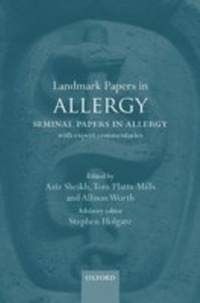
Landmark Papers in Allergy: Seminal Papers in Allergy with Expert Commentaries
Seminal Papers in Allergy with Expert Commentaries
1st Edition
Published on 28. February 2013
360 pages
978-0-19-166336-9 (ISBN)
Description

The increasing incidence and prevalence of allergic disease worldwide is one of the most remarkable phenomena of the past 50 years. One in three people in developed countries will experience an allergic condition at some point in their lives and advances in understanding the causes of this trend, and in allergy treatment and care, have captured the imagination of scientists, clinicians and the public. Landmark Papers in Allergy is a definitive collection of over 90 papers charting key discoveries and scientific advances in relation to allergy and the development of treatment and care for allergic disorders. Comprehensive in its coverage, the book includes the first clear descriptions of allergic diseases, the major advances in treatments, such as the discovery of antihistamines, cortisone, biological therapies and immunotherapy, the great immunological advances, such as thediscovery of immunoglobulin E (IgE) and leukotrienes, the possible factors behind the increase in allergy, such as the house dust mite, changes in hygiene and diet, and the growing understanding of the social, psychological and quality-of-life consequences of allergy. Including authoritative commentaries from leading international experts providing reflections on the historical importance and current relevance of each landmark paper, Landmark papers in Allergy is essential reading for any clinician or academic with an interest in allergy.
More details
Other editions
Additional editions
Aziz Sheikh | Thomas Platts-Mills | Allison Worth
Landmark Papers in Allergy
Seminal Papers in Allergy with Expert Commentaries
Book
02/2013
Oxford University Press
€140.50
Shipment within 15-20 days
Content
- Cover
- Contents
- Abbreviations
- Contributors
- Timeline
- Section I: 1800-1899
- 1 Did Bostock discover allergic rhinitis?
- Case of a periodical affection of the eyes and chest (1819)
- 2 Early insights into the characteristics of asthma
- An analysis of a hundred and fifty unpublished cases of asthma No 1. The influence of sex and age in determining the liability to asthma (1866)
- 3 Identifying asthma triggers
- An analysis of a hundred and fifty unpublished cases of asthma No 2. On the immediate excitants of the asthmatic paroxysm (1866)
- 4 Innovative experiments which helped to unravel the aetiological basis of hay fever
- Experimental researches on the causes and nature of catarrhus aestivus (hay-fever and hay-asthma) (1873)
- 5 Could two very different conditions share a similar pathophysiology?
- Bronchial asthma in the principles and practice of medicine (1892)
- Section II: 1900-1949
- 6 What's in a name? First use of the term 'allergy'
- Allergie (1906)
- 7 An innovative treatment for food allergy
- A case of egg poisoning (1908)
- 8 Laying the foundation for specific immunotherapy
- Prophylactic inoculation against hay fever (1911)
- 9 Celebrating the case study: Schloss' description of atopic dermatitis
- A case of allergy to common foods (1912)
- 10 Richet's Nobel Lecture
- Anaphylaxis: Nobel Lecture (1913)
- 11 A serendipitous discovery
- The anaphylactic reaction of plain muscle in the guinea-pig (1913)
- 12 Cooke's early insights into the potentially curative role of immunotherapy for hay fever
- The treatment of hay fever by active immunization (1915)
- 13 Does eczema have an allergic aetiology?
- Cutaneous reaction from proteins in eczema (1916)
- 14 . . . and what about angioedema and urticaria?
- Causation of eczema, urticaria, and angioneurotic edema by proteins other than those derived from food: study xviii (1918)
- 15 Prausnitz, Küstner, and the first diagnostic test for allergy
- Studies on supersensitivity (1921)
- 16 Introducing atopy
- On the classification of the phenomena of hypersensitiveness (1923)
- 17 Ephedra-laying the foundations for modern autonomic pharmacology
- The action of ephedrine, the active principle of the Chinese drug Ma Huang (1924)
- 18 First attempts to unravel the relationship between diet and allergy
- The influence of breast and artificial feeding on infantile eczema (1936)
- 19 Demonstrating serological changes induced by ragweed extract
- Studies on immunity in a type of human allergy (hay fever): serologic response of non-sensitive individuals to pollen injections (1937)
- 20 Bovet's Nobel Prize-winning discovery of antihistamines
- Action protectrice des éthers phénoliques au cours de l'intoxication histaminique (Protective action of phenolic ethers on the course of histamine intoxication) (1937)
- 21 Identification of slow-reacting substance
- The liberation of a slow-reacting smooth muscle-stimulating substance in anaphylaxis (1940)
- 22 Oral allergy syndrome
- Studies in food allergy: II. Sensitization to fresh fruits: clinical and experimental observations (1942)
- Section III: 1950-1999
- 23 In praise of famous men: early cortisone studies
- The effect of cortisone on bronchial asthma and hay fever occurring in subjects sensitive to ragweed pollen (1950)
- 24 The relationship between mast cells and histamine
- The presence of histamine in tissue mast cells (1953)
- 25 What goes round comes around: developing allergen immunotherapy
- Prophylaxis of summer hay-fever and asthma: a controlled trial comparing crude grass-pollen extract with the isolated main protein component (1954)
- 26 Burnet, clonal selection theory, and acquired immunological tolerance
- Auto-immune disease. I. Modern immunological concepts (1959)
- 27 Slow-reacting substance of anaphylaxis
- The release of histamine and formation of a slow-reacting substance (SRS-A) during anaphylactic shock (1960)
- 28 Loveless and wasp-venom immunotherapy
- Immunization in wasp-sting allergy through venom repositories and periodic stings (1962)
- 29 Developing an understanding of mast cell biology
- Mechanisms of immunologic injury of rat peritoneal mast cells (1966)
- 30 Disodium cromoglycate for allergic asthma
- A double-blind trial of disodium cromoglycate in the treatment of allergic bronchial asthma (1967)
- 31 Ancient Egyptian soup for treating asthma: Cox and Intal
- Disodium cromoglycate (FPL 670) ('Intal'): a specific inhibitor of reaginic antibody-antigen mechanisms (1967)
- 32 RAST: Iconic test for allergic sensitization
- Diagnosis of allergy by an in-vitro test for allergen antibodies (1967)
- 33 The discovery of IgE
- Identification of ?E-antibodies as a carrier of reaginic activity (1967) and Gunnar Johansson and Hans Bennich: Studies on a new class of human immunoglobulins. I. Immunological properties (1967)
- 34 Penicillin allergy: a model for practical clinical translational science
- The relationship between direct immediate skin tests and passive transfer tests in man: studies in the penicillin allergy system (1967)
- 35 Unravelling the relationship between Dermatophagoides pteronyssinus and asthma
- The house-dust mite (Dermatophagoides pteronyssinus) and the allergens it produces. Identity with the house-dust allergen (1967)
- 36 The Gell-Coombs classification
- Classification of allergic reactions responsible for clinical hypersensitivity and disease (1968)
- 37 The dawn of molecular allergology
- Immunoglobulin E, a new class of human immunoglobulin (1968)
- 38 Immunotherapy can change the natural history of respiratory allergy
- The value of hyposensitization therapy for bronchial asthma in children: a 14-year study (1968)
- 39 Anatomy of the asthmatic bronchi
- A comparison of the quantitative anatomy of the bronchi in normal subjects, in status asthmaticus, in chronic bronchitis, and in emphysema (1969)
- 40 Identifying a novel cause of occupational allergy
- Pulmonary disease due to inhalation of derivatives of Bacillus subtilis containing proteolytic enzyme (1969)
- 41 Delayed hypersensitivity to pollen allergens
- Cell-mediated (delayed) hypersensitivity in patients with summer hay fever (1969)
- 42 Inhaled beclomethasone dipropionate: stepping-up asthma care
- Beclomethasone dipropionate: a new steroid aerosol for the treatment of allergic asthma (1972)
- 43 Challenging notions of the 'atopic personality'
- Infantile eczema (1976)
- 44 Establishing and investigating the relationship between food allergy and asthma
- Objective clinical and laboratory studies of immediate hypersensitivity reactions to foods in asthmatic children (1976)
- 45 The histamine-inhalational test
- Bronchial reactivity to inhaled histamine: a method and clinical survey (1977)
- 46 Allergic reactions to colloid infusions-another chapter in the colloid debate
- Incidence and severity of anaphylactoid reactions to colloid volume substitutes (1977)
- 47 Total and specific IgE and allergic bronchopulmonary aspergillosis
- Evidence that Aspergillus fumigatus growing in the airway of man can be a potent stimulus of specific and nonspecific IgE formation (1977)
- 48 Immunotherapy for venom allergy comes of age
- A controlled trial of immunotherapy in insect hypersensitivity (1978)
- 49 Extending the evidence for immunotherapy to the management of children with house-dust-mite-triggered asthma
- Controlled trial of hyposensitisation to Dermatophagoides pteronyssinus in children with asthma (1978)
- 50 Insights from Xhosa children into environmental risk factors for the development of asthma
- Prevalence of asthma: a comparative study of urban and rural Xhosa children (1979)
- 51 Viral infection, allergic sensitization, and asthma
- Development of allergy in children: I. association with virus infections (1979)
- 52 Immune responses in atopic eczema
- Basophils in allergen-induced patch test sites in atopic dermatitis (1982)
- 53 Understanding the relationship between atopic sensitization and airway hyperresponsiveness in asthma
- Allergen-induced increase in bronchial responsiveness to histamine: relationship to the late asthmatic response and change in airway caliber (1982)
- 54 Key insights into the relationship between food allergy and atopic dermatitis
- Role of immediate food hypersensitivity in the pathogenesis of atopic dermatitis (1983)
- 55 From slow-reacting substance of anaphylaxis to anti-leukotrienes
- Leukotrienes: mediators of immediate hypersensitivity reactions and inflammation (1983)
- 56 Once more unto the breach: the role of the damaged bronchial epithelium in asthma
- Damage of the airway epithelium and bronchial reactivity in patients with asthma (1985)
- 57 Management of anaphylactic shock
- Clinical observations on the pathophysiology and treatment of anaphylactic cardiovascular collapse (1986)
- 58 The hygiene hypothesis
- Hay fever, hygiene, and household size (1989)
- 59 In search of the elixir for childhood allergy and asthma prevention
- Exposure to house-dust mite allergen (Der p I) and the development of asthma in childhood (1990)
- 60 A new way of considering 'quality of life'
- Development and testing of a new measure of health status for clinical trials in rhinoconjunctivitis (1991)
- 61 Food allergy and anaphylaxis
- Fatal and near-fatal anaphylactic reactions to food in children and adolescents (1992)
- 62 Allergen avoidance: the Isle of Wight study
- Effect of allergen avoidance on development of allergic disorders in infancy (1992)
- 63 Introducing sputum counts
- Use of induced sputum cell counts to investigate airway inflammation in asthma (1992)
- 64 Atopic asthma is a TH2-cell-mediated disease
- Predominant TH2-like bronchoalveolar T-lymphocyte population in atopic asthma (1992)
- 65 Investigating the impact of hay fever on educational performance
- Seasonal allergic rhinitis and antihistamine effects on children's learning (1992)
- 66 Findings from an early peanut immunotherapy trial
- Treatment of peanut allergy with rush immunotherapy (1992)
- 67 Auto-immune mechanisms in chronic urticaria
- Autoantibodies against the high-affinity IgE receptor as a cause of histamine release in chronic urticaria (1993)
- 68 Air pollution, mortality, and the need for public health policy
- An association between air pollution and mortality in six US cities (1993)
- 69 The geography of asthma and atopy: after the Berlin wall came down
- Prevalence of asthma and atopy in two areas of West and East Germany (1994)
- 70 The role of animal allergens in allergic disease
- Quantitative assessment of exposure to dog (Can f 1) and cat (Fel d 1) allergens: Relation to sensitization and asthma among children living in Los Alamos, New Mexico (1995)
- 71 The natural history of wheezing: the Tucson cohort
- Asthma and wheezing in the first six years of life (1995)
- 72 Measuring food-specific IgE values
- Relationship between food-specific IgE concentrations and the risk of positive food challenges in children and adolescents (1997)
- 73 Tuberculosis exposure and atopy
- The inverse association between tuberculin responses and atopic disorder (1997)
- 74 The inner-city home environment and asthma
- The role of cockroach allergy and exposure to cockroach allergen in causing morbidity among inner-city children with asthma (1997)
- 75 Mapping the burden of allergic disease in childhood: ISAAC
- Worldwide variation in prevalence of symptoms of asthma, allergic rhinoconjunctivitis, and atopic eczema: ISAAC (1998)
- 76 The relationship between obesity and asthma
- Prospective study of body mass index, weight change, and risk of adult-onset asthma in women (1999)
- 77 The emergence of monoclonal antibodies
- Treatment of allergic asthma with monoclonal anti-IgE antibody (1999)
- 78 The renaissance in allergen immunotherapy
- Long-term clinical efficacy of grass-pollen immunotherapy (1999)
- 79 Pet exposure in early life and the development of allergy and asthma
- Does early exposure to cat or dog protect against later allergy development? (1999)
- Section IV: 2000-2012
- 80 Predicting the development of childhood asthma
- A clinical index to define risk of asthma in young children with recurrent wheezing (2000)
- 81 Role of eosinophils in asthma
- Effects of an interleukin-5 blocking monoclonal antibody on eosinophils, airway hyperresponsiveness, and the late asthmatic response (2000)
- 82 Learning from anaphylaxis fatalities
- Lessons for management of anaphylaxis from a study of fatal reactions (2000)
- 83 Peanut allergy and quality of life
- The psychological burden of peanut allergy as perceived by adults with peanut allergy and the parents of peanut-allergic children (2000)
- 84 The Janus face of endotoxin: for good and bad?
- Relation between house-dust endotoxin exposure, type 1 T-cell development, and allergen sensitisation in infants at high risk of asthma (2000)
- 85 Testing the 'hygiene hypothesis': probiotics for the primary prevention of atopic eczema
- Probiotics in primary prevention of atopic disease: a randomised, placebo-controlled trial (2001)
- 86 The impact of food allergy on health-related quality of life
- The impact of childhood food allergy on quality of life (2001)
- 87 Does idiopathic eosinophilic esophagitis have an allergic aetiology?
- Idiopathic eosinophilic esophagitis is associated with a TH2-type allergic inflammatory response (2001)
- 88 Dawn of the genomic age for asthma
- Association of the ADAM33 gene with asthma and bronchial hyperresponsiveness (2002)
- 89 Endotoxins, allergy, and tolerance
- Environmental exposure to endotoxin and its relation to asthma in school-age children (2002)
- 90 Inherited skin-barrier defects and risk of developing 'atopic' eczema
- Common loss-of-function variants of the epidermal barrier protein filaggrin are a major predisposing factor for atopic dermatitis (2006)
- 91 Anti-IgE: biologicals reach the inner cities
- Randomized trial of omalizumab (anti-IgE) for asthma in inner-city children (2011)
- Section V: Conclusions
- 92 From the 18th to the 21st century, and beyond . . .
- Index
- A
- B
- C
- D
- E
- F
- G
- H
- I
- J
- K
- L
- M
- N
- O
- P
- Q
- R
- S
- T
- U
- V
- W
- X
- Z
