

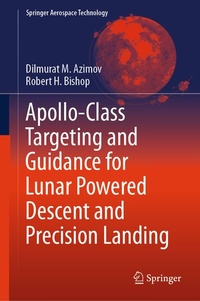
Apollo-Class Targeting and Guidance for Lunar Powered Descent and Precision Landing
Description

This book explores the reconstruction, extension, and enhancement of the Apollo targeting and guidance algorithms, integrating original guidance concepts with new analytical solutions. It details the Apollo ground-based and on-board algorithms, their iterative targeting procedures, and their performance in post-flight mission reconstructions. The book further introduces advanced real-time targeting methods that improve landing accuracy and autonomy, supporting future robotic and human lunar landing missions. By eliminating iterative computations, these solutions enable real-time re-targeting during powered descent, ensuring safer and more precise landings. This work bridges past Apollo-era methods with modern advancements, making it essential for undergraduate and graduate students, aerospace engineers, researchers, and mission designers.
More details
Other editions
Additional editions
Persons
Dilmurat Azimov is a Professor of Mechanical Engineering at the University of Hawaii at Manoa. His research focuses on space trajectory optimization, guidance, navigation and control (GNC), optimal control, and orbit determination using observations for astrodynamics applications. His expertise includes analytical solutions for optimal control problems and applying them to mission design and to the implementation of guidance, control and targeting schemes for aerospace vehicles, including unmanned aerial vehicles (UAVs).
Dr. Bishop is the Vice Chancellor for Engineering at the Texas A&M System, Dean of Engineering at Texas A&M University, and Director of the Texas A&M Engineering Experiment Station. He is a full professor in the Department of Aerospace Engineering. His research interests include systems theory, guidance and control of spacecraft, navigation and estimation, with a special focus on small satellites and planetary precision landing.
Content
Reconstruction of Apollo Ground-based Targeting and On-board Guidance for Powered Descent.- Introduction.- Apollo Descent and Landing Maneuver.- Apollo Lunar Descent and Landing Guidance.- Mathematical Preliminaries.- Approach-Phase Ground-based Targeting.- Braking-Phase Targeting.- P63 Ignition Algorithm.- P63-64 Powered Descent Guidance.- P66 Lunar-landing Guidance.- Simulations and Comparison Analyses.- Integrated Apollo-Class Real-Time Targeting and Guidance for Powered Descent.- Extension and Enhancement of Apollo Guidance.- Optimal Control Problem and Extremals.- Extension of Braking-phase Targeting.- Simulations of Braking Phase using Analytical Solutions.- Real-time Targeting and Re-targeting.- Landing Accuracy.- Conclusions.
