

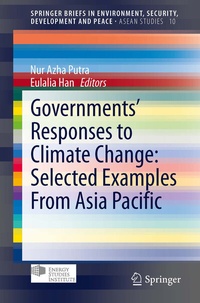
Governments' Responses to Climate Change: Selected Examples From Asia Pacific
Description

This multidisciplinary volume articulates the current and potential public policy discourse between energy security and climate change in the Asia-Pacific region, and the efforts taken to address global warming. This volume is unique as it analyses two important issues climate change and energy security through the lens of geopolitics at the intersection of energy security. It elaborates on the current and potential steps taken by state and non-state actors, as well as the policy innovations and diplomatic efforts (bilateral and multilateral, including regional) that states are pursuing. This Brief stems from the assumption that its audience is aware of the consequences of climate change, and will therefore, only look at the issues identified. It provides a useful read and reference for a wide-range of scholars, policymakers, researchers and post-graduate students.
Reviews / Votes
"Each chapter provides historical context along with discussion of international committees, state policies, energy and economic issues, and environmental impacts of climate policies. . This book is useful for policy-makers, researchers and scholars in presenting energy and climate issues being faced by states in a globalized economy. It provides a persuasive comparative analysis of how Asia-Pacific governments are working to change policies and business practices in an effort to benefit current and future climate conditions." (Nicole Gerber, Natural Hazards Observer, Vol. 34 (5), 2015)
More details
Other editions
Additional editions
Persons
Nur Azha Putra (Singapore) is research associate at the Energy Security Division of the Energy Studies Institute, National University of Singapore. He was previously associate research fellow at the Centre for Non--Traditional Security (NTS) Studies at the S. Rajaratnam School of International Studies, Nanyang Technological University (NTU), Singapore, where he was the lead researcher and coordinator of the Energy Security and NTS Plus programmes, and also led the research on a range of other NTS issues. He holds an MSc in international political economy from NTU, and a Bachelor of Information Technology from Central Queensland University, Australia. Nur Azha Putra is also the co--editor of the volumes on Rethinking Energy Security in Asia: A Non--Traditional Security Perspective, and Energy and Non--Traditional Security in Asia.
Eulalia Han (Ph.D) is a Research Fellow at the Energy Security Division of the Energy Studies Institute, National University of Singapore. She holds a Ph.D in International Relations from Griffith University and a BA in Political Science and International Relations (Class 1 Honours) from the University of Queensland. She has lectured, tutored and designed course materials for undergraduate students and also worked as a Policy Officer with the Department of Emergency Services in Queensland, Australia. Her publications include journal articles in the Australian Journal of Political Science and Media International Australia.
