

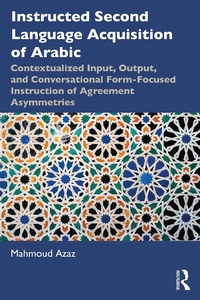
Instructed Second Language Acquisition of Arabic
Contextualized Input, Output, and Conversational Form-Focused Instruction of Agreement Asymmetries
1st Edition
Published on 26. July 2023
182 pages
978-1-000-91182-4 (ISBN)
Description

Instructed Second Language Acquisition of Arabic examines the acquisition of agreement asymmetries in the grammatical system of Arabic as a second/foreign language through the lens of instructed second language acquisition.
The book explores how to improve the processes of L2 learning of Arabic using evidence-based classroom research. Before it does this, it characterizes the variable challenges that English L2 learners of Arabic face when they acquire four structural cases in Arabic grammar that entail agreement asymmetries. Using the pretest-posttest design, it examines the effects of four classroom interventions using quantitative and qualitative measures. In these interventions, form-based and meaning-based measures were used to reveal to what degree learners have developed explicit and implicit knowledge of these aspects of asymmetry. In the concluding chapter, the book provides focused and specific implications based on the results of the four studies. It provides theoretical implications that enrich the discussions of instructed second language Acquisition in Arabic and other languages more broadly. It also provides implications for teachers, curriculum designers, and textbook writers of Arabic.
This book will be informative for Arabic applied linguists, researchers of Arabic SLA, Arabic instructors (at the K-12 and the college level), and Arabic program directors and coordinators. The book will also appeal to all SLA and ISLA researchers.
The book explores how to improve the processes of L2 learning of Arabic using evidence-based classroom research. Before it does this, it characterizes the variable challenges that English L2 learners of Arabic face when they acquire four structural cases in Arabic grammar that entail agreement asymmetries. Using the pretest-posttest design, it examines the effects of four classroom interventions using quantitative and qualitative measures. In these interventions, form-based and meaning-based measures were used to reveal to what degree learners have developed explicit and implicit knowledge of these aspects of asymmetry. In the concluding chapter, the book provides focused and specific implications based on the results of the four studies. It provides theoretical implications that enrich the discussions of instructed second language Acquisition in Arabic and other languages more broadly. It also provides implications for teachers, curriculum designers, and textbook writers of Arabic.
This book will be informative for Arabic applied linguists, researchers of Arabic SLA, Arabic instructors (at the K-12 and the college level), and Arabic program directors and coordinators. The book will also appeal to all SLA and ISLA researchers.
More details
Edition
1. Auflage
Language
English
Place of publication
London
United Kingdom
Publishing group
Taylor & Francis Ltd
Target group
Professional and scholarly
Illustrations
149 Tables, black and white
ISBN-13
978-1-000-91182-4 (9781000911824)
Copyright in bibliographic data and cover images is held by Nielsen Book Services Limited or by the publishers or by their respective licensors: all rights reserved.
Schweitzer Classification
Other editions
Additional editions
Mahmoud Azaz
Instructed Second Language Acquisition of Arabic
Contextualized Input, Output, and Conversational Form-Focused Instruction of Agreement Asymmetries
Book
07/2023
1st Edition
Routledge
€52.60
Shipment within 15-20 days
Mahmoud Azaz
Instructed Second Language Acquisition of Arabic
Contextualized Input, Output, and Conversational Form-Focused Instruction of Agreement Asymmetries
Book
07/2023
1st Edition
Routledge
€195.10
Shipment within 15-20 days
Person
Mahmoud Azaz is Associate Professor of Arabic Language, Linguistics and Pedagogy and Second Language Acquisition and Teaching, and Distinguished Fellow at the University of Arizona. He is the Director of Graduate Studies at the School of Middle Eastern and North African Studies and the chair of the instructional dimension in the PhD program in Second Language Acquisition and Teaching.
Content
Acknowledgments
Abbreviations
Transliteration Symbols
About the Author
Introduction
Chapter 1: Agreement Symmetries and Asymmetries in Standard Arabic
Chapter 2: The Academic Discipline of Instructed Second Language Acquisition
Chapter 3: Instructed Second Language Acquisition of Noun-Adjective Agreement Asymmetries
Chapter 4: Instructed Second Language Acquisition of Referential Asymmetries
Chapter 5: Instructed Second Language Acquisition of Subject-Verb Agreement Asymmetries
Chapter 6: Instructed Second Language Acquisition of Numeric Agreement Asymmetries
Chapter 7: Theoretical and Pedagogical Implications
References
Appendices
Index
Abbreviations
Transliteration Symbols
About the Author
Introduction
Chapter 1: Agreement Symmetries and Asymmetries in Standard Arabic
Chapter 2: The Academic Discipline of Instructed Second Language Acquisition
Chapter 3: Instructed Second Language Acquisition of Noun-Adjective Agreement Asymmetries
Chapter 4: Instructed Second Language Acquisition of Referential Asymmetries
Chapter 5: Instructed Second Language Acquisition of Subject-Verb Agreement Asymmetries
Chapter 6: Instructed Second Language Acquisition of Numeric Agreement Asymmetries
Chapter 7: Theoretical and Pedagogical Implications
References
Appendices
Index
