

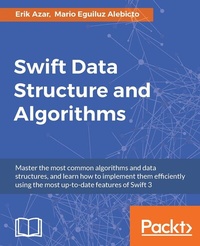
Swift Data Structure and Algorithms
Implement Swift structures and algorithms natively
Published on 8. July 2025
286 pages
978-1-78588-465-8 (ISBN)
Description

Master the most common algorithms and data structures, and learn how to implement them efficiently using the most up-to-date features of Swift 3
Key Features
[*] Develop a deep understanding of the collections in the Swift Standard Library with this step-by-step guide
[*] Develop native Swift data structures and algorithms for use in mobile, desktop, and server-based applications
[*] Learn about performance efficiency between different data structures and algorithms
Book DescriptionApple's Swift language has expressive features that are familiar to those working with modern functional languages, but also provides backward support for Objective-C and Apple's legacy frameworks. These features are attracting many new developers to start creating applications for OS X and iOS using Swift. Designing an application to scale while processing large amounts of data or provide fast and efficient searching can be complex, especially running on mobile devices with limited memory and bandwidth. Learning about best practices and knowing how to select the best data structure and algorithm in Swift is crucial to the success of your application and will help ensure your application is a success. That's what this book will teach you. Starting at the beginning, this book will cover the basic data structures and Swift types, and introduce asymptotic analysis. You'll learn about the standard library collections and bridging between Swift and Objective-C collections. You will see how to implement advanced data structures, sort algorithms, work with trees, advanced searching methods, use graphs, and performance and algorithm efficiency. You'll also see how to choose the perfect algorithm for your problem. What you will learn
[*] Get to know about the basic data structures and how to use the Swift REPL
[*] Use the Swift Standard Library collections bridging to Objective-C collections, and find out about protocol-oriented programming
[*] Find out about Swift generators and sequences, and see how to use them to implement advanced data structures such as Stack, StackList, Queue, and LinkedList
[*] Implement sorting algorithms such as Insertion Sort, Merge Sort, and Quick Sort and understand the performance trade-offs between them
[*]See how to implement various binary trees, B-Tree, and Splay Trees
[*] Perform advanced searching methods using Red-Black trees, AVL trees, and Trie trees, and take a look at several substring search algorithms
[*] Get to know about the data structures used in graphs and how to implement graphs such as depth-first search, breadth-first search, directed graphs, spanning tree, and shortest path
[*] Explore algorithm efficiency and see how to measure it
Who this book is forThis book is for developers who want to learn how to implement and use common data structures and algorithms natively in Swift. Whether you are a self-taught developer without a formal technical background or you have a degree in Computer Science, this book will provide with the knowledge you need to develop advanced data structures and algorithms in Swift using the latest language features.
Key Features
[*] Develop a deep understanding of the collections in the Swift Standard Library with this step-by-step guide
[*] Develop native Swift data structures and algorithms for use in mobile, desktop, and server-based applications
[*] Learn about performance efficiency between different data structures and algorithms
Book DescriptionApple's Swift language has expressive features that are familiar to those working with modern functional languages, but also provides backward support for Objective-C and Apple's legacy frameworks. These features are attracting many new developers to start creating applications for OS X and iOS using Swift. Designing an application to scale while processing large amounts of data or provide fast and efficient searching can be complex, especially running on mobile devices with limited memory and bandwidth. Learning about best practices and knowing how to select the best data structure and algorithm in Swift is crucial to the success of your application and will help ensure your application is a success. That's what this book will teach you. Starting at the beginning, this book will cover the basic data structures and Swift types, and introduce asymptotic analysis. You'll learn about the standard library collections and bridging between Swift and Objective-C collections. You will see how to implement advanced data structures, sort algorithms, work with trees, advanced searching methods, use graphs, and performance and algorithm efficiency. You'll also see how to choose the perfect algorithm for your problem. What you will learn
[*] Get to know about the basic data structures and how to use the Swift REPL
[*] Use the Swift Standard Library collections bridging to Objective-C collections, and find out about protocol-oriented programming
[*] Find out about Swift generators and sequences, and see how to use them to implement advanced data structures such as Stack, StackList, Queue, and LinkedList
[*] Implement sorting algorithms such as Insertion Sort, Merge Sort, and Quick Sort and understand the performance trade-offs between them
[*]See how to implement various binary trees, B-Tree, and Splay Trees
[*] Perform advanced searching methods using Red-Black trees, AVL trees, and Trie trees, and take a look at several substring search algorithms
[*] Get to know about the data structures used in graphs and how to implement graphs such as depth-first search, breadth-first search, directed graphs, spanning tree, and shortest path
[*] Explore algorithm efficiency and see how to measure it
Who this book is forThis book is for developers who want to learn how to implement and use common data structures and algorithms natively in Swift. Whether you are a self-taught developer without a formal technical background or you have a degree in Computer Science, this book will provide with the knowledge you need to develop advanced data structures and algorithms in Swift using the latest language features.
All prices
More details
Edition
Digital original
Language
English
Place of publication
Birmingham
United Kingdom
Target group
Professional and scholarly
US School Grade: College Graduate Student
Edition type
Digital original
File size
8,34 MB
ISBN-13
978-1-78588-465-8 (9781785884658)
Copyright in bibliographic data and cover images is held by Nielsen Book Services Limited or by the publishers or by their respective licensors: all rights reserved.
Schweitzer Classification
Other editions
Additional editions
Erik Azar | Mario Eguiluz Alebicto
Swift Data Structure and Algorithms
Book
11/2016
Packt Publishing
€51.00
Shipment within 3-4 weeks
Persons
Alebicto Mario Eguiluz :
Mario Eguiluz Alebicto is a software engineer with over 15 years of experience in development. He started developing software with Java, later switched to Objective-C when the first iPhone delighted the world, and now, he is working with Swift and involved in backend technologies. He loves to code, build exciting projects, and learn new languages and frameworks. Apart from software development, Mario loves to travel, learn new hobbies, practice sports, and considers himself a hardcore gamer, which he has been since he was a child.
Mario Eguiluz Alebicto is a software engineer with over 15 years of experience in development. He started developing software with Java, later switched to Objective-C when the first iPhone delighted the world, and now, he is working with Swift and involved in backend technologies. He loves to code, build exciting projects, and learn new languages and frameworks. Apart from software development, Mario loves to travel, learn new hobbies, practice sports, and considers himself a hardcore gamer, which he has been since he was a child.
Content
Table of Contents
Walking Across the Playground
Working with Commonly Used Data Structures
Standing on the Shoulders of Giants
Sorting Algorithms
Seeing the Forest Through the Tree
Advanced Searching Methods
Graph Algorithms
Performance and Algorithm Efficiency
Choosing the Perfect Algorithm
Walking Across the Playground
Working with Commonly Used Data Structures
Standing on the Shoulders of Giants
Sorting Algorithms
Seeing the Forest Through the Tree
Advanced Searching Methods
Graph Algorithms
Performance and Algorithm Efficiency
Choosing the Perfect Algorithm

