

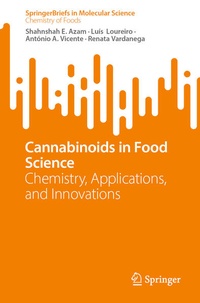
Cannabinoids in Food Science
Description

This book offers an overview of cannabinoids, from their chemical structures and biosynthesis to their applications in medicine, food, and beyond. It bridges the gap between historical uses and cutting-edge science, providing a detailed look at phytocannabinoids, endocannabinoids, and synthetic cannabinoids. With a special focus on food applications, the book examines how cannabinoids are being integrated into innovative food products, exploring their functional benefits, bioavailability, and regulatory challenges. It highlights the potential of cannabinoids as ingredients in functional foods and beverages, offering insights into industrial processes and the future of cannabinoid-enriched products. With clear explanations of cannabinoid metabolism, the endocannabinoid system, and advanced analytical techniques, this book also addresses emerging trends, legal considerations, and future opportunities. It is an invaluable resource for researchers, industry professionals, and students in chemistry, biology, and pharmacology.
More details
Other editions
Additional editions
Persons
Renata Vardanega is a food engineering specialist with expertise in cannabinoids in food science. She holds a Master's and Ph.D. in Food Engineering from Universidade Estadual de Campinas (Brazil) and has published over 60 scientific works, including articles, reviews, and book chapters. Her research focuses on food technology, process engineering, and innovative strategies to improve cannabinoid bioavailability in edible products. Dr. Vardanega is the inventor of two patents, recipient of four UNICAMP Inventors Awards, and has led international projects such as a Marie Sklodowska-Curie Postdoctoral Project.
Shahnshah E Azam holds a bachelor's and master's degree in food science and technology from Pakistan. He is currently pursuing a Ph. D. in Chemical and Biological Engineering at the University of Minho, Portugal. His research focuses on the development of advanced oral delivery systems to improve and modulate cannabinoid absorption, with a particular emphasis on food-grade self-nanoemulsifying drug delivery systems to enhance cannabinoid bioavailability. He has published five research papers and completed two projects during the early stage of his doctoral studies.
António A. Vicente graduated in Food Engineering. He is a Professor in the Department of Biological Engineering at the University fo Minho (Portugal), and has dedicated his work to the development of micro and nanotechnological systems for application in the Agro-food sector, to the evaluation of their behavior in dynamic in vitro digestion systems, among other thematics. He has published 400+ articles, 30+ book chapters and 5 patents, and edited 5 scientific books. Since 2020 he is included in the top 2 % most cited researchers list published by Stanford University.
Luís Loureiro is a biochemist and food science researcher with expertise in innovative processing technologies. He holds an MSc. in Applied Biochemistry and a Ph.D. in Food Science, Technology, and Nutrition from the University of Minho (Portugal). His research focuses on extraction and functionalization of bioactive compounds and sustainable strategies for zero-waste and circular economy in food systems. Dr. Loureiro has published 11 articles and contributed to national and international projects.
Content
Introduction.- Chemical composition, classification, and metabolism of cannabinoids.- Extraction of cannabinoids.- Analytical techniques for identification and quantification of cannabinoids.- Practical aspects for the incorporation of cannabinoids in food products.
