

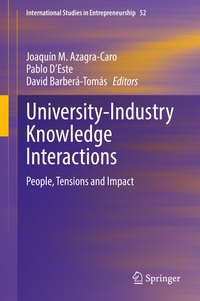
University-Industry Knowledge Interactions
Description

University-industry interaction combines several layers of actors, states and effects. People make choices, based on their individual characteristics, at different stages of a scientific career, in a highly internationalised profession. Tensions arise when university administrators and managers need to strike a balance among different promotion instruments, or when the university or public research organisation tries to solve the trade-offs between long- and short-term relationships, or among new management practices. Impacts are related to scientific agendas, the economic returns for firms or the societal benefits. This book adopts a people-tension-impact approach to identify key insights, by combining qualitative and quantitative research, established and novel methodologies, and different geographic settings. The chapters in this volume provide new perspectives on university-industry interactions related to gender biases, entrepreneurial involvement of PhD students and the role of international mobility. They also focus on how the positive impacts of university-industry interactions coexist with unresolved tensions linked to policy combinations, long-term contractual relationships, management practices and organisational strategies.
More details
Other editions
Additional editions
Persons
David Barberá-Tomás is Associate Professor in the Polytechnic University of Valencia (Spain), associated to INGENIO (CSIC-UPV). His academic research studies different areas of innovation, such as medical innovation, innovation policy, innovation in creative sectors, or innovation and social entrepreneurship.
Pablo D'Este
is a Senior Research Fellow at INGENIO (CSIC-Universitat Politècnica de València). He conducts research in the field of innovation studies covering topics such as university-business interactions and their impact on academic and business performance, academic entrepreneurship, knowledge networks and innovation, and medical innovation.
