

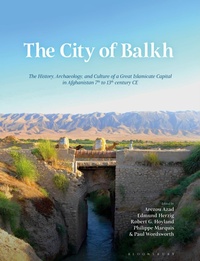
The City of Balkh
The History, Archaeology, and Culture of a Great Islamicate Capital in Afghanistan 7th to 13th Century Ce
Published on 28. May 2026
440 pages
978-1-78673-627-7 (ISBN)
Description

In the early Islamic age, the city of Balkh was one of the largest and most influential cities in the world. Situated on the northern plains of modern Afghanistan, Balkh flourished from the 7th to the 13th centuries, home to a wide variety of scholars, artists and religious leaders.
This book presents the first comprehensive analysis of the history and archaeology of early Islamic Balkh. Archaeological research undertaken throughout the twentieth century has investigated the evolution of the city, but only more recently has the evidence for its medieval development been pieced together. The authors collate and examine the available textual and artefactual material in order to recreate the history of this unique city and assess its critical role in early medieval Eurasia.
This book presents the first comprehensive analysis of the history and archaeology of early Islamic Balkh. Archaeological research undertaken throughout the twentieth century has investigated the evolution of the city, but only more recently has the evidence for its medieval development been pieced together. The authors collate and examine the available textual and artefactual material in order to recreate the history of this unique city and assess its critical role in early medieval Eurasia.
More details
Language
English
Place of publication
London
United Kingdom
Publishing group
Bloomsbury Publishing PLC
Target group
College/higher education
Professional and scholarly
Illustrations
100 Integrated Colour illus, 79 full page, 43 half page
File size
405,72 MB
ISBN-13
978-1-78673-627-7 (9781786736277)
Copyright in bibliographic data and cover images is held by Nielsen Book Services Limited or by the publishers or by their respective licensors: all rights reserved.
Schweitzer Classification
Other editions
Additional editions
Arezou Azad | Edmund Herzig | Robert G. Hoyland
The City of Balkh
The History, Archaeology, and Culture of a Great Islamicate Capital in Afghanistan 7th to 13th century CE
Book
approx. 06/2026
Bloomsbury Academic
€111.50
Not yet published
Persons
Arezou Azad holds the Chair in the Art and Heritage of Afghanistan at the Institut national des
langues et civilisations orientale in Paris and is Senior Research Fellow at the University of Oxford
and Director of the Invisible East programme.
Edmund Herzig is Masoumeh and Fereydoon Soudavar Professor of Persian Studies at the
University of Oxford and Professorial Fellow in Iranian Studies at Wadham College, Oxford.
Robert G. Hoyland is Professor of the Late Antique and Early Islamic History of the Middle East at
New York University's Institute for the Study of the Ancient World, having formerly taught at the
universities of Oxford and St Andrews.
Philippe Marquis was the Director of Délégation archéologique française en Afghanistan (DAFA).
Paul Wordsworth is a Lecturer in Silk Roads Archaeology and Heritage at University College
London, UK.
langues et civilisations orientale in Paris and is Senior Research Fellow at the University of Oxford
and Director of the Invisible East programme.
Edmund Herzig is Masoumeh and Fereydoon Soudavar Professor of Persian Studies at the
University of Oxford and Professorial Fellow in Iranian Studies at Wadham College, Oxford.
Robert G. Hoyland is Professor of the Late Antique and Early Islamic History of the Middle East at
New York University's Institute for the Study of the Ancient World, having formerly taught at the
universities of Oxford and St Andrews.
Philippe Marquis was the Director of Délégation archéologique française en Afghanistan (DAFA).
Paul Wordsworth is a Lecturer in Silk Roads Archaeology and Heritage at University College
London, UK.
Content
List of Figures
List of General Maps
List of Contributors
Note on Text
List of Abbreviations
1. Arezou Azad, Edmund Herzig, Robert Hoyland, Philippe Marquis and Paul Wordsworth Introduction
A. Between the Hindu Kush and the Amu Darya: Balkh in its Geographical Context
2. Paul Wordsworth, Connecting the Early Islamic City: Balkh in Geographical Networks
3. Philippe Marquis (with P. Barthélémy, J. Bendezu-Sarmiento, E. de la Vaissière, N. Engel, N. Rasouli, and Y. Ubelmann), The City of Balkh in the Context of the Oasis
4. Munira A. Salahetdinova, Towards a Historical Toponymy of the Balkh Region (translated by A. Qurboniev)
B. Becoming Islamic: Balkh Before, During, and After the Arab-Islamic Conquest
5. Etienne de la Vaissière, From Bactra to Balkh via Naw Bahar
6. Tasha Vorderstrasse, Imagining Balkh: The Chinese Perception of Central Asia during the Tang Dynasty
7. Robert Hoyland, Balkh in the Umayyad Period
C. Shrines, Palaces, and Gardens: Landscapes of Balkh from the Caliphate to the Ghaznavids
8. Arezou Azad, How a City is Made Holy
9. Hugh Kennedy, Balkh as a Capital of the Ghaznavid Sultanate during the Reign of Sultan Mas?ud (1030-41 CE)
10. Domenico Ingenito, Sultan Mahmud's New Garden in Balkh: An Exercise in Literary Archaeology for the Study of Ghaznavid Ephemeral Architecture
D. Archaeological Evidence for the Development of Balkh in the Early Islamic Period
11. Rachel Mairs, Alfred Foucher and the DAFA Excavations at Balkh (1924-25)
12. Chahryar Adle, The Mosque Haji Piyada/Nuh Gunbadan, Balkh (Afghanistan): A Masterpiece of Fadl al-Barmaki Constructed in 178-9/794-5? (translated by Kathleen Hughes)
13. Pierre Siméon and Nader Rasouli, Study of the Mediaeval and Modern Islamic Ceramics from Excavations in Balkh (ninth-eighteenth centuries CE)
14. Stefan Heidemann, The Settlement Pattern of Tepe Zargaran in Balkh: Coin Finds in Relation to Local History
Appendix 1: Drawings of ceramics from Balkh
Appendix 2: Photographs of ceramics from Balkh
Appendix 3: Fabrics of ceramics from Balkh
Appendix 4: Catalogue and photographs of the coins of Balkh
List of General Maps
List of Contributors
Note on Text
List of Abbreviations
1. Arezou Azad, Edmund Herzig, Robert Hoyland, Philippe Marquis and Paul Wordsworth Introduction
A. Between the Hindu Kush and the Amu Darya: Balkh in its Geographical Context
2. Paul Wordsworth, Connecting the Early Islamic City: Balkh in Geographical Networks
3. Philippe Marquis (with P. Barthélémy, J. Bendezu-Sarmiento, E. de la Vaissière, N. Engel, N. Rasouli, and Y. Ubelmann), The City of Balkh in the Context of the Oasis
4. Munira A. Salahetdinova, Towards a Historical Toponymy of the Balkh Region (translated by A. Qurboniev)
B. Becoming Islamic: Balkh Before, During, and After the Arab-Islamic Conquest
5. Etienne de la Vaissière, From Bactra to Balkh via Naw Bahar
6. Tasha Vorderstrasse, Imagining Balkh: The Chinese Perception of Central Asia during the Tang Dynasty
7. Robert Hoyland, Balkh in the Umayyad Period
C. Shrines, Palaces, and Gardens: Landscapes of Balkh from the Caliphate to the Ghaznavids
8. Arezou Azad, How a City is Made Holy
9. Hugh Kennedy, Balkh as a Capital of the Ghaznavid Sultanate during the Reign of Sultan Mas?ud (1030-41 CE)
10. Domenico Ingenito, Sultan Mahmud's New Garden in Balkh: An Exercise in Literary Archaeology for the Study of Ghaznavid Ephemeral Architecture
D. Archaeological Evidence for the Development of Balkh in the Early Islamic Period
11. Rachel Mairs, Alfred Foucher and the DAFA Excavations at Balkh (1924-25)
12. Chahryar Adle, The Mosque Haji Piyada/Nuh Gunbadan, Balkh (Afghanistan): A Masterpiece of Fadl al-Barmaki Constructed in 178-9/794-5? (translated by Kathleen Hughes)
13. Pierre Siméon and Nader Rasouli, Study of the Mediaeval and Modern Islamic Ceramics from Excavations in Balkh (ninth-eighteenth centuries CE)
14. Stefan Heidemann, The Settlement Pattern of Tepe Zargaran in Balkh: Coin Finds in Relation to Local History
Appendix 1: Drawings of ceramics from Balkh
Appendix 2: Photographs of ceramics from Balkh
Appendix 3: Fabrics of ceramics from Balkh
Appendix 4: Catalogue and photographs of the coins of Balkh
