

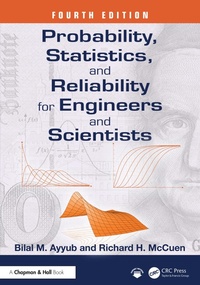
Probability, Statistics, and Reliability for Engineers and Scientists
4th Edition
Published on 12. May 2025
638 pages
978-1-040-30543-0 (ISBN)
Description

Virtually every engineer and scientist must be able to collect, analyze, interpret, and properly use vast arrays of data. This means acquiring a solid foundation in the methods of data analysis and synthesis. Understanding the theoretical aspects is important, but learning to properly apply the theory to real-world problems is essential.
The goal of this popular and proven book is to introduce the fundamentals of probability, statistics, reliability, and risk methods to engineers and scientists for the purpose of data and uncertainty analysis and modeling in support of decision-making.
The primary objectives to the author's approach include: (1) introducing probability, statistics, reliability, and risk methods to students and practicing professionals in engineering and the sciences; (2) emphasizing the practical use of these methods; and (3) establishing the limitations, advantages, and disadvantages of the methods. The book was developed with an emphasis on solving real-world technological problems that engineers and scientists are asked to solve as part of their professional responsibilities.
Upon graduation, engineers and scientists must have a solid academic foundation in methods of data analysis and synthesis, as the analysis and synthesis of complex systems are common tasks that confront even entry-level professionals.
The underlying theory, especially the assumptions central to the methods, is presented, but then the proper application of the theory is presented through realistic examples, often using actual data. Every attempt is made to show that methods of data analysis are not independent of each other. Instead, we show that real-world problem-solving often involves applying many of the methods presented in different chapters.
Probability, Statistics, and Reliability for Engineers and Scientists, here in its fourth edition, is a very popular textbook. Ultimately, readers will find its content of great value in problem-solving and decision-making, particularly in practical applications.
The goal of this popular and proven book is to introduce the fundamentals of probability, statistics, reliability, and risk methods to engineers and scientists for the purpose of data and uncertainty analysis and modeling in support of decision-making.
The primary objectives to the author's approach include: (1) introducing probability, statistics, reliability, and risk methods to students and practicing professionals in engineering and the sciences; (2) emphasizing the practical use of these methods; and (3) establishing the limitations, advantages, and disadvantages of the methods. The book was developed with an emphasis on solving real-world technological problems that engineers and scientists are asked to solve as part of their professional responsibilities.
Upon graduation, engineers and scientists must have a solid academic foundation in methods of data analysis and synthesis, as the analysis and synthesis of complex systems are common tasks that confront even entry-level professionals.
The underlying theory, especially the assumptions central to the methods, is presented, but then the proper application of the theory is presented through realistic examples, often using actual data. Every attempt is made to show that methods of data analysis are not independent of each other. Instead, we show that real-world problem-solving often involves applying many of the methods presented in different chapters.
Probability, Statistics, and Reliability for Engineers and Scientists, here in its fourth edition, is a very popular textbook. Ultimately, readers will find its content of great value in problem-solving and decision-making, particularly in practical applications.
More details
Edition
4th edition
Language
English
Place of publication
London
United Kingdom
Publishing group
Taylor & Francis Ltd
Target group
College/higher education
Professional and scholarly
Illustrations
141 Tables, black and white; 149 Line drawings, black and white; 149 Illustrations, black and white
File size
18,54 MB
ISBN-13
978-1-040-30543-0 (9781040305430)
Copyright in bibliographic data and cover images is held by Nielsen Book Services Limited or by the publishers or by their respective licensors: all rights reserved.
Schweitzer Classification
Other editions
Additional editions
Bilal M. Ayyub | Richard H. McCuen
Probability, Statistics, and Reliability for Engineers and Scientists
Book
05/2025
4th Edition
CRC Press
€213.20
Shipment within 10-20 days

Book
02/2025
CRC Press
Unfortunately, price unknown
Available (delivery time upon request)
Persons
Bilal M. Ayyub, PhD, PE, DistMASCE, HonMASME, is an A. James Clark School of Engineering Professor and Director of the Center for Technology and Systems Management at the University of Maryland, College Park and was a visiting fellow at the National Security Analysis Department of the Applied Physics Laboratory from 2015-2016. He was a chair professor at Tongji University, Shanghai, China (2016-2018) and is currently the Co-Director of its International Joint Research Center for Resilient Infrastructure. He completed his PhD and MSCE degrees from the Georgia Institute of Technology in 1983 and 1981, and BSCE from Kuwait University in 1980. Dr. Ayyub's main research interests and work are in risk, resilience, sustainability, uncertainty, and decision analysis, applied to civil, infrastructure, and energy. Professor Ayyub is also a fellow of the Society of Naval Architects and Marine Engineers (SNAME), the Structural Engineering Institute (SEI), and the Society for Risk Analysis (2017-018 Treasurer), and a senior member of the Institute of Electrical and Electronics Engineers (IEEE). Dr. Ayyub completed research and development projects for governmental and private entities worldwide. He is the recipient of several awards, most recently the 2024 ASCE OPAL Award for Education; the 2018 ASCE Alfredo Ang Award on Risk Analysis and Management of Civil Infrastructure; the 2019 ASCE President Medal for efforts to bring adaptive design to the profession to help address a changing climate; the 2019 ASCE Le Val Lund Award for contributions to resilience enhancement and risk reduction of lifeline-networked systems through measurement science and associated economics of informing policy and decision-making practices; the 2018 ENR Newsmaker Award for passionate efforts in giving engineers their first formal guidance to be more resilient to weather extremes when designing infrastructure; and the 2016 ASNE Solberg Award for significant engineering research and development accomplishments in the field of ship survivability. He is the author and co-author of more than 650 publications in journals, conference proceedings, and reports, and the founding editor-in-chief of the ASCEASME Journal on Risk and Uncertainty in Engineering Systems in its two parts on civil and mechanical engineering. In addition to 15 edited books, his eight textbooks include the following titles: Uncertainty Modeling and Analysis for Engineers and Scientists (Chapman & Hall/CRC 2006 with G. Klir), Risk Analysis in Engineering and Economics (Chapman & Hall/CRC 2003, 2014), Elicitation of Expert Opinions for Uncertainty and Risks (CRC Press 2002), and Numerical Methods for Engineers (Prentice Hall 1996 with McCuen, 2nd ed. Chapman & Hall/CRC 2016). Dr. Ayyub is an academician of the Georgian National Academy of Science, Tbilisi, Georgia, and serves on the National Oceanic and Atmospheric Administration (NOAA) Science Advisory Board, the National Academies Board of Environmental Change and Society, and the Roundtable on Macroeconomics and Climate Related Risks and Opportunities.
Richard H. McCuen, PhD, is an emeritus professor of civil and environmental engineering at the University of Maryland. He retired as the Ben Dyer Professor of Civil & Environmental Engineering (1998-2020). Dr. McCuen received a BSCE degree from Carnegie-Mellon University (1967) and MSCE and PhD (1971) degrees from the Georgia Institute of Technology. He was a faculty member at the University of Maryland for 49 years and served as Director of the Engineering Honors Program for more than 35 years. He is the author of 29 textbooks including Hydrologic Analysis and Design (4th ed., 2017), Modeling Hydrologic Change (2002), and Critical Thinking, Idea Innovation, and Creativity (2023). He received the 2015 Ven Te Chow Award for Research, Education, and Service from ASCE, the 1991 James M. Robbins Award for Excellence in Teaching from Chi Epsilon, the 2017 President's Outstanding Service Award from the AWRA, and the 1988 Icko Iben Award from the AWRA.
Richard H. McCuen, PhD, is an emeritus professor of civil and environmental engineering at the University of Maryland. He retired as the Ben Dyer Professor of Civil & Environmental Engineering (1998-2020). Dr. McCuen received a BSCE degree from Carnegie-Mellon University (1967) and MSCE and PhD (1971) degrees from the Georgia Institute of Technology. He was a faculty member at the University of Maryland for 49 years and served as Director of the Engineering Honors Program for more than 35 years. He is the author of 29 textbooks including Hydrologic Analysis and Design (4th ed., 2017), Modeling Hydrologic Change (2002), and Critical Thinking, Idea Innovation, and Creativity (2023). He received the 2015 Ven Te Chow Award for Research, Education, and Service from ASCE, the 1991 James M. Robbins Award for Excellence in Teaching from Chi Epsilon, the 2017 President's Outstanding Service Award from the AWRA, and the 1988 Icko Iben Award from the AWRA.
Content
IntroductionIntroduction
Knowledge, Information, and Opinions
Ignorance and Uncertainty
Aleatory and Epistemic Uncertainties in System Abstraction
Characterizing and Modeling Uncertainty
Simulation for Uncertainty Analysis and Propagation
Simulation Projects
Data Description and Treatment
Introduction
Classification of Data
Graphical Description of Data
Histograms and Frequency Diagrams
Descriptive Measures
Applications
Analysis of Simulated Data
Simulation Projects
Fundamentals of Probability
Introduction
Sets, Sample Spaces, and Events
Mathematics of Probability
Random Variables and Their Probability Distributions
Moments
Application: Water Supply and Quality
Simulation and Probability Distributions
Simulation Projects
Probability Distributions for Discrete Random Variables
Introduction
Bernoulli Distribution
Binomial Distribution
Geometric Distribution
Poisson Distribution
Negative Binomial and Pascal Probability Distributions
Hypergeometric Probability Distribution
Applications
Simulation of Discrete Random Variables
A Summary of Distributions
Simulation Projects
Probability Distributions for Continuous Random Variables
Introduction
Uniform Distribution
Normal Distribution
Lognormal Distribution
Exponential Distribution
Triangular Distribution
Gamma Distribution
Rayleigh Distribution
Beta Distribution
Statistical Probability Distributions
Extreme Value Distributions
Applications
Simulation and Probability Distributions
A Summary of Distributions
Simulation Projects
Multiple Random Variables
Introduction
Joint Random Variables and Their Probability Distributions
Functions of Random Variables
Modeling Aleatory and Epistemic Uncertainty
Applications
Multivariable Simulation
Simulation Projects
Simulation
Introduction
Monte Carlo Simulation
Random Numbers
Generation of Random Variables
Generation of Selected Discrete Random Variables
Generation of Selected Continuous Random Variables
Applications
Simulation Projects
Fundamentals of Statistical Analysis
Introduction
Properties of Estimators
Method-of-Moments Estimation
Maximum Likelihood Estimation
Sampling Distributions
Univariate Frequency Analysis
Applications
Simulation Projects
Hypothesis Testing
Introduction
General Procedure
Hypothesis Tests of Means
Hypothesis Tests of Variances
Tests of Distributions
Applications
Simulation of Hypothesis Test Assumptions
Simulation Projects
Analysis of Variance
Introduction
Test of Population Means
Multiple Comparisons in the ANOVA Test
Test of Population Variances
Randomized Block Design
Two-Way ANOVA
Experimental Design
Applications
Simulation Projects
Confidence Intervals and Sample-Size Determination
Introduction
General Procedure
Confidence Intervals on Sample Statistics
Sample Size Determination
Relationship between Decision Parameters and Types I and II Errors
Quality Control
Applications
Simulation Projects
Regression Analysis
Introduction
Correlation Analysis
Introduction to Regression
Principle of Least Squares
Reliability of the Regression Equation
Reliability of Point Estimates of the Regression Coefficients
Confidence Intervals of the Regression Equation
Correlation versus Regression
Applications of Bivariate Regression Analysis
Simulation and Prediction Models
Simulation Projects
Multiple and Nonlinear Regression Analysis
Introduction
Correlation Analysis
Multiple Regression Analysis
Polynomial Regression Analysis
Regression Analysis of Power Models
Applications
Simulation in Curvilinear Modeling
Simulation Projects
Reliability Analysis of Components
Introduction
Time to Failure
Reliability of Components
First-Order Reliability Method
Advanced Second-Moment Method
Simulation Methods
Reliability-Based Design
Application: Structural reliability of a Pressure Vessel
Simulation Projects
Reliability and Risk Analysis of Systems
Introduction
Reliability of Systems
Risk Analysis
Risk-Based Decision Analysis
Application: System Reliability of a Post-Tensioned Truss
Simulation Projects
Bayesian Methods
Introduction
Bayesian Probabilities
Bayesian Estimation of Parameters
Bayesian Statistics
Applications
Appendix A: Probability and Statistics Tables
Appendix B: Taylor Series Expansion
Appendix C: Data for Simulation Projects
Appendix D: Semester Simulation Project
Index
Problems appear at the end of each chapter.
Knowledge, Information, and Opinions
Ignorance and Uncertainty
Aleatory and Epistemic Uncertainties in System Abstraction
Characterizing and Modeling Uncertainty
Simulation for Uncertainty Analysis and Propagation
Simulation Projects
Data Description and Treatment
Introduction
Classification of Data
Graphical Description of Data
Histograms and Frequency Diagrams
Descriptive Measures
Applications
Analysis of Simulated Data
Simulation Projects
Fundamentals of Probability
Introduction
Sets, Sample Spaces, and Events
Mathematics of Probability
Random Variables and Their Probability Distributions
Moments
Application: Water Supply and Quality
Simulation and Probability Distributions
Simulation Projects
Probability Distributions for Discrete Random Variables
Introduction
Bernoulli Distribution
Binomial Distribution
Geometric Distribution
Poisson Distribution
Negative Binomial and Pascal Probability Distributions
Hypergeometric Probability Distribution
Applications
Simulation of Discrete Random Variables
A Summary of Distributions
Simulation Projects
Probability Distributions for Continuous Random Variables
Introduction
Uniform Distribution
Normal Distribution
Lognormal Distribution
Exponential Distribution
Triangular Distribution
Gamma Distribution
Rayleigh Distribution
Beta Distribution
Statistical Probability Distributions
Extreme Value Distributions
Applications
Simulation and Probability Distributions
A Summary of Distributions
Simulation Projects
Multiple Random Variables
Introduction
Joint Random Variables and Their Probability Distributions
Functions of Random Variables
Modeling Aleatory and Epistemic Uncertainty
Applications
Multivariable Simulation
Simulation Projects
Simulation
Introduction
Monte Carlo Simulation
Random Numbers
Generation of Random Variables
Generation of Selected Discrete Random Variables
Generation of Selected Continuous Random Variables
Applications
Simulation Projects
Fundamentals of Statistical Analysis
Introduction
Properties of Estimators
Method-of-Moments Estimation
Maximum Likelihood Estimation
Sampling Distributions
Univariate Frequency Analysis
Applications
Simulation Projects
Hypothesis Testing
Introduction
General Procedure
Hypothesis Tests of Means
Hypothesis Tests of Variances
Tests of Distributions
Applications
Simulation of Hypothesis Test Assumptions
Simulation Projects
Analysis of Variance
Introduction
Test of Population Means
Multiple Comparisons in the ANOVA Test
Test of Population Variances
Randomized Block Design
Two-Way ANOVA
Experimental Design
Applications
Simulation Projects
Confidence Intervals and Sample-Size Determination
Introduction
General Procedure
Confidence Intervals on Sample Statistics
Sample Size Determination
Relationship between Decision Parameters and Types I and II Errors
Quality Control
Applications
Simulation Projects
Regression Analysis
Introduction
Correlation Analysis
Introduction to Regression
Principle of Least Squares
Reliability of the Regression Equation
Reliability of Point Estimates of the Regression Coefficients
Confidence Intervals of the Regression Equation
Correlation versus Regression
Applications of Bivariate Regression Analysis
Simulation and Prediction Models
Simulation Projects
Multiple and Nonlinear Regression Analysis
Introduction
Correlation Analysis
Multiple Regression Analysis
Polynomial Regression Analysis
Regression Analysis of Power Models
Applications
Simulation in Curvilinear Modeling
Simulation Projects
Reliability Analysis of Components
Introduction
Time to Failure
Reliability of Components
First-Order Reliability Method
Advanced Second-Moment Method
Simulation Methods
Reliability-Based Design
Application: Structural reliability of a Pressure Vessel
Simulation Projects
Reliability and Risk Analysis of Systems
Introduction
Reliability of Systems
Risk Analysis
Risk-Based Decision Analysis
Application: System Reliability of a Post-Tensioned Truss
Simulation Projects
Bayesian Methods
Introduction
Bayesian Probabilities
Bayesian Estimation of Parameters
Bayesian Statistics
Applications
Appendix A: Probability and Statistics Tables
Appendix B: Taylor Series Expansion
Appendix C: Data for Simulation Projects
Appendix D: Semester Simulation Project
Index
Problems appear at the end of each chapter.
