

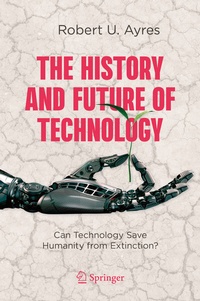
The History and Future of Technology
Can Technology Save Humanity from Extinction?
1st Edition
Published on 27. July 2021
XVIII, 830 pages
978-3-030-71393-5 (ISBN)
Description

Eminent physicist and economist, Robert Ayres, examines the history of technology as a change agent in society, focusing on societal roots rather than technology as an autonomous, self-perpetuating phenomenon. With rare exceptions, technology is developed in response to societal needs that have evolutionary roots and causes. In our genus
Homo
, language evolved in response to a need for our ancestors to communicate, both in the moment, and to posterity. A band of hunters had no chance in competition with predators that were larger and faster without this type of organization, which eventually gave birth to writing and music. The steam engine did not leap fully formed from the brain of James Watt. It evolved from a need to pump water out of coal mines, driven by a need to burn coal instead of firewood, in turn due to deforestation. Later, the steam engine made machines and mechanization possible. Even quite simple machines increased human productivity by a factor of hundreds, if not thousands. That was the Industrial Revolution.
If we count electricity and the automobile as a second industrial revolution, and the digital computer as the beginning of a third, the world is now on the cusp of a fourth revolution led by microbiology. These industrial revolutions have benefited many in the short term, but devastated the Earth's ecosystems. Can technology save the human race from the catastrophic consequences of its past success? That is the question this book will try to answer.
If we count electricity and the automobile as a second industrial revolution, and the digital computer as the beginning of a third, the world is now on the cusp of a fourth revolution led by microbiology. These industrial revolutions have benefited many in the short term, but devastated the Earth's ecosystems. Can technology save the human race from the catastrophic consequences of its past success? That is the question this book will try to answer.
More details
Series
Language
English
Place of publication
Cham
Switzerland
Publishing group
Springer International Publishing
Product notice
Reflowable
Illustrations
XVIII, 830 p. 286 illus., 217 illus. in color.
File size
33,48 MB
ISBN-13
978-3-030-71393-5 (9783030713935)
DOI
10.1007/978-3-030-71393-5
Schweitzer Classification
Other editions
Additional editions
Book
07/2021
Springer
€64.19
Shipment within 7-9 days
Person
Professor Ayres holds a PhD in Mathematical Physics from Kings College, University of London, a MSc in Physics from the University of Maryland and a BA, BSc from the University of Chicago. He is currently Emeritus Professor of Economics and Political Science and of Technology and Operations Management at INSEAD, the international graduate business school.
He joined INSEAD in 1992, becoming the first Sandoz (now Novartis) Chair of Management and the Environment, as well as the founder of CMER, Center for the Management of Environmental Resources. He directed CMER from 1992-2000. Since retirement he has been a visiting professor at Chalmers Institute of Technology in Sweden (where he was also a King's Professor) and Institute Scholar at the International Institute for Applied Systems Analysis (IIASA) in Austria. He remains active, producing publications on topics ranging from Industrial Metabolism and Industrial Ecology, through Environmental Policy and Environmental Economics, to Energy. Professor Ayres is the author or coauthor of 21 books, most recently including The Economic Growth Engine (2009, with Benjamin Warr), Crossing the Energy Divide (2009, with Edward Ayres) and Bubble Economy (2014), Energy, Complexity and Wealth Maximization (2018) and "On Capitalism and Inequality" (2020).
He joined INSEAD in 1992, becoming the first Sandoz (now Novartis) Chair of Management and the Environment, as well as the founder of CMER, Center for the Management of Environmental Resources. He directed CMER from 1992-2000. Since retirement he has been a visiting professor at Chalmers Institute of Technology in Sweden (where he was also a King's Professor) and Institute Scholar at the International Institute for Applied Systems Analysis (IIASA) in Austria. He remains active, producing publications on topics ranging from Industrial Metabolism and Industrial Ecology, through Environmental Policy and Environmental Economics, to Energy. Professor Ayres is the author or coauthor of 21 books, most recently including The Economic Growth Engine (2009, with Benjamin Warr), Crossing the Energy Divide (2009, with Edward Ayres) and Bubble Economy (2014), Energy, Complexity and Wealth Maximization (2018) and "On Capitalism and Inequality" (2020).
Content
Chapter 1. Introduction.- Chapter 2. Fire and water: technologies extending nature.- Chapter 3. Extensions of the body.- Chapter 4. Words and music.- Chapter 5. Printing, movable type and books.- Chapter 6. The Enlightenment: the rise of science.- Chapter 7. The first stage of industrialization: coking and canals (1712- 1820).- Chapter 8. Machine tools and mechanization.- Chapter 9. The triumph of steam and steel (1820-1876).- Chapter 10. Petroleum and petrochemicals.- Chapter 11. Anesthesia, surgery, and modern medicine.- Chapter 12. Mobility: From rails to roads to space travel.- Chapter 13. Electricity and electrification of factories and homes.- Chapter 14. Communications: From carrier pigeons to telephones and radio (1876-1976).- Chapter 15. The history of artifiicial light.- Chapter 16. Electronic broadcast media: radio and TV.- Chapter 17. Photography and movies.- Chapter 18. The transistor transition: 1945-1969.- Chapter 19. Machine computation and digitization.- Chapter 20. The Internet and the Worldwide Web.- Chapter 21. The Eco-footprint of material wealth: pollution, climate change and epidemics.- Chapter 22. Nuclear power.- Chapter 23. Solar Power and renewables.- Chapter 24. Scarce elements and scarce metals.- Chapter 25. Food and agriculture.- Chapter 26. Biotechnology and Human Health.- Chapter 27. Can technology save Homo Sapiens from Extinction? Utopia 2120.
