

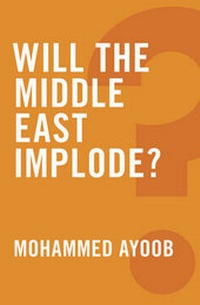
Will the Middle East Implode?
Description

In this short book, leading Middle East scholar Mohammed Ayoobargues that the Arab Spring has both changed and charged some ofthe region's thorniest problems - from the rise of politicalIslam to Iran's nuclear ambitions, the Israel-Palestineconflict to rivalries between key regional powers. Exploring thesources of conflict in the Middle East and their various linkages,Ayoob offers a thoughtful and balanced assessment of whether theregion is indeed destined for implosion or whether politicalsagacity and diplomatic creativity can bring it back from thebrink.
More details
Other editions
Additional editions
Person
Content
1 After the Arab Spring 1
2 The Islamist Challenge 12
3 Deadlock over Palestine 46
4 Regional and Global Rivalries 73
5 Iran and "the Bomb" 113
6 Will the Middle East Implode? 144
Afterword 164
Further Reading 177
Notes 182
2
The Islamist Challenge
Islamism and Islamists are broad umbrella terms that hide as much as they reveal. At the most general level, Islamism refers to a vague political ideology that asserts that Islam, in some shape or form, should guide the constitutional framework and policies of states with predominantly Muslim populations. Islamist parties and movements crystallized during the twentieth century largely as a result of Muslim societies' interaction from a position of weakness with the West. Their diagnosis of the ills of Muslim societies that led to the latter's domination by European powers was that these societies, and especially their elites, had moved away from the basic norms of Islamic behavior and that their weakness was the result of this fundamental shortcoming. Their prescription was that if Islamic codes of behavior could be reintroduced into the political lives of their countries, Muslim societies would regain their former strength and position of glory. Islamist movements were, therefore, as much products of modernity as they were reactions to it.
However, given the politically and socially fractured nature of the Muslim world, Islamist movements, where they arose, became prisoners of their own social and political contexts. Different leadership styles and intellectual convictions also added to the diversity of Islamist movements. Consequently, these movements and their leader-ships ended up interpreting the general Islamist dictum relating to the relevance of Islam to political life in manifold ways and covering a broad spectrum of convictions. Such diversity helped make Islamist movements and parties relevant in their national contexts but at the same time exploded the myth of the Islamist monolith.1
This broad spectrum of Islamist parties and movements includes mainstream political parties, such as the Ennahda (Renaissance) of Tunisia and the Muslim Brotherhood of Egypt and the latter's offshoots in other Arab countries. These parties, like their post-Islamist cousin the Justice and Development Party (AKP) of Turkey, are primarily Islamically inspired political machines whose main objective is to build broad coalitions to capture political power in order to infuse the functioning of the state with Islamic societal values. Although some of them, such as the Muslim Brotherhood, are ostensibly committed to the introduction of sharia law, they are willing to make compromises that relegate this to the status of a long-term goal that may or may not attain fruition. Others, such as the AKP, have jettisoned this goal totally and publicly and committed themselves to upholding the values of the secular state while preserving Islamic societal norms. Ennahda of Tunisia seems to be moving in a similar direction.
Islamist movements also include the salafis, the Muslim equivalents of the Puritans or Fundamentalists of Christendom, who follow strict and literalist codes of Islamic conduct and pattern their behavior on the example set by the first generation of pious Muslims - the salaf-al-salih or righteous ancestors. Most of these groups are either apolitical or adopt peaceful methods of persuasion to change society and influence politics. Some of them, such as the al-Nour Party in Egypt, in a dramatic departure from earlier patterns of behavior, have lately entered the realm of competitive politics in the wake of the Arab upheavals.
At the fringes - and they form a minuscule part of the Islamist universe - Islamist movements include militant, extremist formations, many of whom are grouped under the term salafias well but diverge from the salafis in very important ways. They are Leninist organizations that are products of hybridization between social conservatism and political radicalism, whose primary objectives are political rather than religious or social. These militant groups are not averse to engaging in violent acts to achieve their political ends. They are popularly known as "jihadis," a perversion of the term "mujahidin" (those who fight in the way of God), but one that has no Islamic significance whatsoever. However, it has become popular in journalistic and even academic discourse in the West. This category includes both national jihadis who aim at violently overthrowing local regimes, the "near enemy," and transnational jihadis, above all al-Qaeda and its affiliates, who have global agendas and whose primary target is the "far enemy," the United States and its Western allies.2
Western skepticism and suspicion
It is worth noting, however, that the history of even mainstream, non-radical Islamist parties' relationship with the West, and especially with the United States, has been at best rocky and at worst hostile. This is why the emergence of mainstream Islamist parties in the wake of the Arab Spring as major political players and in some cases as leading members of governing coalitions, as in Egypt and Tunisia, set off alarm bells in many quarters, especially in the United States. These include conservative and staunchly pro-Israel segments of American opinion traditionally wary of Islamist parties and movements because they believe that anti-American and anti-Israeli sentiments are embedded in the Islamists' genes.
Even liberal Western analysts of the Middle Eastern scene have expressed strong reservations about the Islamist parties because of what they see as the tendency among mainstream Islamists, epitomized by some of the policies of the Egyptian Muslim Brotherhood, to make compromises with elements of the old order, particularly the military top brass, to ensure the Islamists' smooth accession to office at the cost of the revolutions' objectives. While this strategy failed in Egypt, where the military overthrew the elected government in July 2013, it did leave the impression that the Muslim Brotherhood was willing to sacrifice long-term democratic goals for immediate political gain. Furthermore, segments of Arab populations that consider themselves secular and/or liberal as well as remnants of the old regimes displaced by the uprisings express strong skepticism about the objectives, intentions, and tactics of the Islamist parties as the latter move toward the centers of political power. It was this combination of holdovers from the Mubarak regime and liberal-secular elements in the Egyptian polity that led to the military coup against President Morsi's government, with the liberals providing political cover for the military brass's self-serving motives.
Criticism and disquiet over mainstream Islamist parties stem from two key concerns: firstly, the Islamist parties' apparently skin-deep commitment to democratic principles, famously expressed by the phrase "one person, one vote, one time"; secondly, the mainstream Islamists' penchant for anti-Western and anti-Israeli rhetoric that their Western critics fear will eventually be translated into policy, such as removal of American military bases from countries hosting them, suspension or even revocation of peace treaties with Israel, and political and military support to groups such as the Palestinian Hamas and the Lebanese Hizbullah that have been declared terrorist organizations by the United States.
The first concern owes much to the statements and writings of some of the leading figures who dominated the Islamist political and intellectual universe during the first half of the twentieth century. Sayyid Qutb, the Egyptian Brotherhood's chief ideologue in the 1950s and 1960s, epitomized this group. These ideologues advocated the sovereignty of God (hakimiyya), denied the full sovereignty of the people, circumscribed the legislative powers of people's assemblies, and subjected human-made constitutional provisions to the test of compatibility with the commands of God.3
But Islamist movements have evolved a great deal from the time when Qutb dominated the Islamist intellectual universe. He is no longer considered the philosopher par excellence of the Muslim Brotherhood, and his most controversial ideas, especially those that seemed to advocate violent overthrow of existing regimes in the Arab world, were indirectly refuted by the Supreme Guide of the Brotherhood as early as 1969, soon after Qutb's execution in 1966, and directly in 1982. In the latter year the Supreme Guide of the Muslim Brotherhood declared unequivocally that "Sayyid Qutb represented himself and not the Muslim Brethren."4 Moreover, Qutb's writings have been variously interpreted by succeeding generations of Islamists. Both moderates and extremists (inside and outside the Brotherhood) have used his writings to justify their own agendas. This is the case because Qutb's ideas were still evolving when he was executed by President Nasser in 1966, and therefore lend themselves to multiple and differing interpretations.
The evolution of the mainstream Islamists' approach toward moderation and political participation clearly witnessed in the case of the Egyptian Muslim Brotherhood is visible across the spectrum of Islamist parties. This has been particularly the case where political systems such as Jordan and Morocco, even though insufficiently democratic, have liberalized enough to provide greater opportunities for political participation. Transformations in their approach to politics that have taken place in the Muslim Brotherhood's Jordanian branch, the Islamic Action Front (IAF), and in the Justice and Development Party (PJD) in Morocco...
