

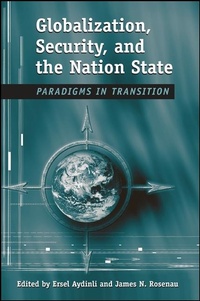
Globalization, Security, and the Nation State
Description

This volume studies the links among the concepts of globalization, security, and the authority of the nation state, drawing attention to why and how these three concepts are interrelated and why they should be studied together. Contributors explore the connections between security and global transformations, and the corresponding or resulting changes in state structures that emerge. Probing and extending existing paradigms, the book offers three regional cases studies: the periphery states of the Middle East and North Africa, the second world states of the Russian Federation, and the core states of the European Union. It concludes with three chapters that synthesize the above themes to identify corresponding changes in the patterns of international politics.
Ersel Aydinli is Assistant Professor of International Relations at Bilkent University in Turkey. James N. Rosenau is University Professor of International Affairs at The George Washington University. He is the author and editor of many books, including Distant Proximities: Dynamics beyond Globalization and Thinking Theory Thoroughly: Coherent Approaches to an Incoherent World, Second Edition (coauthored with Mary Durfee).
More details
Other editions
Additional editions
Persons
Ersel Aydinli is Assistant Professor of International Relations at Bilkent University in Turkey. James N. Rosenau is University Professor of International Affairs at The George Washington University. He is the author and editor of many books, including Distant Proximities: Dynamics beyond Globalization and Thinking Theory Thoroughly: Coherent Approaches to an Incoherent World, Second Edition (coauthored with Mary Durfee).
Content
Acknowledgments
Introduction
JAMES N. ROSENAU AND ERSEL AYDINLI
Part I: Reconceptualizing Security
1. Security in the Age of Globalization: Separating Appearance from Reality
MOHAMMED AYOOB
2. Two Terrors, One Problem
KEN BOOTH
3. The National Security State and Global Terrorism: Why the State Is Not Prepared for the New Kind of War
T. V. PAUL
Part II: State Transformations and Responses
4. The Rise of the Trading State Revisited
MARK R. BRAWLEY
5. State Transformation and New Security Dilemmas
GEORG SØRENSEN
6. Anarchy Meets Globalization: A New Security Dilemma for the Modernizing State
ERSEL AYDINLI
Part III: Regional Reflections
7. Global Challenges to Russia's National Security: Any Chances for Resisting/Bandwagoning/Adapting/ Contributing to an Emerging World Order?
ALEXANDER SERGOUNIN
8. Globalization and (In)Security in AMENA: A Contextual Double-pronged Analysis
BAHGAT KORANY
9. The Constellation of Securities in Europe
OLE WÆVER
Part IV: Emerging International Patterns
10. The Security Dynamics of a 1 + 4 World
BARRY BUZAN
11. Prospects for a New World Order
DAVID GOLDFISCHER
12. Turbulence and Terrorism: Reframing or Readjusting the Model?
JAMES N. ROSENAU
Conclusion: Seeking Conceptual Links for Changing Paradigms
ERSEL AYDINLI
Bibliography
Contributors
Books in Series in Global Politics
Index
