

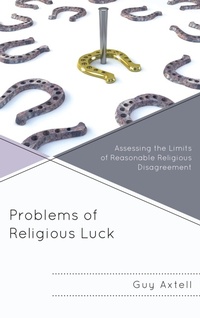
Problems of Religious Luck
Assessing the Limits of Reasonable Religious Disagreement
1st Edition
Published on 7. July 2020
308 pages
978-1-4985-5018-5 (ISBN)
Description

To speak of being religious lucky certainly sounds odd. But then, so does "My faith holds value in God's plan, while yours does not." This book argues that these two concerns - with the concept of religious luck and with asymmetric or sharply differential ascriptions of religious value - are inextricably connected. It argues that religious luck attributions can profitably be studied from a number of directions, not just theological, but also social scientific and philosophical.
There is a strong tendency among adherents of different faith traditions to invoke asymmetric explanations of the religious value or salvific status of the home religion vis-à-vis all others. Attributions of good/bad religious luck and exclusivist dismissal of the significance of religious disagreement are the central phenomena that the book studies.
Part I lays out a taxonomy of kinds of religious luck, a taxonomy that draws upon but extends work on moral and epistemic luck. It asks: What is going on when persons, theologies, or purported revelations ascribe various kinds of religiously-relevant traits to insiders and outsiders of a faith tradition in sharply asymmetric fashion? "I am saved but you are lost"; "My religion is holy but yours is idolatrous"; "My faith tradition is true, and valued by God, but yours is false and valueless."
Part II further develops the theory introduced in Part I, pushing forward both the descriptive/explanatory and normative sides of what the author terms his inductive risk account. Firstly, the concept of inductive risk is shown to contribute to the needed field of comparative fundamentalism by suggesting new psychological markers of fundamentalist orientation. The second side of what is termed an inductive risk account is concerned with the epistemology of religious belief, but more especially with an account of the limits of reasonable religious disagreement. Problems of inductively risky modes of belief-formation problematize claims to religion-specific knowledge. But the inductive risk account does not aim to set religion apart, or to challenge the reasonableness of religious belief tout court. Rather the burden of the argument is to challenge the reasonableness of attitudes of religious exclusivism, and to demotivate the "polemical apologetics" that exclusivists practice and hope to normalize.
There is a strong tendency among adherents of different faith traditions to invoke asymmetric explanations of the religious value or salvific status of the home religion vis-à-vis all others. Attributions of good/bad religious luck and exclusivist dismissal of the significance of religious disagreement are the central phenomena that the book studies.
Part I lays out a taxonomy of kinds of religious luck, a taxonomy that draws upon but extends work on moral and epistemic luck. It asks: What is going on when persons, theologies, or purported revelations ascribe various kinds of religiously-relevant traits to insiders and outsiders of a faith tradition in sharply asymmetric fashion? "I am saved but you are lost"; "My religion is holy but yours is idolatrous"; "My faith tradition is true, and valued by God, but yours is false and valueless."
Part II further develops the theory introduced in Part I, pushing forward both the descriptive/explanatory and normative sides of what the author terms his inductive risk account. Firstly, the concept of inductive risk is shown to contribute to the needed field of comparative fundamentalism by suggesting new psychological markers of fundamentalist orientation. The second side of what is termed an inductive risk account is concerned with the epistemology of religious belief, but more especially with an account of the limits of reasonable religious disagreement. Problems of inductively risky modes of belief-formation problematize claims to religion-specific knowledge. But the inductive risk account does not aim to set religion apart, or to challenge the reasonableness of religious belief tout court. Rather the burden of the argument is to challenge the reasonableness of attitudes of religious exclusivism, and to demotivate the "polemical apologetics" that exclusivists practice and hope to normalize.
More details
Edition
1. Auflage
Language
English
Place of publication
New York
United States
Publishing group
Bloomsbury Publishing Plc
Target group
Professional and scholarly
Illustrations
2 BW Illustrations, 2 Tables
ISBN-13
978-1-4985-5018-5 (9781498550185)
Copyright in bibliographic data and cover images is held by Nielsen Book Services Limited or by the publishers or by their respective licensors: all rights reserved.
Schweitzer Classification
Other editions
Additional editions
Book
12/2018
Lexington Books
€130.50
Article exhausted; check different version
Person
Guy Axtell is professor of philosophy at Radford University.
Content
Part I
Religious Cognition and Philosophy of Luck
1 Types of Religious Luck: A Working Taxonomy
2 The New Problem of Religious Luck
Part II
Applications and Implications of Inductive Risk
3 Enemy in the Mirror: The Need for Comparative Fundamentalism
4 We Are All of the Common Herd: Montaigne and the Psychology of our 'Importunate Presumptions'
5 Scaling the 'Brick Wall': Measuring and Censuring Strongly Fideistic Religious Orientation
6 The Pattern Stops Here? Counter-Inductive Thinking, Counter-Intuitive Ideas, and Cognitive Science of Religion
Religious Cognition and Philosophy of Luck
1 Types of Religious Luck: A Working Taxonomy
2 The New Problem of Religious Luck
Part II
Applications and Implications of Inductive Risk
3 Enemy in the Mirror: The Need for Comparative Fundamentalism
4 We Are All of the Common Herd: Montaigne and the Psychology of our 'Importunate Presumptions'
5 Scaling the 'Brick Wall': Measuring and Censuring Strongly Fideistic Religious Orientation
6 The Pattern Stops Here? Counter-Inductive Thinking, Counter-Intuitive Ideas, and Cognitive Science of Religion
