

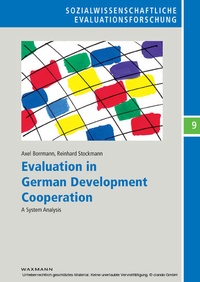
Evaluation in German Development Cooperation
A System Analysis
1st Edition
Published on 1. November 2009
208 pages
978-3-8309-7269-3 (ISBN)
Description

In Germany, development cooperation is the policy field with the longest tradition in evaluation. All major German organisations in development cooperation use the instrument of evaluation - however, to different degrees with regard to qualitative and quantitative aspects. This study on behalf of the German Federal Ministry for Economic Cooperation and Development (BMZ) analyses methodically analyses the way the different organisations evaluate, how much they know about the impact of their projects and programmes, and if or how their evaluation systems can be integrated a larger whole.
Until now, there has been no comparable analysis, neither in other German policy fields nor in development cooperation of other European countries.
Axel Borrmann arbeitet als Senior Economist im Hamburgischen WeltWirtschaftsInstitut (HWWI) (www.hwwi.org). Schwerpunkte seiner Forschungsarbeit sind internationale Handels- und Entwicklungspolitik sowie Entwicklungszusammenarbeit. Er ist als Gutachter für zahlreiche nationale und internationale Organisationen tätig. Axel Borrmann is Research associate at the Hamburg Institute of International Economics (www.hwwi.org). His main areas of research are international trade and development policy and development cooperation. He has been working as an expert for numerous national and international organisations.
Until now, there has been no comparable analysis, neither in other German policy fields nor in development cooperation of other European countries.
Axel Borrmann arbeitet als Senior Economist im Hamburgischen WeltWirtschaftsInstitut (HWWI) (www.hwwi.org). Schwerpunkte seiner Forschungsarbeit sind internationale Handels- und Entwicklungspolitik sowie Entwicklungszusammenarbeit. Er ist als Gutachter für zahlreiche nationale und internationale Organisationen tätig. Axel Borrmann is Research associate at the Hamburg Institute of International Economics (www.hwwi.org). His main areas of research are international trade and development policy and development cooperation. He has been working as an expert for numerous national and international organisations.
More details
Other editions
Additional editions
Book
11/2009
1st Edition
Waxmann
€29.90
Article exhausted; check different version
Content
1 - Book Cover [Seite 1]
2 - Foreword [Seite 5]
3 - Contents [Seite 7]
4 - Directory of abbreviations and acronyms [Seite 11]
5 - 0 Summary [Seite 15]
5.1 - 0.1 Evaluation of development cooperation under changing conditions [Seite 15]
5.2 - 0.2 Findings [Seite 16]
5.3 - 0.3 Recommendations [Seite 24]
6 - 1 Background and objectives of the study [Seite 29]
6.1 - 1.1 The need for a new System Analysis [Seite 29]
6.2 - 1.2 Stock taking of previous system analyses and reform agenda [Seite 30]
6.3 - 1.3 Changing international development policy conditions and consequences for evaluations in the coming years [Seite 31]
6.3.1 - 1.3.1 Changing development cooperation objectives in the 1990s [Seite 31]
6.3.2 - 1.3.2 New political agenda since 2000 [Seite 33]
6.3.3 - 1.3.3 The future development of framework conditions: three scenarios [Seite 34]
6.3.4 - 1.3.4 Changing implementation modalities [Seite 35]
6.3.5 - 1.3.5 Consequences for evaluation, methodological implications of change [Seite 39]
6.3.6 - 1.3.6 Implications for the North-South partnership [Seite 39]
6.3.7 - 1.3.7 Conclusion [Seite 40]
6.4 - 1.4 Changing national development cooperation framework conditions [Seite 41]
6.4.1 - 1.4.1 International trends and implementation [Seite 41]
6.4.2 - 1.4.2 Changes in the objectives of German development policy as a result of the MDGs [Seite 41]
6.4.3 - 1.4.3 Ownership and alignment [Seite 42]
6.4.4 - 1.4.4 Harmonisation & coherence [Seite 43]
6.4.5 - 1.4.5 Orientation towards impact [Seite 44]
6.4.6 - 1.4.6 Volume of German development cooperation [Seite 45]
6.4.7 - 1.4.7 Summary [Seite 45]
6.5 - 1.5 More recent developments in the evaluation of development cooperation [Seite 45]
6.6 - 1.6 Objective of analysis [Seite 49]
7 - 2 Study design [Seite 51]
7.1 - 2.1 Definitions and demarcation lines [Seite 51]
7.2 - 2.2 Development cooperation agencies in the study [Seite 53]
7.3 - 2.3 Methods used [Seite 55]
7.3.1 - 2.3.1 Foundations [Seite 55]
7.3.2 - 2.3.2 Data collection methods, instruments and evaluation methods [Seite 56]
7.4 - 2.4 Workflow for the study [Seite 57]
7.5 - 2.5 Evaluators and directors [Seite 58]
7.5.1 - 2.5.1 Directors [Seite 59]
7.5.2 - 2.5.2 Evaluators, assignment to development cooperation institutions, other domains of responsibility [Seite 59]
7.5.3 - 2.5.3 Peers [Seite 60]
7.6 - 2.6 Acknowledgement [Seite 60]
8 - 3 The evaluation systems of German development cooperation agencies: An analysis of their institutional, conceptual, methodological and systemic features [Seite 63]
8.1 - 3.1 Introduction [Seite 63]
8.2 - 3.2 Foundations and objectives of evaluation policy [Seite 64]
8.3 - 3.3 Institutionalisation and independence of the evaluation [Seite 71]
8.4 - 3.4 Planning and workflow in the evaluation [Seite 85]
8.4.1 - 3.4.1 Planning [Seite 85]
8.4.2 - 3.4.2 Workflow [Seite 91]
8.5 - 3.5 Forms of evaluation [Seite 97]
8.5.1 - 3.5.1 Introduction [Seite 97]
8.5.2 - 3.5.2 Forms and scope [Seite 99]
8.5.3 - 3.5.3 Resources [Seite 106]
8.6 - 3.6 Quality of evaluations [Seite 110]
8.7 - 3.7 Human resources [Seite 119]
8.8 - 3.8 Usage [Seite 127]
8.9 - 3.9 Involvement of partners [Seite 133]
8.10 - 3.10 Networking [Seite 137]
9 - 4 The quality of evaluation systems from the perspective of the DAC Principles [Seite 143]
9.1 - 4.1 Introduction [Seite 143]
9.2 - 4.2 Credibility and independence [Seite 143]
9.3 - 4.3 Usefulness [Seite 149]
9.4 - 4.4 Quality [Seite 150]
9.5 - 4.5 Partnership [Seite 154]
9.6 - 4.6 Networking, system formation and change [Seite 155]
10 - 5 Recommendations for the reform of the evaluation systems [Seite 163]
10.1 - 5.1 Introduction [Seite 163]
10.2 - 5.2 System development [Seite 163]
10.3 - 5.3 Foundations and objectives [Seite 164]
10.4 - 5.4 Institutionalisation [Seite 164]
10.5 - 5.5 Planning and workflow [Seite 164]
10.6 - 5.6 Forums and scope [Seite 165]
10.7 - 5.7 Quality [Seite 165]
10.8 - 5.8 Human resources [Seite 166]
10.9 - 5.9 Usage [Seite 166]
10.10 - 5.10 Partners [Seite 167]
10.11 - 5.11 Networking [Seite 167]
11 - 6 Bibliography [Seite 168]
12 - 7. Annexes [Seite 173]
12.1 - 7.1 Terms of References [Seite 173]
12.2 - 7.2 Study guideline [Seite 178]
12.3 - 7.3 DAC-Principles for Evaluation of Development cooperation [Seite 185]
12.4 - 7.4 DAC: Evaluations Systems and Use: Working Instrument for Peer Reviews and Assessments [Seite 193]
12.5 - 7.5 DAC Evaluation Quality Standards [Seite 198]
2 - Foreword [Seite 5]
3 - Contents [Seite 7]
4 - Directory of abbreviations and acronyms [Seite 11]
5 - 0 Summary [Seite 15]
5.1 - 0.1 Evaluation of development cooperation under changing conditions [Seite 15]
5.2 - 0.2 Findings [Seite 16]
5.3 - 0.3 Recommendations [Seite 24]
6 - 1 Background and objectives of the study [Seite 29]
6.1 - 1.1 The need for a new System Analysis [Seite 29]
6.2 - 1.2 Stock taking of previous system analyses and reform agenda [Seite 30]
6.3 - 1.3 Changing international development policy conditions and consequences for evaluations in the coming years [Seite 31]
6.3.1 - 1.3.1 Changing development cooperation objectives in the 1990s [Seite 31]
6.3.2 - 1.3.2 New political agenda since 2000 [Seite 33]
6.3.3 - 1.3.3 The future development of framework conditions: three scenarios [Seite 34]
6.3.4 - 1.3.4 Changing implementation modalities [Seite 35]
6.3.5 - 1.3.5 Consequences for evaluation, methodological implications of change [Seite 39]
6.3.6 - 1.3.6 Implications for the North-South partnership [Seite 39]
6.3.7 - 1.3.7 Conclusion [Seite 40]
6.4 - 1.4 Changing national development cooperation framework conditions [Seite 41]
6.4.1 - 1.4.1 International trends and implementation [Seite 41]
6.4.2 - 1.4.2 Changes in the objectives of German development policy as a result of the MDGs [Seite 41]
6.4.3 - 1.4.3 Ownership and alignment [Seite 42]
6.4.4 - 1.4.4 Harmonisation & coherence [Seite 43]
6.4.5 - 1.4.5 Orientation towards impact [Seite 44]
6.4.6 - 1.4.6 Volume of German development cooperation [Seite 45]
6.4.7 - 1.4.7 Summary [Seite 45]
6.5 - 1.5 More recent developments in the evaluation of development cooperation [Seite 45]
6.6 - 1.6 Objective of analysis [Seite 49]
7 - 2 Study design [Seite 51]
7.1 - 2.1 Definitions and demarcation lines [Seite 51]
7.2 - 2.2 Development cooperation agencies in the study [Seite 53]
7.3 - 2.3 Methods used [Seite 55]
7.3.1 - 2.3.1 Foundations [Seite 55]
7.3.2 - 2.3.2 Data collection methods, instruments and evaluation methods [Seite 56]
7.4 - 2.4 Workflow for the study [Seite 57]
7.5 - 2.5 Evaluators and directors [Seite 58]
7.5.1 - 2.5.1 Directors [Seite 59]
7.5.2 - 2.5.2 Evaluators, assignment to development cooperation institutions, other domains of responsibility [Seite 59]
7.5.3 - 2.5.3 Peers [Seite 60]
7.6 - 2.6 Acknowledgement [Seite 60]
8 - 3 The evaluation systems of German development cooperation agencies: An analysis of their institutional, conceptual, methodological and systemic features [Seite 63]
8.1 - 3.1 Introduction [Seite 63]
8.2 - 3.2 Foundations and objectives of evaluation policy [Seite 64]
8.3 - 3.3 Institutionalisation and independence of the evaluation [Seite 71]
8.4 - 3.4 Planning and workflow in the evaluation [Seite 85]
8.4.1 - 3.4.1 Planning [Seite 85]
8.4.2 - 3.4.2 Workflow [Seite 91]
8.5 - 3.5 Forms of evaluation [Seite 97]
8.5.1 - 3.5.1 Introduction [Seite 97]
8.5.2 - 3.5.2 Forms and scope [Seite 99]
8.5.3 - 3.5.3 Resources [Seite 106]
8.6 - 3.6 Quality of evaluations [Seite 110]
8.7 - 3.7 Human resources [Seite 119]
8.8 - 3.8 Usage [Seite 127]
8.9 - 3.9 Involvement of partners [Seite 133]
8.10 - 3.10 Networking [Seite 137]
9 - 4 The quality of evaluation systems from the perspective of the DAC Principles [Seite 143]
9.1 - 4.1 Introduction [Seite 143]
9.2 - 4.2 Credibility and independence [Seite 143]
9.3 - 4.3 Usefulness [Seite 149]
9.4 - 4.4 Quality [Seite 150]
9.5 - 4.5 Partnership [Seite 154]
9.6 - 4.6 Networking, system formation and change [Seite 155]
10 - 5 Recommendations for the reform of the evaluation systems [Seite 163]
10.1 - 5.1 Introduction [Seite 163]
10.2 - 5.2 System development [Seite 163]
10.3 - 5.3 Foundations and objectives [Seite 164]
10.4 - 5.4 Institutionalisation [Seite 164]
10.5 - 5.5 Planning and workflow [Seite 164]
10.6 - 5.6 Forums and scope [Seite 165]
10.7 - 5.7 Quality [Seite 165]
10.8 - 5.8 Human resources [Seite 166]
10.9 - 5.9 Usage [Seite 166]
10.10 - 5.10 Partners [Seite 167]
10.11 - 5.11 Networking [Seite 167]
11 - 6 Bibliography [Seite 168]
12 - 7. Annexes [Seite 173]
12.1 - 7.1 Terms of References [Seite 173]
12.2 - 7.2 Study guideline [Seite 178]
12.3 - 7.3 DAC-Principles for Evaluation of Development cooperation [Seite 185]
12.4 - 7.4 DAC: Evaluations Systems and Use: Working Instrument for Peer Reviews and Assessments [Seite 193]
12.5 - 7.5 DAC Evaluation Quality Standards [Seite 198]
