

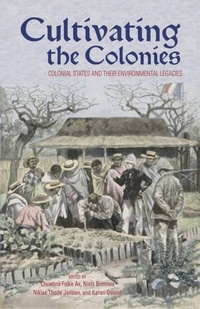
Cultivating the Colonies
Colonial States and Their Environmental Legacies
1st Edition
Published on 16. June 2014
277 pages
978-0-89680-479-1 (ISBN)
Description

The essays collected in Cultivating the Colonies demonstrate how the relationship between colonial power and nature revealsthe nature of power. Each essay explores how colonial governments translated ideas about the management of exoticnature and foreign people into practice, and how they literally "got their hands dirty" in the business of empire.
The eleven essays include studies of animal husbandry in the Philippines, farming in Indochina, and indigenous medicine in India. They are global in scope, ranging from the Russian North to Mozambique, examining the consequences of colonialismon nature, including its impact on animals, fisheries, farmlands, medical practices, and even the diets of indigenouspeople.
Cultivating the Colonies establishes beyond all possible doubt the importance of the environment as a locus for studyingthe power of the colonial state.
The eleven essays include studies of animal husbandry in the Philippines, farming in Indochina, and indigenous medicine in India. They are global in scope, ranging from the Russian North to Mozambique, examining the consequences of colonialismon nature, including its impact on animals, fisheries, farmlands, medical practices, and even the diets of indigenouspeople.
Cultivating the Colonies establishes beyond all possible doubt the importance of the environment as a locus for studyingthe power of the colonial state.
Reviews / Votes
"Scholars of environmental history would benefit from reading this lucidly written book, especially because it discusses diverse cases and has useful references to vernacular sources." (Technology and Culture) "A coherent and excellent volume on the environmental history of the arable and non-arable colonial world...this book is a valuable and important addition to global and comparative world environmental history." (European History Quarterly) "Cultivating the Colonies embarks on an ambitious task, investigating the nuts and bolts of colonial environmental governance and understanding how that study can illuminate the modern complexities in post-independence states. The editors and authors have done well not to shy away from the complexity of their task. Rather than attempting to address every nuance of colonial history, Cultivating the Colonies provides well defined case studies that will serve as examples for future study and investigation of colonial management of nature and people." (Middle Ground Journal)More details
Series
Edition
1. Auflage
Language
English
Place of publication
Athens
United States
Target group
Professional and scholarly
File size
1,54 MB
ISBN-13
978-0-89680-479-1 (9780896804791)
Copyright in bibliographic data and cover images is held by Nielsen Book Services Limited or by the publishers or by their respective licensors: all rights reserved.
Schweitzer Classification
Other editions
Additional editions
Christina Folke Ax | Niels Brimnes | Niklas Thode Jensen
Cultivating the Colonies
Colonial States and Their Environmental Legacies
Book
06/2011
Ohio University Press
€52.00
Shipment within 3-4 weeks
Persons
Christina Folke Ax is at the University of Iceland on a postdoctoral project. She has published articles in the Scandinavian Journal of History and in Nordic Perspectives on Encountering Foreignness.
Niels Brimnes is an associate professor of history at Aarhus University in Denmark. He is the author of Constructing the Colonial Encounter: Right and Left Hand Castes in Early Colonial South India.
Niklas Thode Jensen is a Marie Curie Postdoctoral Fellow at the Department of History and Civilization at the European University Institute in Florence, Italy. His forthcoming book is titled For the Health of the Enslaved: Slaves, Medicine and Power in the Danish West Indies, 1803-1848.
Karen Oslund is an assistant professor of world history at Towson University in Maryland. Her publications include Iceland Imagined: Nature, Culture, and Storytelling in the North Atlantic
and a coedited volume with David L. Hoyt, The Study of Language and the Politics of Community in Global Context,1740-1940.
Niels Brimnes is an associate professor of history at Aarhus University in Denmark. He is the author of Constructing the Colonial Encounter: Right and Left Hand Castes in Early Colonial South India.
Niklas Thode Jensen is a Marie Curie Postdoctoral Fellow at the Department of History and Civilization at the European University Institute in Florence, Italy. His forthcoming book is titled For the Health of the Enslaved: Slaves, Medicine and Power in the Danish West Indies, 1803-1848.
Karen Oslund is an assistant professor of world history at Towson University in Maryland. Her publications include Iceland Imagined: Nature, Culture, and Storytelling in the North Atlantic
and a coedited volume with David L. Hoyt, The Study of Language and the Politics of Community in Global Context,1740-1940.
Content
- Intro
- Cover
- Title Page
- Copyright
- Dedication
- Contents
- List of Illustrations
- Acknowledgments
- Introduction: Getting Our Hands Dirty
- Part 1: Perceiving the Colonial Environment
- Chapter One: The Prospective Colonist and Strange Environments: Advice on Health and Prosperity
- Chapter Two: Carved Out of Nature: Identity and Environment in German Colonial Africa
- Chapter Three: The Science of Nature and the Nature of Science in the Spanish and American Philippines
- Chapter Four: Aerial Photography and Colonial Discourse on the Agricultural Crisis in Late-Colonial Indochina, 1930a??1945
- Part 2: Managing the Colonial Environment
- Chapter Five: Wetland Colonies: Louisiana, Guangzhou, Pondicherry, and Senegal
- Chapter Six: Colonization of the Russian North: A Frozen Frontier
- Chapter Seven: Recasting Disease and Its Environment: Indigenous Medical Practitioners, the Plague, and Politics in Colonial India, 1898a??1910
- Chapter Eight: Changing Times, Changing Palates: The Dietary Impacts of Basuto Adaptation to New Rulers, Crops, and Markets, 1830sa??1966
- Part 3: The Legacy of Colonialism
- Chapter Nine: State Rationality, Development, and the Making of State Territory: From Colonial Extraction to Postcolonial Conservation in Southern Mozambique
- Chapter Ten: Ecological Communication at the Oxford Imperial Forestry Institute
- Chapter Eleven: Colonial Experts, Developmental and Environmental Doctrines, and the Legacies of Late British Colonialism
- List of Contributors
- Index
