

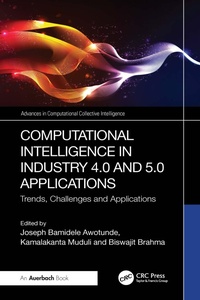
Computational Intelligence in Industry 4.0 and 5.0 Applications
Trends, Challenges and Applications
1st Edition
Published on 6. February 2025
423 pages
978-1-040-27544-3 (ISBN)
Description

Industry 4.0 and 5.0 applications will revolutionize production, enabling smart manufacturing machines to interact with their environments. These machines will become self-aware, self-learning, and capable of real-time data interpretation for self-diagnosis and prevention of production issues. They will also self-calibrate and prioritize tasks to enhance production quality and efficiency.
Computational Intelligence in Industry 4.0 and 5.0 Applications examines applications that merge three key disciplines: computational intelligence (CI), Industry 4.0, and Industry 5.0. It presents solutions using Industrial Internet of Things (IIoT) technologies, augmented by CI-based techniques, modeling, controls, estimations, applications, systems, and future scopes. These applications use data from smart sensors, processed through enhanced CI methods, to make smart automation more effective.
Industry 4.0 integrates data and intelligent automation into manufacturing, using technologies like CI, the IoT, the IIoT, and cloud computing. It transforms data into actionable insights for decision-making and process optimization, essential for modern competitive businesses managing high-speed data integration in production processes. Currently, Industries 4.0 and 5.0 are undergoing significant transformations due to advances in applying artificial intelligence (AI), big data analytics, telecommunication technologies, and control theory. These applications are increasingly multidisciplinary, integrating mechanical, control, and information technologies. However, they face such technical challenges as parametric uncertainties, external disturbances, sensor noise, and mechanical failures. To address these, this book examines such CI technologies as fuzzy logic, neural networks, and reinforcement learning and their application to modeling, control, and estimation. It also covers recent advancements in IIoT sensors, microcontrollers, and big data analytics that further enhance CI-based solutions in Industry 4.0 and 5.0 systems.
Computational Intelligence in Industry 4.0 and 5.0 Applications examines applications that merge three key disciplines: computational intelligence (CI), Industry 4.0, and Industry 5.0. It presents solutions using Industrial Internet of Things (IIoT) technologies, augmented by CI-based techniques, modeling, controls, estimations, applications, systems, and future scopes. These applications use data from smart sensors, processed through enhanced CI methods, to make smart automation more effective.
Industry 4.0 integrates data and intelligent automation into manufacturing, using technologies like CI, the IoT, the IIoT, and cloud computing. It transforms data into actionable insights for decision-making and process optimization, essential for modern competitive businesses managing high-speed data integration in production processes. Currently, Industries 4.0 and 5.0 are undergoing significant transformations due to advances in applying artificial intelligence (AI), big data analytics, telecommunication technologies, and control theory. These applications are increasingly multidisciplinary, integrating mechanical, control, and information technologies. However, they face such technical challenges as parametric uncertainties, external disturbances, sensor noise, and mechanical failures. To address these, this book examines such CI technologies as fuzzy logic, neural networks, and reinforcement learning and their application to modeling, control, and estimation. It also covers recent advancements in IIoT sensors, microcontrollers, and big data analytics that further enhance CI-based solutions in Industry 4.0 and 5.0 systems.
More details
Series
Edition
1. Auflage
Language
English
Place of publication
London
United Kingdom
Publishing group
Taylor & Francis Ltd
Target group
Professional and scholarly
Illustrations
16 Tables, black and white; 60 Line drawings, black and white; 60 Illustrations, black and white
ISBN-13
978-1-040-27544-3 (9781040275443)
Copyright in bibliographic data and cover images is held by Nielsen Book Services Limited or by the publishers or by their respective licensors: all rights reserved.
Schweitzer Classification
Other editions
Additional editions
Joseph Bamidele Awotunde | Kamalakanta Muduli | Biswajit Brahma
Computational Intelligence in Industry 4.0 and 5.0 Applications
Trends, Challenges and Applications
Book
approx. 07/2026
1st Edition
Auerbach
€65.00
Not yet published
Joseph Bamidele Awotunde | Kamalakanta Muduli | Biswajit Brahma
Computational Intelligence in Industry 4.0 and 5.0 Applications
Trends, Challenges and Applications
Book
02/2025
1st Edition
Auerbach
€244.60
Shipment within 10-20 days
Persons
Joseph Bamidele Awotunde is a Lecturer with the Computer Science Department, University of Ilorin, Ilorin, Nigeria. He has to his credit over 200 publications in reputable outlets such as Elsevier, Springer, Hindawi, and Taylor & Francis, among others, covering journals, edited conference proceedings, and chapters in books. He is also the editor of four books.
Kamalakanta Muduli is an Associate Professor and Head of the School of Mechanical Engineering at Papua New Guinea University of Technology.
Biswajit Brahma is a Senior Data and Visualization Engineer at McKesson, USA. His expertise is demonstrated by more than 50 publications in prestigious SCI/Scopus journals, showcasing his dedication to advancing knowledge in the fields of AI/ML and deep learning.
Kamalakanta Muduli is an Associate Professor and Head of the School of Mechanical Engineering at Papua New Guinea University of Technology.
Biswajit Brahma is a Senior Data and Visualization Engineer at McKesson, USA. His expertise is demonstrated by more than 50 publications in prestigious SCI/Scopus journals, showcasing his dedication to advancing knowledge in the fields of AI/ML and deep learning.
Content
1. Industry 4.0: Challenges and Issues Encountered in Manufacturing and Testing of MEMS Devices. 2. The Industrial Internet of Things (IIoT): Overview, Architecture, Challenges, and Possible Solutions. 3. Artificial Intelligence in Industry 5.0: Transforming Manufacturing through Machine Learning and Robotics in Collaborative Age. 4. Computational Intelligence in the Industrial Internet of Things. 5. Security, Privacy, Trust, and Other Issues in Industries 4.0 and 5.0. 6. Fine-Tuning for a Deep Learning Model in Optimizing Ransomware Attack Detection in the Industry 4.0 and 5.0 Era. 7. Blockchain in Industry 4.0 and Industry 5.0: A Paradigm Shift towards Decentralized Efficiency and Autonomous Ecosystems. 8. Integration of Digital of Twins in Industries 4.0 and 5.0. 9. Computational Intelligence in Big Data Analytics. 10. The Role of Augmented Reality, Virtual Reality, and Mixed Reality in Industries 4.0 and 5.0. 11. Industry 4.0 Design Principles, Technologies, and Applications. 12. Industry 4.0 and Computational Intelligence for Fighting COVID-19: A Case Study.
