

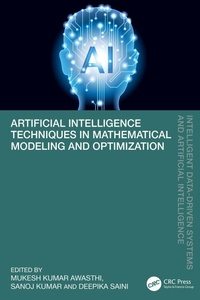
Artificial Intelligence Techniques in Mathematical Modeling and Optimization
1st Edition
Published on 30. April 2026
346 pages
978-1-040-68252-4 (ISBN)
Description

Artificial Intelligence Techniques in Mathematical Modeling and Optimization offers a dynamic and comprehensive examination of the intersection between artificial intelligence and mathematical modeling. This edited volume brings together innovative research exploring how AI-driven methods revolutionize traditional approaches to complex optimization problems, enabling enhanced performance, interpretability, and real-world applicability across diverse domains.
Covering foundational and advanced topics, the book introduces readers to machine learning, deep learning, and reinforcement learning as critical tools for modeling high-dimensional, nonlinear, and stochastic systems. Chapters delve into essential aspects like data pre-processing, feature engineering, neural network architectures, swarm intelligence, quantum optimization, and multi-objective decision-making. Emerging techniques such as Fire Hawk Optimization Plus (FHO+), hybrid deep learning-quantum frameworks, and explainable AI (XAI) are discussed in the context of real-world scenarios ranging from energy systems and manufacturing to disaster prediction and healthcare analytics.
This volume uniquely bridges theory and application by integrating algorithmic strategies with case studies on predictive maintenance, renewable energy optimization, cyclone detection, heart disease prediction, and postpartum mental health risk assessment. It also investigates the role of circular economy principles in inventory optimization and examines future trends including neuromorphic computing and ethical AI.
Key Features:
? Systematic exploration of AI-based optimization in mathematical modeling.
? In-depth coverage of ML/DL methods, quantum algorithms, and nature-inspired techniques.
? Practical applications in industrial manufacturing, healthcare, smart energy, and environmental resilience.
? Detailed discussions on model training, generalization, hyperparameter tuning, and overfitting control.
? Includes practical tools such as AutoML, PINNs, CNNs, and quantum convolutional networks.
? Forward-looking insights into sustainable optimization, interpretability, and autonomous AI systems.
This volume is an essential resource for graduate students, researchers, and practitioners in applied mathematics, computer science, engineering, and data-driven optimization, offering the theoretical depth and application-driven clarity needed to tackle modern scientific and engineering challenges through AI-powered modeling and decision systems.
Covering foundational and advanced topics, the book introduces readers to machine learning, deep learning, and reinforcement learning as critical tools for modeling high-dimensional, nonlinear, and stochastic systems. Chapters delve into essential aspects like data pre-processing, feature engineering, neural network architectures, swarm intelligence, quantum optimization, and multi-objective decision-making. Emerging techniques such as Fire Hawk Optimization Plus (FHO+), hybrid deep learning-quantum frameworks, and explainable AI (XAI) are discussed in the context of real-world scenarios ranging from energy systems and manufacturing to disaster prediction and healthcare analytics.
This volume uniquely bridges theory and application by integrating algorithmic strategies with case studies on predictive maintenance, renewable energy optimization, cyclone detection, heart disease prediction, and postpartum mental health risk assessment. It also investigates the role of circular economy principles in inventory optimization and examines future trends including neuromorphic computing and ethical AI.
Key Features:
? Systematic exploration of AI-based optimization in mathematical modeling.
? In-depth coverage of ML/DL methods, quantum algorithms, and nature-inspired techniques.
? Practical applications in industrial manufacturing, healthcare, smart energy, and environmental resilience.
? Detailed discussions on model training, generalization, hyperparameter tuning, and overfitting control.
? Includes practical tools such as AutoML, PINNs, CNNs, and quantum convolutional networks.
? Forward-looking insights into sustainable optimization, interpretability, and autonomous AI systems.
This volume is an essential resource for graduate students, researchers, and practitioners in applied mathematics, computer science, engineering, and data-driven optimization, offering the theoretical depth and application-driven clarity needed to tackle modern scientific and engineering challenges through AI-powered modeling and decision systems.
More details
Series
Edition
1. Auflage
Language
English
Place of publication
London
United Kingdom
Publishing group
Taylor & Francis Ltd
Target group
College/higher education
Professional and scholarly
Product notice
Reflowable
Illustrations
45 Tables, black and white; 70 Line drawings, black and white; 9 Halftones, black and white; 79 Illustrations, black and white
File size
7,86 MB
ISBN-13
978-1-040-68252-4 (9781040682524)
Copyright in bibliographic data and cover images is held by Nielsen Book Services Limited or by the publishers or by their respective licensors: all rights reserved.
Schweitzer Classification
Other editions
Additional editions
Mukesh Kumar Awasthi | Sanoj Kumar | Deepika Saini
Artificial Intelligence Techniques in Mathematical Modeling and Optimization
Book
04/2026
1st Edition
CRC Press
€259.98
Shipment within 15-20 days
Persons
Mukesh Kumar Awasthi has done his Ph.D. on the topic "Viscous Correction for the Potential Flow Analysis of Capillary and Kelvin-Helmholtz instability". He is working as an Assistant Professor in the Department of Mathematics at Babasaheb Bhimrao Ambedkar University, Lucknow. Dr. Awasthi is specialized in the mathematical modeling of flow problems. He has taught courses of Fluid Mechanics, Discrete Mathematics, Partial differential equations, Abstract Algebra, Mathematical Methods, and Measure theory to postgraduate students. He has acquired excellent knowledge in the mathematical modeling of flow problems and he can solve these problems analytically as well as numerically. He has a good grasp of the subjects like viscous potential flow, electro-hydrodynamics, magneto-hydrodynamics, heat, and mass transfer. He has excellent communication skills and leadership qualities. He is self-motivated and responds to suggestions in a more convincing manner. Dr. Awasthi has qualified National Eligibility Test (NET) conducted on all India level in the year 2008 by the Council of Scientific and Industrial Research (CSIR) and got Junior Research Fellowship (JRF) and Senior Research Fellowship (SRF) for doing research. He has published 135 plus research publications (journal articles/books/book chapters/conference articles) in national and international journals and conferences. Also, he has published 19 books. He is also a series editor of Artificial Intelligence and Machine Learning for Intelligent Engineering Systems published by CRC Press. He has attended many symposia, workshops, and conferences in mathematics as well as fluid mechanics. He has got the "Research Awards" consecutively four times from 2013-2016 by the University of Petroleum and Energy Studies, Dehradun, India. He has also received the start-up research fund for his project "Nonlinear study of the interface in multilayer fluid system" from UGC, New Delhi. He is also listed among the top 2% of influential researchers in the world, as prepared by Stanford University based on Scopus data for the years 2022 and 2023. His Orcid is 0000-0002-6706-5226, Google Scholar web link is https://scholar.google.co.in/citations?user=Dj3ktGAAAAAJ and research gate web link ishttps://www.researchgate.net/profile/Mukesh-Awasthi-2.
Sanoj Kumar works as an assistant professor (SG) at Data Science Cluster, SOCS, UPES, Dehradun, Uttarakhand, India. Earlier, he worked as a postdoctoral fellow with the Department of Mathematics and Computer Science, University of Udine, Italy, from October 2013 to September 2014. He completed his PhD in mathematics from IIT Roorkee, India, in 2013. Dr. Kumar's research interests include image processing, computer vision, and machine learning. He has authored more than 25 papers published in referred international journals and conferences. He has also authored two book chapters. He is a reviewer for various journals such as ISA Transactions, IET Image Processing, Optical Engineering, Applied Mathematical Modeling, Mathematics, etc. He also got the best paper and young scientist awards in NETCRYPT 2020. His teaching area includes Engineering Mathematics I, Engineering Mathematics II, discrete mathematics, graph theory, optimization techniques, numerical analysis, linear algebra, probability and statistics, real analysis, complex analysis, differential equation, digital image processing and introduction to data science, etc.
Deepika Saini is an assistant professor at Graphic Era (deemed to be) University, Dehradun, Uttarakhand, India. Previously, in 2016, she received her Ph.D. in Mathematics from IIT Roorkee in India. She completed her M.Sc. in Mathematics from H.N.B. Garhwal University, Srinagar, Uttarakhand, India. She won the gold medal for securing first place among all PG students in her M.Sc. in 2005. Dr. Saini's research interests include computer vision, image processing, computer graphics, and their applications in various branches of engineering. She has published more than 20 papers in various international journals and reputed conferences. She has also authored a book chapter. She also got the best paper award in NETCRYPT 2020. Her teaching area includes Mathematics I, Mathematics II, Mathematics III, discrete mathematics, computer based numerical and statistics techniques, linear programming, numerical analysis, linear algebra, algebra, differential equation etc.
Sanoj Kumar works as an assistant professor (SG) at Data Science Cluster, SOCS, UPES, Dehradun, Uttarakhand, India. Earlier, he worked as a postdoctoral fellow with the Department of Mathematics and Computer Science, University of Udine, Italy, from October 2013 to September 2014. He completed his PhD in mathematics from IIT Roorkee, India, in 2013. Dr. Kumar's research interests include image processing, computer vision, and machine learning. He has authored more than 25 papers published in referred international journals and conferences. He has also authored two book chapters. He is a reviewer for various journals such as ISA Transactions, IET Image Processing, Optical Engineering, Applied Mathematical Modeling, Mathematics, etc. He also got the best paper and young scientist awards in NETCRYPT 2020. His teaching area includes Engineering Mathematics I, Engineering Mathematics II, discrete mathematics, graph theory, optimization techniques, numerical analysis, linear algebra, probability and statistics, real analysis, complex analysis, differential equation, digital image processing and introduction to data science, etc.
Deepika Saini is an assistant professor at Graphic Era (deemed to be) University, Dehradun, Uttarakhand, India. Previously, in 2016, she received her Ph.D. in Mathematics from IIT Roorkee in India. She completed her M.Sc. in Mathematics from H.N.B. Garhwal University, Srinagar, Uttarakhand, India. She won the gold medal for securing first place among all PG students in her M.Sc. in 2005. Dr. Saini's research interests include computer vision, image processing, computer graphics, and their applications in various branches of engineering. She has published more than 20 papers in various international journals and reputed conferences. She has also authored a book chapter. She also got the best paper award in NETCRYPT 2020. Her teaching area includes Mathematics I, Mathematics II, Mathematics III, discrete mathematics, computer based numerical and statistics techniques, linear programming, numerical analysis, linear algebra, algebra, differential equation etc.
Content
1. Introduction to Artificial Intelligence-Driven Mathematical Modelling. 2. Foundation of Mathematical Modeling. 3. Machine Learning Fundamentals for Optimization. 4. Hybrid Artificial Intelligence Techniques in Optimization. 5. Data Pre-processing and Feature Engineering for Optimization. 6. Evolutionary Algorithms and Optimization. 7. Neural Networks in Mathematical Modeling. 8. Reinforcement Learning for Optimization. 9. Bayesian Optimization. 10. Metaheuristic Algorithms and Artificial Intelligence. 11. Artificial Intelligence-Enhanced Decision Support Systems. 12. Optimization in Machine Learning. 13. Multi-Objective Optimization Using Artificial Intelligence. 14. Ethical and Societal Implications of Artificial Intelligence in Modeling. 15. Future Trends and Emerging Technologies in Artificial Intelligence Optimization.
