

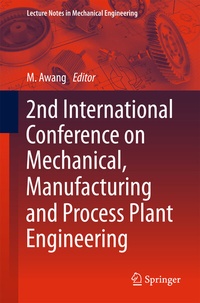
2nd International Conference on Mechanical, Manufacturing and Process Plant Engineering
Published on 28. April 2017
VI, 126 pages
978-981-10-4232-4 (ISBN)
Description

This volume presents selected papers from the 2nd International Conference on Mechanical, Manufacturing and Process Plant Engineering (ICMMPE 2016) which was held from 23rd to 24th November, 2016 in Kuala Lumpur, Malaysia. The proceedings discuss genuine problems of joining technologies that are heart of manufacturing sectors. It discusses the findings of experimental and numerical works from soldering, arc welding to solid state joining technology that faced by current industry.
More details
Series
Edition
1st ed. 2017
Language
English
Place of publication
Singapore
Singapore
Publishing group
Springer Singapore
Target group
Professional and scholarly
Product notice
Reflowable
Illustrations
VI, 126 p. 72 illus., 54 illus. in color.
File size
5,08 MB
ISBN-13
978-981-10-4232-4 (9789811042324)
DOI
10.1007/978-981-10-4232-4
Schweitzer Classification
Other editions
Additional editions
Mokhtar Awang
2nd International Conference on Mechanical, Manufacturing and Process Plant Engineering
Book
04/2017
Springer
€106.99
Shipment within 15-20 days
Person
Content
1 - Contents [Seite 6]
2 - 1 A Review of Friction Stir Welding Pin Profile [Seite 8]
2.1 - Abstract [Seite 8]
2.2 - 1 Introduction [Seite 8]
2.3 - 2 Experimental Studies on FSW Pin Profiles [Seite 10]
2.4 - 3 Simulation on FSW Pin Profiles [Seite 15]
2.5 - 4 Optimization on FSW Pin Profiles [Seite 17]
2.6 - 5 Conclusion [Seite 18]
2.7 - Acknowledgements [Seite 18]
2.8 - Appendix 1: A Summary of Experimental Study on Different Pin Profiles [Seite 19]
2.9 - References [Seite 23]
3 - 2 Friction Stir Welding of Polymers: An Overview [Seite 26]
3.1 - Abstract [Seite 26]
3.2 - 1 Introduction [Seite 26]
3.3 - 2 Friction Stir Weldability of Polymers [Seite 28]
3.4 - 3 The Research Progress in Friction Stir Welding of Polymers [Seite 29]
3.4.1 - 3.1 Optimum Welding Parameters for the FSW of Polymers [Seite 29]
3.4.2 - 3.2 Role of Tool Design on FSW of Polymers [Seite 33]
3.4.3 - 3.3 Effects of External Heat Induction [Seite 35]
3.4.4 - 3.4 Submerged FSW of Polymers [Seite 36]
3.4.5 - 3.5 Microstructure Evolution [Seite 36]
3.4.6 - 3.6 Elimination of Root Defect in FSW of Polymers [Seite 37]
3.4.7 - 3.7 Effects of Crystallinity on the Properties of Polymer [Seite 38]
3.4.8 - 3.8 Material Flow During FSW Process [Seite 39]
3.5 - 4 Conclusions [Seite 40]
3.6 - 5 Recommendations [Seite 40]
3.7 - Acknowledgements [Seite 41]
3.8 - References [Seite 41]
4 - 3 Variation of Tool Offsets and Its Influence on Mechanical Properties of Dissimilar Friction Stir Welding of Aluminum Alloy 6061 and S235JR Mild Steel by Conventional Belting Milling Machine [Seite 44]
4.1 - Abstract [Seite 44]
4.2 - 1 Introduction [Seite 44]
4.3 - 2 Experimental Procedure [Seite 46]
4.4 - 3 Results [Seite 47]
4.4.1 - 3.1 Effect of Tool Offset [Seite 47]
4.4.1.1 - 3.1.1 Tool Offset +0.2 mm [Seite 47]
4.4.1.2 - 3.1.2 Tool Offset 0 mm [Seite 48]
4.4.1.3 - 3.1.3 Tool Offset ?0.2 mm [Seite 50]
4.4.2 - 3.2 Microhardness [Seite 51]
4.5 - 4 Conclusions [Seite 52]
4.6 - References [Seite 53]
5 - 4 Fracture Behavior of Intermetallic Compound (IMC) of Solder Joints Based on Finite Elements' Simulation Result [Seite 55]
5.1 - Abstract [Seite 55]
5.2 - 1 Introduction [Seite 55]
5.3 - 2 Methods [Seite 56]
5.3.1 - 2.1 FE Solder Joint Modeling [Seite 57]
5.4 - 3 Results and Discussion [Seite 59]
5.4.1 - 3.1 Validation of FE Model with Brown & Srawley Equation [Seite 59]
5.4.2 - 3.2 The Effect on Different Crack Length on Fracture Parameter [Seite 59]
5.4.3 - 3.3 The Effect on Different IMC Thickness on Fracture Parameter [Seite 60]
5.4.4 - 3.4 The Effect on Different Young's Modulus on Fracture Parameter [Seite 61]
5.5 - 4 Conclusions [Seite 62]
5.6 - Acknowledgements [Seite 62]
5.7 - References [Seite 62]
6 - 5 Effect of Isothermal Aging on Mechanical Properties of Sn-3.0Ag-0.5Cu Solder Alloy with Porous Cu Interlayer Addition [Seite 64]
6.1 - Abstract [Seite 64]
6.2 - 1 Introduction [Seite 64]
6.3 - 2 Experimental Procedures [Seite 66]
6.3.1 - 2.1 Material Selection and Sample Preparation [Seite 66]
6.3.2 - 2.2 Isothermal Aging and Analysis Procedure [Seite 66]
6.4 - 3 Results and Discussion [Seite 67]
6.4.1 - 3.1 Effect of Porous Cu Interlayer on Joint Strength During Isothermal Aging Process [Seite 67]
6.4.2 - 3.2 Fracture Surface Analysis [Seite 68]
6.5 - 4 Conclusions [Seite 71]
6.6 - Acknowledgements [Seite 71]
6.7 - References [Seite 71]
7 - 6 On Amorphous Phase Formation in Dissimilar Friction Stir Welding of Aluminum to Steel [Seite 73]
7.1 - Abstract [Seite 73]
7.2 - 1 Introduction [Seite 74]
7.2.1 - 1.1 Hybrid Structure [Seite 74]
7.2.2 - 1.2 Friction Stir Welding [Seite 75]
7.2.3 - 1.3 Amorphous Phase [Seite 75]
7.3 - 2 Experimental Works [Seite 77]
7.4 - 3 Results and Discussion [Seite 78]
7.5 - 4 Conclusion [Seite 84]
7.6 - References [Seite 85]
8 - 7 Influence of Loading Rate on Deformation Behaviour and Sealing Performance of Spiral Wound Gasket in Flange Joint [Seite 86]
8.1 - Abstract [Seite 86]
8.2 - 1 Introduction [Seite 87]
8.3 - 2 Experimental Procedure [Seite 88]
8.4 - 3 Gasket Characteristics at Different Loading Rate [Seite 90]
8.5 - 4 Flange Joint with Gasket [Seite 90]
8.5.1 - 4.1 FE Model of Flange Joint [Seite 91]
8.6 - 5 Gasket Behaviour [Seite 92]
8.6.1 - 5.1 Gasket Contact Stress Distribution [Seite 93]
8.6.2 - 5.2 Sealing Performance [Seite 94]
8.7 - 6 Conclusions [Seite 95]
8.8 - References [Seite 96]
9 - 8 Effect of Bevel Angles on Tensile Strength of SS304 Steel Weld Joints [Seite 97]
9.1 - Abstract [Seite 97]
9.2 - 1 Introduction [Seite 97]
9.3 - 2 Experimental Procedure [Seite 100]
9.3.1 - 2.1 Modelling [Seite 100]
9.3.2 - 2.2 Experiment Methodology [Seite 101]
9.4 - 3 Results and Discussion [Seite 104]
9.4.1 - 3.1 Results [Seite 104]
9.4.2 - 3.2 Discussion [Seite 105]
9.4.2.1 - 3.2.1 Yield Stress [Seite 106]
9.5 - 4 Conclusions [Seite 107]
9.6 - Acknowledgements [Seite 108]
9.7 - References [Seite 108]
10 - 9 Developing a Finite Element Model for Thermal Analysis of Friction Stir Welding by Calculating Temperature Dependent Friction Coefficient [Seite 109]
10.1 - Abstract [Seite 109]
10.2 - 1 Introduction [Seite 110]
10.3 - 2 Mathematical Model Description [Seite 112]
10.3.1 - 2.1 Sliding, Sticking and Partial Sliding/Sticking Condition [Seite 112]
10.4 - 3 Experimental Set-up [Seite 115]
10.5 - 4 Numerical Model Description [Seite 116]
10.6 - 5 Results and Discussion [Seite 117]
10.6.1 - 5.1 The Effect of the Temperature in the Friction Coefficient [Seite 117]
10.6.2 - 5.2 Temperature Distribution Results at Different Welding Stages [Seite 120]
10.6.3 - 5.3 Temperature Profile at the Welding Cross Section [Seite 120]
10.6.4 - 5.4 Temperature Distribution in the Top Surface [Seite 123]
10.6.5 - 5.5 Temperature Comparison of Different Friction Coefficient Values [Seite 125]
10.7 - 6 Conclusions [Seite 126]
10.8 - References [Seite 127]
2 - 1 A Review of Friction Stir Welding Pin Profile [Seite 8]
2.1 - Abstract [Seite 8]
2.2 - 1 Introduction [Seite 8]
2.3 - 2 Experimental Studies on FSW Pin Profiles [Seite 10]
2.4 - 3 Simulation on FSW Pin Profiles [Seite 15]
2.5 - 4 Optimization on FSW Pin Profiles [Seite 17]
2.6 - 5 Conclusion [Seite 18]
2.7 - Acknowledgements [Seite 18]
2.8 - Appendix 1: A Summary of Experimental Study on Different Pin Profiles [Seite 19]
2.9 - References [Seite 23]
3 - 2 Friction Stir Welding of Polymers: An Overview [Seite 26]
3.1 - Abstract [Seite 26]
3.2 - 1 Introduction [Seite 26]
3.3 - 2 Friction Stir Weldability of Polymers [Seite 28]
3.4 - 3 The Research Progress in Friction Stir Welding of Polymers [Seite 29]
3.4.1 - 3.1 Optimum Welding Parameters for the FSW of Polymers [Seite 29]
3.4.2 - 3.2 Role of Tool Design on FSW of Polymers [Seite 33]
3.4.3 - 3.3 Effects of External Heat Induction [Seite 35]
3.4.4 - 3.4 Submerged FSW of Polymers [Seite 36]
3.4.5 - 3.5 Microstructure Evolution [Seite 36]
3.4.6 - 3.6 Elimination of Root Defect in FSW of Polymers [Seite 37]
3.4.7 - 3.7 Effects of Crystallinity on the Properties of Polymer [Seite 38]
3.4.8 - 3.8 Material Flow During FSW Process [Seite 39]
3.5 - 4 Conclusions [Seite 40]
3.6 - 5 Recommendations [Seite 40]
3.7 - Acknowledgements [Seite 41]
3.8 - References [Seite 41]
4 - 3 Variation of Tool Offsets and Its Influence on Mechanical Properties of Dissimilar Friction Stir Welding of Aluminum Alloy 6061 and S235JR Mild Steel by Conventional Belting Milling Machine [Seite 44]
4.1 - Abstract [Seite 44]
4.2 - 1 Introduction [Seite 44]
4.3 - 2 Experimental Procedure [Seite 46]
4.4 - 3 Results [Seite 47]
4.4.1 - 3.1 Effect of Tool Offset [Seite 47]
4.4.1.1 - 3.1.1 Tool Offset +0.2 mm [Seite 47]
4.4.1.2 - 3.1.2 Tool Offset 0 mm [Seite 48]
4.4.1.3 - 3.1.3 Tool Offset ?0.2 mm [Seite 50]
4.4.2 - 3.2 Microhardness [Seite 51]
4.5 - 4 Conclusions [Seite 52]
4.6 - References [Seite 53]
5 - 4 Fracture Behavior of Intermetallic Compound (IMC) of Solder Joints Based on Finite Elements' Simulation Result [Seite 55]
5.1 - Abstract [Seite 55]
5.2 - 1 Introduction [Seite 55]
5.3 - 2 Methods [Seite 56]
5.3.1 - 2.1 FE Solder Joint Modeling [Seite 57]
5.4 - 3 Results and Discussion [Seite 59]
5.4.1 - 3.1 Validation of FE Model with Brown & Srawley Equation [Seite 59]
5.4.2 - 3.2 The Effect on Different Crack Length on Fracture Parameter [Seite 59]
5.4.3 - 3.3 The Effect on Different IMC Thickness on Fracture Parameter [Seite 60]
5.4.4 - 3.4 The Effect on Different Young's Modulus on Fracture Parameter [Seite 61]
5.5 - 4 Conclusions [Seite 62]
5.6 - Acknowledgements [Seite 62]
5.7 - References [Seite 62]
6 - 5 Effect of Isothermal Aging on Mechanical Properties of Sn-3.0Ag-0.5Cu Solder Alloy with Porous Cu Interlayer Addition [Seite 64]
6.1 - Abstract [Seite 64]
6.2 - 1 Introduction [Seite 64]
6.3 - 2 Experimental Procedures [Seite 66]
6.3.1 - 2.1 Material Selection and Sample Preparation [Seite 66]
6.3.2 - 2.2 Isothermal Aging and Analysis Procedure [Seite 66]
6.4 - 3 Results and Discussion [Seite 67]
6.4.1 - 3.1 Effect of Porous Cu Interlayer on Joint Strength During Isothermal Aging Process [Seite 67]
6.4.2 - 3.2 Fracture Surface Analysis [Seite 68]
6.5 - 4 Conclusions [Seite 71]
6.6 - Acknowledgements [Seite 71]
6.7 - References [Seite 71]
7 - 6 On Amorphous Phase Formation in Dissimilar Friction Stir Welding of Aluminum to Steel [Seite 73]
7.1 - Abstract [Seite 73]
7.2 - 1 Introduction [Seite 74]
7.2.1 - 1.1 Hybrid Structure [Seite 74]
7.2.2 - 1.2 Friction Stir Welding [Seite 75]
7.2.3 - 1.3 Amorphous Phase [Seite 75]
7.3 - 2 Experimental Works [Seite 77]
7.4 - 3 Results and Discussion [Seite 78]
7.5 - 4 Conclusion [Seite 84]
7.6 - References [Seite 85]
8 - 7 Influence of Loading Rate on Deformation Behaviour and Sealing Performance of Spiral Wound Gasket in Flange Joint [Seite 86]
8.1 - Abstract [Seite 86]
8.2 - 1 Introduction [Seite 87]
8.3 - 2 Experimental Procedure [Seite 88]
8.4 - 3 Gasket Characteristics at Different Loading Rate [Seite 90]
8.5 - 4 Flange Joint with Gasket [Seite 90]
8.5.1 - 4.1 FE Model of Flange Joint [Seite 91]
8.6 - 5 Gasket Behaviour [Seite 92]
8.6.1 - 5.1 Gasket Contact Stress Distribution [Seite 93]
8.6.2 - 5.2 Sealing Performance [Seite 94]
8.7 - 6 Conclusions [Seite 95]
8.8 - References [Seite 96]
9 - 8 Effect of Bevel Angles on Tensile Strength of SS304 Steel Weld Joints [Seite 97]
9.1 - Abstract [Seite 97]
9.2 - 1 Introduction [Seite 97]
9.3 - 2 Experimental Procedure [Seite 100]
9.3.1 - 2.1 Modelling [Seite 100]
9.3.2 - 2.2 Experiment Methodology [Seite 101]
9.4 - 3 Results and Discussion [Seite 104]
9.4.1 - 3.1 Results [Seite 104]
9.4.2 - 3.2 Discussion [Seite 105]
9.4.2.1 - 3.2.1 Yield Stress [Seite 106]
9.5 - 4 Conclusions [Seite 107]
9.6 - Acknowledgements [Seite 108]
9.7 - References [Seite 108]
10 - 9 Developing a Finite Element Model for Thermal Analysis of Friction Stir Welding by Calculating Temperature Dependent Friction Coefficient [Seite 109]
10.1 - Abstract [Seite 109]
10.2 - 1 Introduction [Seite 110]
10.3 - 2 Mathematical Model Description [Seite 112]
10.3.1 - 2.1 Sliding, Sticking and Partial Sliding/Sticking Condition [Seite 112]
10.4 - 3 Experimental Set-up [Seite 115]
10.5 - 4 Numerical Model Description [Seite 116]
10.6 - 5 Results and Discussion [Seite 117]
10.6.1 - 5.1 The Effect of the Temperature in the Friction Coefficient [Seite 117]
10.6.2 - 5.2 Temperature Distribution Results at Different Welding Stages [Seite 120]
10.6.3 - 5.3 Temperature Profile at the Welding Cross Section [Seite 120]
10.6.4 - 5.4 Temperature Distribution in the Top Surface [Seite 123]
10.6.5 - 5.5 Temperature Comparison of Different Friction Coefficient Values [Seite 125]
10.7 - 6 Conclusions [Seite 126]
10.8 - References [Seite 127]
