

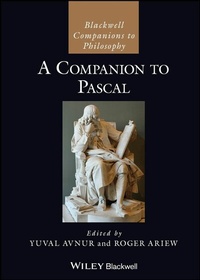
A Companion to Pascal
Description

An interdisciplinary exploration of Pascal's philosophy across theology, science, and political thought
Blaise Pascal has emerged as a central figure in early modern thought whose legacy transcends traditional disciplinary boundaries. A Companion to Pascal addresses the growing scholarly need for an integrated perspective on his philosophy, bringing together essays by leading scholars that contextualize, analyze, and extend Pascal's work. It offers a wide-ranging and in-depth examination of Pascal's multifaceted intellectual contributions that enables readers to progressively build and apply knowledge across the disciplines Pascal influenced, ranging from theology and mathematics to epistemology and political philosophy.
The Companion opens by situating Pascal within his intellectual milieu-his interactions with Augustinian theology, his responses to Montaigne and Descartes, and his involvement with the Port-Royal community. Parts II and III move into Pascal's technical contributions, including his foundational role in probability and physics and his unique epistemological stance. Subsequent sections examine Pascal's rhetorical strategies and religious commitments alongside his political and ethical views. The final part assesses Pascal's enduring influence, tracing his impact through figures such as Søren Kierkegaard, William James, and Pierre Duhem.
A vital resource for those seeking an understanding of Pascal's philosophical outlook and enduring legacy, A Companion to Pascal:
- Presents a unique interdisciplinary approach to Pascal that spans philosophy, theology, science, literature, and political thought
- Offers new perspectives on Pascal's engagement with Descartes, Montaigne, and Augustine
- Explores lesser-known dimensions of Pascal's work, such as his influence on phenomenology and Marxist theory
- Analyzes the philosophical implications of Pascal's scientific and mathematical innovations
- Includes focused chapters on Pascal's Wager, logic, epistemology, and his views on grace and predestination
With a comprehensive structure that allows both thematic and chronological exploration of Pascal's thought, A Companion to Pascal is ideal for advanced students and scholars in philosophy, theology, history of science, and French literature. It is particularly valuable for university-level courses in Early Modern Philosophy, Philosophy of Religion, and Intellectual History, and serves as an essential reference for academics, educators, and interdisciplinary researchers.
More details
Other editions
Additional editions

Persons
Yuval Avnur is Professor of Philosophy at Scripps College, Claremont. His research focuses on epistemology and early modern philosophy, with a particular interest in skepticism and religion. Avnur has published widely on these issues, and is author of The Skeptic and the Veridicalist and Why Read Pascal Today? He is also editor of Midwest Studies in Philosophy and co-editor of Introduction to Philosophy: Classical and Contemporary Readings.
Roger Ariew is Distinguished University Professor of Philosophy at the University of South Florida. A leading scholar of Descartes and Cartesianism, Ariew is the author of Descartes Among the Scholastics, Descartes and the First Cartesians,¿and co-author of Historical Dictionary of Descartes and Cartesian Philosophy.
Content
Notes on Contributors vii
Introduction to The Blackwell Companion to Pascal 1
Roger Ariew and Yuval Avnur
Part I The Intellectual Context 11
1 Pascal, Life, and Works 13
Daniel Collette
2 The Augustinian Model: The True Religion 33
Vincent Carraud and Yoen Qian- Laurent
3 Pascal and Montaigne: Reading, Interpreting, and Using 55
Alberto Frigo
4 Pascal as a Reader of Descartes 72
Dan Arbib
5 Pascal(s), Arnauld(s), and Port- Royal(s) 93
Eric Stencil
6 The Theological Context for Pascal's Wager 113
Roger Ariew
Part II Mathematics and Natural Philosophy 135
7 Pascal's Mathematics 137
Sébastien Maronne
8 Pascal's "Physics" 177
Aaron Spink Copyrighted Material
9 Pascal's Philosophy of Science 192
Sophie Roux
Part III Logic, Epistemology, and Metaphysics 211
10 Pascal and the Port- Royal Logic: The Making of a Pascal Logician 213
Élodie Cassan
11 The Geometric Mind 236
Gilles Olivo
12 Pascal's Cordate Skepticism 252
Yuval Avnur
13 Knowledge and Belief in Pascal's Philosophy 269
Yoen Qian-Laurent
14 Pascal on Mind and Free Will 299
William Wood
Part IV Literary Style, Religion, Ethics, and Political Philosophy 317
15 Pascal and Poetry 319
Tony Gheeraert
16 Pascal on Divine Hiddenness 340
John L. Schellenberg
17 Grace and Predestination According to Pascal: The Truth of Saint Augustine's Followers "Holds the Middle" Between Two Contrary Errors 351
Sylvain Josset
18 Ethics and Casuistry: The Ethics of Debate in Pascal's Provincial Letters 367
Syliane Malinowski- Charles and Marc André Bernier
19 The Provincial Letters 381
Emma Gilby
20 Pascal's Political Philosophy 397
Ryan Patrick Hanley
Part V Legacy 413
21 Pascal, Inc.: Jacqueline Pascal and Gilberte Pascal- Périer 415
Daniel Collette
22 From Pascal to Malebranche: An Ambiguous Legacy 426
Madeleine Ropars
23 Moralizing the Wager: Pascal's Wager, Kant's Moral Argument, and Clifford's Principle 442
Lawrence Pasternack
24 Kierkegaard 455
Lydia Amir
25 Pascal and William James 479
Jeffrey Jordan
26 Pierre Duhem's Pascalian Philosophy of Science 494
Roger Ariew
27 Marxists on Pascal: Henri Lefebvre and Lucien Goldmann 507
Michael Moriarty
28 Pascal in the Light of the Phenomenology of Max Scheler and Martin Heidegger 519
Sylvain Josset
29 Pascalian Expectations and Explorations 532
Alan Hájek and Elizabeth Jackson
Index 551
Notes on Contributors
Professor Lydia Amir teaches at the Department of Philosophy at Tufts University in the USA. Apart from various articles and essays, she authored five books, one on philosophy in France (Routledge 2021), and edited two anthologies and one handbook. She works under contract on a few additional manuscripts, among them a book on Montaigne for Brill and on Spinoza and Nietzsche for de Gruyter. She contributed to the official publications of the Kierkegaard Center in Copenhagen and published in the Kierkegaard Studies Yearbook. She edits a journal that she has founded and four book series, one on Spinoza and His Legacy.
Dan Arbib , a former student of the École Normale Supérieure, agrégé and Doctor of Philosophy, is a maître de conférences in the history of modern philosophy at Sorbonne University. Scientific secretary of the Bulletin cartésien since 2010, he has published La lucidité de l'éthique. Etudes sur Levinas (Hermann, 2014), Descartes, la métaphysique et l'infini (PUF, 2017, 2nd ed. 2021) and edited the collective work devoted to Descartes; Méditations métaphysiques, Objections et Réponses (Vrin, 2019).
Roger Ariew is a Distinguished University Professor at the University of South Florida. He is the author of Descartes among the Scholastics (Brill, 2011) and Descartes and the First Cartesians (Oxford, 2014), among other works, and is currently producing, with Erik-Jan Bos, René Descartes, The Complete Correspondence in English Translation, 3 vols. (Oxford); vol. I: From the Early Years to the Discourse on Method, 1619-1638, was published in 2024.
Yuval Avnur is Professor of Philosophy at Scripps College, Claremont. He has written widely on skepticism, philosophy of religion, applied epistemology, Hume, and Pascal, including Why Read Pascal Today?, a forthcoming book for Cambridge University Press. He is also editor of Midwest Studies in Philosophy and coeditor of this volume.
Marc André Bernier is a full professor of French literature at the Université du Québec à Trois-Rivières, Marc André Bernier is a member of the Royal Society of Canada's Academy of Arts and Humanities. A former president of the International Society for Eighteenth-Century Studies (ISECS), he has been director of the Centre interuniversitaire de recherche sur la première modernité, XVIe-XVIIIe siècles (CIREM 16-18) since 2020. His work focuses on rhetoric, literary archives, and the relations between literature and moral philosophy during the early modern period.
Vincent Carraud is Professor of the History of Modern Philosophy at the Sorbonne and Director of the Centre d'études cartésiennes. In 2010, he was awarded the Grand Prix de Philosophie by the Académie Française. He is the author of numerous works on Pascal, including Pascal et la philosophie (PUF, Épimethée, 2007 [1992], Quadrige, 2023), Pascal. Des connaissances naturelles à l'étude de l'homme (Vrin, 2007) and Pascal: de la certitude (PUF, 2023).
Élodie Cassan is Associate Professor in the Philosophy Department of University of Rouen Normandy (URN) and a Research Member of Équipe de Recherche Interdisciplinaire sur les Aires Culturelles (ERIAC, UR 4705). Her recent publications include Logic and Methodology in the Early Modern Period, a special issue of Perspectives on Science (no. 29-3; 2021) which she edited, and the monograph Le Langage de la raison. De Descartes à la Linguistique cartésienne (Paris, Vrin, 2023).
Daniel Collette is a teaching assistant professor at Marquette University. His work focuses on Pascalian metaphysics and Mary Shepherd's philosophy of religion. He has published on Hobbes, Descartes, Leibniz, and John Amos Comenius; at present, he is coediting the Philosophical Works of Blaise and Jacqueline Pascal.
Alberto Frigo teaches the history of modern philosophy at the Università Statale of Milan. He has published two monographs on Pascal (L'évidence du Dieu caché. Introduction à lecture des Pensées de Pascal, PURH 2015; L'esprit du corps. La doctrine pascalienne de l'amour, Vrin 2016) and has edited Montaigne's Correspondence (Le Monnier 2010) and Sebond's Theologia naturalis (Latin text and Montaigne's French translation, Garnier 2022). His latest essay is Charité bien ordonnée de saint Augustin à Goethe. Six etudes (Cerf 2021).
Tony Gheeraert , a former student of the École Normale Supérieure in Paris, is a Professor of French Literature at the University of Rouen Normandie. He is the author of Le Chant de la grâce. Port-Royal et la poésie (2003, awarded the Pierre-Georges Castex Prize by the Académie des Sciences Morales et Politiques), Saturne aux deux visages: introduction à l'Astrée d'Honoré d'Urfé (2005), and Une fantaisie à la manière de Callot: introduction au Roman comique de Scarron (2021). He has also edited the tales of Perrault and his contemporaries (2006 and 2012), and the Oeuvres chrétiennes d'Arnauld d'Andilly (2020).
Emma Gilby is Professor of Early Modern French Literature and Thought at the University of Cambridge, and currently Director of French. Much of her research has focused on poetic theory and its connections to the rhetoric, philosophy, and theology of seventeenth-century France. Her more recent publications include Descartes's Fictions: Reading Philosophy with Poetics (OUP, 2018) and, as co-editor, The Places of Early Modern Criticism (OUP, 2022).
Alan Hájek is a professor of philosophy at the Australian National University. His research interests include the philosophical foundations of probability and decision theory, formal epistemology, conditionals, and philosophy of religion. He studied statistics and mathematics at the University of Melbourne, received an MA in philosophy at the University of Western Ontario, and a PhD in philosophy at Princeton University. He taught at the California Institute of Technology before moving to the ANU.
Ryan Patrick Hanley is Professor of Political Science at Boston College and author of over sixty articles and chapters and four books on early modern political philosophy, including Love's Enlightenment: Rethinking Charity in Modernity (Cambridge, 2017), and The Political Philosophy of Fénelon (Oxford, 2020). He is also editor and translator of Fénelon: Moral and Political Writings (Oxford, 2020), and editor of Love: A History, forthcoming from OUP in the Oxford Philosophical Concepts series.
Elizabeth Jackson is an Associate Professor of Philosophy at Saint Louis University. Her research is in epistemology and philosophy of religion. In epistemology, she is interested in the belief-credence connection, epistemic permissivism, and pragmatic and moral encroachment. In philosophy of religion, she's interested in the rationality of religious commitment, and specifically Pascal's Wager and the nature of faith. She completed her PhD in philosophy at the University of Notre Dame.
Jeffrey Jordan (1959-2025) was Professor of Philosophy at the University of Delaware, where he joined the faculty in 1990. His research focused on the philosophy of religion. He was the author of Pascal's Wager: Pragmatic Arguments and Belief in God (Oxford University Press, 2006), editor of Gambling on God: Essays on Pascal's Wager (Rowman & Littlefield, 1994), and co-editor, with Daniel Howard-Snyder, of Faith, Freedom, and Rationality: Essays in the Philosophy of Religion (Rowman & Littlefield, 1996).
Sylvain Josset holds the highest French teaching qualification (Agrégation) in philosophy and a PhD in philosophy. His doctoral thesis was on "La logique du cour" selon Pascal. Surmonter le cartésianisme. He is currently a researcher on a Franco-German project on the phenomenologist Max Scheler (Sorbonne University and European University Viadrina Frankfurt (Oder)). His areas of research are modern philosophy, contemporary philosophy and phenomenology, and metaphysics, ontology, and epistemology.
Syliane Malinowski-Charles is a full professor of philosophy at the Université du Québec à Trois-Rivières (QC, Canada), where she started to teach in 2011. After the completion of her PhD on the affects in Spinoza in 2002 and two postdoctoral fellowships (Montréal and Princeton), she was appointed at Temple University (Philadelphia) and subsequently taught at Bishop's University (Sherbrooke). Her research deals mostly with theories of mind in Early Modern Philosophy, notably in Spinoza, Descartes, Pascal, Malebranche, and Hobbes.
Sébastien Maronne is an associate professor of history and philosophy of mathematics at the Mathematical Institute of Toulouse, France. He works on the history of early modern mathematics (Descartes, Pascal, Roberval) and on historical epistemology...
