

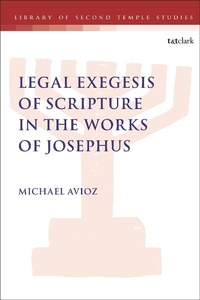
Legal Exegesis of Scripture in the Works of Josephus
1st Edition
Published on 12. November 2020
192 pages
978-0-567-68116-4 (ISBN)
Description

Michael Avioz builds upon his earlier work on Josephus as an exegete, providing a comprehensive study of Josephus' contribution to the crystallization of the Halakha which focuses on the similarities (and dissimilarities) between his work and the tannaitic sources, as well as contemporary Second Temple sources.
Avioz begins by providing a clear definition of Halakha, and offering an explanation of methodology and sources. He then examines the structure and contents of the Pentateuch in Josephus' writing, before moving on to more specific coverage of the Decalogue in the work of Josephus and its relation to other laws in the Pentateuch. Further analysis is applied to the laws in the books of Leviticus-Deuteronomy and on laws that appear outside the Pentateuch. Throughout, Avioz makes close comparisons between biblical laws and Josephus' rewriting of them, in order to consider the reasons behind this rewriting and the origins of the texts that Josephus may have had access to in his exegetical work. Avioz is consequently able to draw clear conclusions about the interpretative traditions that Josephus had access to and worked within, and about how he used them in his writing.
Avioz begins by providing a clear definition of Halakha, and offering an explanation of methodology and sources. He then examines the structure and contents of the Pentateuch in Josephus' writing, before moving on to more specific coverage of the Decalogue in the work of Josephus and its relation to other laws in the Pentateuch. Further analysis is applied to the laws in the books of Leviticus-Deuteronomy and on laws that appear outside the Pentateuch. Throughout, Avioz makes close comparisons between biblical laws and Josephus' rewriting of them, in order to consider the reasons behind this rewriting and the origins of the texts that Josephus may have had access to in his exegetical work. Avioz is consequently able to draw clear conclusions about the interpretative traditions that Josephus had access to and worked within, and about how he used them in his writing.
More details
Series
Edition
1. Auflage
Language
English
Place of publication
London
United Kingdom
Publishing group
Bloomsbury Publishing PLC
Target group
Professional and scholarly
ISBN-13
978-0-567-68116-4 (9780567681164)
Copyright in bibliographic data and cover images is held by Nielsen Book Services Limited or by the publishers or by their respective licensors: all rights reserved.
Schweitzer Classification
Other editions
Additional editions
Michael Avioz
Legal Exegesis of Scripture in the Works of Josephus
Book
08/2022
T.& T.Clark Ltd
€57.13
Shipment within 3-4 weeks
Michael Avioz
Legal Exegesis of Scripture in the Works of Josephus
Book
11/2020
T.& T.Clark Ltd
€136.60
Shipment within 3-4 weeks
Person
Content
Preface
Abbreviations
Introduction
Chapter 1: The Laws of Exodus in Josephus
Chapter 2: The Laws of Leviticus in Josephus' Writings
Chapter 3: The Laws of the Book of Numbers in Josephus
Chapter 4: The Laws of Deuteronomy in Josephus
Chapter 5: Juxtaposition in Josephus' Rewriting of the Laws
Chapter 6: Reasons for the Commandments in Josephus' Writings
Chapter 7: Josephus' Perspective on Defining Moses as a Lawgiver or Mediator
Chapter 8: Was Josephus Influenced by Roman Law?
Conclusions
Bibliography
Index
Abbreviations
Introduction
Chapter 1: The Laws of Exodus in Josephus
Chapter 2: The Laws of Leviticus in Josephus' Writings
Chapter 3: The Laws of the Book of Numbers in Josephus
Chapter 4: The Laws of Deuteronomy in Josephus
Chapter 5: Juxtaposition in Josephus' Rewriting of the Laws
Chapter 6: Reasons for the Commandments in Josephus' Writings
Chapter 7: Josephus' Perspective on Defining Moses as a Lawgiver or Mediator
Chapter 8: Was Josephus Influenced by Roman Law?
Conclusions
Bibliography
Index
