

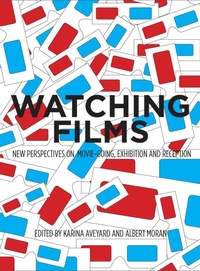
Watching Films
New Perspectives on Movie-Going, Exhibition and Reception
1st Edition
Published on 6. January 2013
442 pages
978-1-78320-165-5 (ISBN)
Description

Whether we stream them on our laptops, enjoy them in theatres or slide them into DVD players to watch on our TVs, movies are part of what it means to be socially connected in the twenty-first century. Despite its significant role in our lives, the act of watching films remains an area of social activity that is little studied and thus, little understood.
In Watching Films, an international cast of contributors correct this problem with a comprehensive investigation of movie going, cinema exhibition, and film reception around the world. With a focus on the social, economic and cultural factors that influence how we watch and think about movies, this volume centres its investigations on four areas of inquiry: Who watches films? Under what circumstances? What consequences and affects follow? And what do these acts of consumption mean? Responding to these questions, the contributors provide both historical perspective and fresh insights about the ways in which new viewing arrangements and technologies influence how films get watched everywhere from Canada to China to Ireland.
A long-overdue consideration of an important topic, Watching Films provides an engrossing overview of how we do just that in our homes and across the globe.
In Watching Films, an international cast of contributors correct this problem with a comprehensive investigation of movie going, cinema exhibition, and film reception around the world. With a focus on the social, economic and cultural factors that influence how we watch and think about movies, this volume centres its investigations on four areas of inquiry: Who watches films? Under what circumstances? What consequences and affects follow? And what do these acts of consumption mean? Responding to these questions, the contributors provide both historical perspective and fresh insights about the ways in which new viewing arrangements and technologies influence how films get watched everywhere from Canada to China to Ireland.
A long-overdue consideration of an important topic, Watching Films provides an engrossing overview of how we do just that in our homes and across the globe.
Reviews / Votes
'Addresses a broad range of topics under the umbrella of "new cinema history," and thus serves as a jumping-off point for new and established scholars interested in exploring a different form of film criticism and analysis' -- CHOICE, A. F. Winstead 'Texts like 'Watching Films' prove invaluable with their emphasis on audience research and exhibition practices.' -- Post Script, L. Raw 'The collection is intended to address neglected terrain within film studies, to complement the wealth of material focused purely on the cinematic text. The collection succeeds, aptly demonstrating the value of analyzing broader infrastructures of reception.' -- Media International Australia, C. HightMore details
Edition
1. Auflage
Language
English
Place of publication
United Kingdom
Publishing group
Intellect
Target group
Professional and scholarly
ISBN-13
978-1-78320-165-5 (9781783201655)
Copyright in bibliographic data and cover images is held by Nielsen Book Services Limited or by the publishers or by their respective licensors: all rights reserved.
Schweitzer Classification
Other editions
Additional editions
Karina Aveyard | Albert Moran
Watching Films
New Perspectives on Movie-Going, Exhibition and Reception
Book
08/2013
Intellect Books
€34.70
Shipment within 3-4 weeks
Persons
Karina Aveyard is a lecturer in the School of Film, Television and Media at the University of East Anglia. Her essays have been published in Media International Australia and Participations and Studies in Australasian Cinema. Karina's research interests include rural and community cinemas, exhibition and distribution and Australian films.
Albert Moran is Professor in the School of Humanities at Griffith University. His most recent books are the monograph New Flows in Global TV (Intellect) and the edited collections Cultural Adaptation (Routledge) and TV Formats Worldwide: Localizing Global Programs (Intellect). Work in progress includes a business biography of the Australian TV format pioneer, Reg Grundy.
Albert Moran is Professor in the School of Humanities at Griffith University. His most recent books are the monograph New Flows in Global TV (Intellect) and the edited collections Cultural Adaptation (Routledge) and TV Formats Worldwide: Localizing Global Programs (Intellect). Work in progress includes a business biography of the Australian TV format pioneer, Reg Grundy.
