

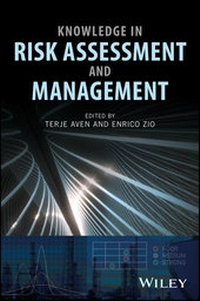
Knowledge in Risk Assessment and Management
Description

Risk assessment and management is fundamentally founded on the knowledge available on the system or process under consideration. While this may be self-evident to the laymen, thought leaders within the risk community have come to recognize and emphasize the need to explicitly incorporate knowledge (K) in a systematic, rigorous, and transparent framework for describing and modeling risk.
Featuring contributions by an international team of researchers and respected practitioners in the field, this book explores the latest developments in the ongoing effort to use risk assessment as a means for characterizing knowledge and/or lack of knowledge about a system or process of interest. By offering a fresh perspective on risk assessment and management, the book represents a significant contribution to the development of a sturdier foundation for the practice of risk assessment and for risk-informed decision making.
How should K be described and evaluated in risk assessment? How can it be reflected and taken into account in formulating risk management strategies? With the help of numerous case studies and real-world examples, this book answers these and other critical questions at the heart of modern risk assessment, while identifying many practical challenges associated with this explicit framework.
This book, written by international scholars and leaders in the field, and edited to make coverage both conceptually advanced and highly accessible:
* Offers a systematic, rigorous and transparent perspective and framework on risk assessment and management, explicitly strengthening the links between knowledge and risk
* Clearly and concisely introduces the key risk concepts at the foundation of risk assessment and management
* Features numerous cases and real-world examples, many of which focused on various engineering applications across an array of industries
Knowledge of Risk Assessment and Management is a must-read for risk assessment and management professionals, as well as graduate students, researchers and educators in the field. It is also of interest to policy makers and business people who are eager to gain a better understanding of the foundations and boundaries of risk assessment, and how its outcomes should be used for decision-making.
More details
Other editions
Additional editions
Persons
TERJE AVEN, PhD is Professor in Risk Analysis and Risk Management at the University of Stavanger, Norway. He is Editor-in-Chief of Journal of Risk and Reliability, the Chairman of the European Safety and Reliability Association and President-Elect of the Society for Risk Analysis.
ENRICO ZIO, PhD is Director of the Chair on Systems Science and the Energetic Challenge of the Foundation Electricite' de France, at the Laboratoire de Genie Industriel (LGI), CentraleSupélec, Universite' Paris-Saclay, France, and full professor of the Department of Energy and President of the Alumni Association at Politecnico di Milano, Italy.
Content
List of Contributors vii
Preface ix
Acknowledgements xv
Part I Fundamental Ideas, Principles and Approaches 1
1 Risk Assessment with Broad Uncertainty and Knowledge Characterisation: An Illustrating Case Study 3
Terje Aven and Roger Flage
2 The Enigma of Knowledge in the Risk Field 27
Terje Aven and Marja Ylönen
3 Treatment and Communication of Uncertain Assumptions in (Semi-) quantitative Risk Assessments 49
Roger Flage and Christine L. Berner
4 Critical Slowing-down Framework for Monitoring Early Warning Signs of Surprise and Unforeseen Events 81
Ivan Damnjanovic and Terje Aven
5 Improving the Foundation and Practice of Uncertainty Analysis: Strengthening Links to Knowledge and Risk 103
Terje Aven
6 Completeness Uncertainty: Conceptual Clarification and Treatment 127
Torbjørn Bjerga, Terje Aven, and Roger Flage
7 Quality of Risk Assessment: Definition and Verification 143
Terje Aven and Enrico Zio
8 Knowledge-driven System Simulation for Scenario Analysis in Risk Assessment 165
Pietro Turati, Nicola Pedroni, and Enrico Zio
Part II Risk Assessment and Decision Making 221
9 A Decision Support Method for Prioritizing Investments Subject to Uncertainties 223
Shital Thekdi and Terje Aven
10 Risk Analysis under Structural Uncertainty 241
Sven Ove Hansson
Part III Applications 265
11 A Practical Approach to Risk Assessments from Design to Operation of Offshore Oil and Gas Installations 267
Vegard L. Tuft, Beate R. Wagnild, and Olga M. Slyngstad
12 A Semi-quantitative Approach for Assessment of Risk Trends in the Norwegian Oil and Gas Industry 297
Eirik Bjorheim Abrahamsen, Jon Tømmerås Selvik, Bjørnar Heide, and Jan Erik Vinnem
13 Knowledge Engineering at a Risk-informed Regulatory Agency: Challenges and Suggestions 313
Nathan Siu and Kevin Coyne
Index 339
Preface
This book is about knowledge in risk assessment and management. Why a book on this subject? It is because the assessment and management of risk is fundamentally based on the knowledge and information available. Paradoxically, recognizing this simple fact is an important step forward. Indeed, recently the need has arisen of explicitly specifying the concept that risk is conditioned on knowledge (K). Then, the methodologies and approaches for risk assessment and management are to be seen as the supports for incorporating knowledge into a systematic, rigorous and transparent framework. In other words, risk assessment and management is a way of producing, representing and presenting knowledge about phenomena and the future, and then informing decision makers. This is achieved by developing models, representing and expressing uncertainties, propagating the uncertainties and using probabilities or other measures to describe risk. The description of risk is conditional on the knowledge K, as for example a probability is a judgement of uncertainty given some knowledge of the uncertain process or event. Knowledge is typically based on data and information, and takes the form of justified beliefs - often stated as assumptions in the risk model and characterization.
The value of the risk assessment and management, then, stands on the quality of the methodologies and approaches adopted, and on the strength of the knowledge K on which these are built. Whereas procedures of quality assurance have been developed for the former, how to deal with the latter - knowledge K - is still an open issue and a research challenge in risk assessment and management. How should it be described and evaluated in the risk assessment? How should it be reflected and taken into account in the decision-making process of risk management? This book aims to make some contributions to clarifying the problem, answering some of the questions and meeting the related practical challenges.
The book comprises 12 chapters on the fundamental concepts, ideas, principles and approaches involved (Part I), risk assessment and decision-making methods and issues (Part II) and applications (Part III).
Part I
Chapter 1 sets the stage by looking into the fundamental issues and principles related to knowledge characterization in risk assessment and management. An example is used to drive the illustration. The example is simple but sufficiently complete to allow clear discussions of critical aspects of the process, including risk conceptualization and measurements, treatment of uncertainties, characterization of the knowledge available, accounting for potential surprises, consideration of vulnerability, and robustness and resilience.
Chapter 2 follows up by providing a deep look into the concept of knowledge. The chapter reflects on how the knowledge concept used in risk assessment matches the wealth of studies on knowledge that we find in philosophy and sociology. It is questioned how the risk field can learn from these studies, for further developing the knowledge dimension of risk assessment and management.
Chapter 3 discusses the treatment and communication of uncertain assumptions in relation to risk assessments. The chapter describes a formal setup that connects the risk concept, the risk description, risk indices, and the knowledge dimension, including the assumptions in particular. Then, it presents a scheme for systematizing uncertain assumptions, and it is shown how it can be used to provide recommendations on strategies for the treatment of such assumptions from both a risk analyst's and risk manager's perspectives. The setup and scheme build on recent advances in uncertainty-based risk conceptualizations, including, in particular, the concept of assumption deviation risk: the so-called NUSAP notational scheme for uncertainty and quality in science for policy, and the assumption-based planning framework.
Chapter 4 presents a general framework that can provide information about the validity of the assumptions made in a risk model about a system's future behavior, in order to provide early warnings. This is highly relevant for risk assessment and management, as any model-based risk description is strongly dependent on the underlying modeling assumptions and the validity of these assumptions is difficult to express. This question needs to be addressed to adequately understand, assess and manage risk, in particular the risk related to potential surprises and unforeseen events. The framework described in the chapter is based on a signal-processing approach that monitors for signals associated with a trend change in the system's behavior.
Chapter 5 provides an in-depth analysis of uncertainty analysis in a risk assessment and management context. Given the relevance of uncertainty in risk assessment and management - and indeed the importance of what is not known just as much as what is, the chapter presents a general framework for uncertainty analysis, building on what we are uncertain about, who is uncertain and how we should represent or express the uncertainties. The framework has two distinct features:
- a clear distinction between uncertainty as a concept and the way uncertainty is measured or described
- a distinction between the uncertainty of the analysts and that of the decision makers.
Chapter 6 addresses the concept of completeness uncertainty. The interpretations found in the literature of this term are ambiguous, and its treatment appears difficult. The chapter aims at clarifying what the concept is about and it shows that in essence it can be treated as model uncertainty.
Chapter 7 reflects on issues related to the quality of a risk assessment, addressing both "scientific criteria" and "being useful" in a decision-making context. New insights are gained by considering two novel aspects:
- the perspective of risk assessment, which shifts the focus from the accurate risk estimation to the characterization of knowledge and lack of knowledge
- the recognition that decision makers need to go beyond the conditional risk as described and assessed by the risk analysts and experts, to consider unconditional risk.
The quality of risk assessment is then discussed in this context, highlighting the questions of what it depends on, how it can be ensured and checked.
Chapter 8 puts forward modeling and simulation as ways to explore and understand system behavior, for identifying critical scenarios and avoiding surprises. Recognizing that for complex systems, the simulation models can be:
- high-dimensional
- black-boxes
- dynamic
- computationally expensive
the chapter presents adaptive strategies for guiding the simulations so as to increase knowledge of the critical system behavior in a reasonable computational time. Two simulation frameworks for hazard identification are proposed: one focusing on the search for extreme unknown consequences associated with a given set of scenarios and the other focusing on the exploration of those scenarios, potentially leading the system to critical consequences and the retrieval of the corresponding root causes.
Part II
Chapter 9 presents a decision-support prioritization method that incorporates uncertainty through strength-of-knowledge (SoK) and target-sensitivity assessments. Current thinking for assessing these uncertainties and their importance in the decision-making process is based on a probabilistic perspective and decision analysis. The chapter presents a new method for prioritizing investments with consideration of the most influential uncertainties from the decision-making point of view, thereby allowing for systematic SoK considerations. The method is demonstrated on an emergency management system that is vulnerable to future economic, environmental, and political factors.
Chapter 10 addresses the issue of structuring decisions in the process of risk management. When the decision procedure starts, it is often unsettled or unknown exactly:
- what issues are going to be decided upon
- whether a single decision is going to be made about all of them or the decision will be subdivided and in that case how
- when the decision(s) should be made
- what options are open to the decision-maker(s)
- the criteria for a successful decision.
In the chapter, the structuring of decisions is systematized by dividing it into ten major components. Conceptual tools are introduced that can be used for the analysis and management of each of these components. Careful investigation of the consequences of different ways of structuring decisions can provide decision makers with the knowledge needed to ensure the efficiency and transparency of the risk management decision process.
Part III
Chapter 11 presents a practical approach to risk assessment - quantitative risk analysis (QRA) - of offshore oil and gas installations from design to operation, highlighting the importance of knowledge and related assumptions. A QRA is a powerful decision-support tool, used in many industries exposed to major accident risk. QRAs are often large and comprehensive, and are sometimes criticized for providing results too late, being too costly and not adequately addressing uncertainty and possible deviations in input parameters.
Chapter 12...
