

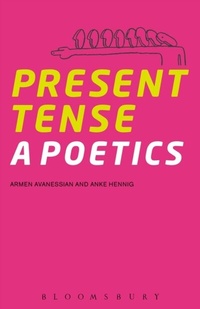
Present Tense
A Poetics
1st Edition
Published on 24. September 2015
272 pages
978-1-62892-766-5 (ISBN)
Description

The invention of the present-tense novel is a literary event whose importance is on par with the discovery of perspective in painting. From the first novels shaped by interior monologues and the use of the present tense in the tradition of modernism, the present tense has, over the course of its century-long evolution, changed the conditions of fictional narration, along with our conceptions of time in a philosophical and linguistic framework. Indeed, to understand the work of an increasing number of contemporary writers - J.M. Coetzee, Tom McCarthy, Thomas Pynchon, to name only a few - it is necessary to both understand the distinct linguistic and literary qualities of the present tense as well as its historical transformation into a genuine tense of contemporary storytelling.
For the first time in literary scholarship, Present Tense: A Poetics offers an account of a profound development in 20th- and 21st-century fiction.
For the first time in literary scholarship, Present Tense: A Poetics offers an account of a profound development in 20th- and 21st-century fiction.
Reviews / Votes
This book renews attention to poetics as a worthy field of literary studies by offering a thorough and systematic examination of the narrative and philosophical significance of tense. The manner of delivery is engaging even as it remains scholarly. Fresh, at times daring, in its propositions, this work will no doubt provoke interest and generate discussion. * Galin Tihanov, George Steiner Professor of Comparative Literature, Queen Mary, University of London, UK * Combining linguistics, literary theory and philosophy of time - in particular utilising Gilles Deleuze's three paradoxes of the past and Gustave Guillaume's language theory - the authors deliver a sound technical analysis of the development of the novel. Claiming that 'only language has the power to define the boundaries of the present,' they produce an innovative and integrated fiction-narratological approach that can be used to identify the characteristics of the altermodern novel. ... Spanning a range of avant-garde writers, philosophers and linguists from Britain, the US, Russia, France, Italy and Germany, this study presents a fascinating insight on temporality and tense-patterns in narrative, demonstrating how the past can be as unpredictable as the future. * The Morning Star * Avanessian and Hennig explore the use of the present tense in novels of the late 20th and early 21st centuries. Specifically, they borrow the art-theoretical term 'altermodern,' first used by art scholar Nicolas Bourriaud, to categorize contemporary novels that employ a new understanding of the present tense, one that marks a break with previously published present-tense novels that employ classical narration. Avanessian and Hennig further argue that the altermodern novel reflects a new understanding of the novel's relationship to time and changes the reader's understanding of the relationship between narration and time. ... [T]he book includes some smart, well-articulated readings of novels. In fact, one of the strengths of this book is the use of exemplary passages from novels written in English, French, German, and Russian; this study does a great job of broadly surveying novels from many traditions. Summing Up: Recommended. Graduate students, researchers, faculty. * CHOICE * How do we account for the widespread use of the present tense in contemporary narratives? What has happened to our understanding of time if a fundamental tenet of fictionality-the idea that narratives make present something that happened in the (real or imagined) past-seems no longer operative? Drawing on narratology, cognitive science, deconstruction and philosophy of language, Avanessian and Hennig reconceptualize the relation between time and narrative; what is more, they rethink poetics as an expanded cultural theory concerned with human world-making. An impressive tour de force. * Andreas Gailus, Associate Professor of German, University of Michigan, USA *More details
Edition
1. Auflage
Language
English
Place of publication
New York
United States
Publishing group
Bloomsbury Publishing PLC (Digital)
ISBN-13
978-1-62892-766-5 (9781628927665)
Copyright in bibliographic data and cover images is held by Nielsen Book Services Limited or by the publishers or by their respective licensors: all rights reserved.
Schweitzer Classification
Other editions
Additional editions
Book
11/2015
Bloomsbury Academic USA
€55.89
Shipment within 3-4 weeks
Persons
Armen Avanessian is Visiting Faculty in the MA Aesthetics and Politics program in the School of Critical Studies at the California Institute of the Arts, USA, and, since 2014, Visiting Lecturer at the Art Institute, FHN Academy Basel, Switzerland. Previously he has been a Visiting Fellow in the German Department at Columbia University and in the German Department at Yale University. From 2007-2014 he taught at the Peter Szondi Institute of Comparative Literature at Free University Berlin, Germany. He is editor in chief at Merve Verlag Berlin. In 2012 he founded a bilingual research platform on Speculative Poetics, including a series of events, translations and publications: www.spekulative-poetik.de.
Anke Hennig is a theorist of literature and visual culture. Currently she is teaching at Central Saint Martins, University of the Arts, London, UK, and organising the international research group 'Retro-Formalism' (www.retroformalism.net). Previously she taught at the Peter Szondi Institute of Comparative Literature at Free University Berlin, Germany, and has been a Fulbright Fellow at New York University, USA.
Anke Hennig is a theorist of literature and visual culture. Currently she is teaching at Central Saint Martins, University of the Arts, London, UK, and organising the international research group 'Retro-Formalism' (www.retroformalism.net). Previously she taught at the Peter Szondi Institute of Comparative Literature at Free University Berlin, Germany, and has been a Fulbright Fellow at New York University, USA.
Content
Acknowledgments
Introduction
1. The Present Tense Novel
2. Readings in Methodology
3. The Imaginary Present Tense
4. Tense Philosophy
Conclusion
Glossary
Notes
Introduction
1. The Present Tense Novel
2. Readings in Methodology
3. The Imaginary Present Tense
4. Tense Philosophy
Conclusion
Glossary
Notes
