

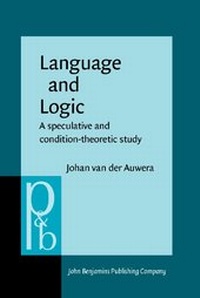
Language and Logic
A speculative and condition-theoretic study
1st Edition
Published on 1. January 1985
XIV, 256 pages
978-90-272-7954-5 (ISBN)
Description

In this volume Van der Auwera attempts to clarify the idea that language reflects both mind and reality and to elucidate the reflection idea by turning it into the cornerstone of a linguistic theory of meaning.
More details
Other editions
Additional editions
Book
01/1985
John Benjamins Publishing Co
€116.60
Shipment within 10-15 days
Content
- LANGUAGE AND LOGICA Speculative and Condition-Theoretic Study
- Editorial page
- Title page
- Copyright Page
- TABLE OF CONTENTS
- PREFACE
- SYMBOLS AND ABBREVIATIONS
- CHAPTER I. METHODOLOGY, CONTENTS, AND RELEVANCE
- CHAPTER II. FROM POSSIBLE WORLDS TO HUMAN ACTION
- 1. Philosophy of mind, ontology, and reflection
- 1.1. Philosophy of mind and reflection
- 1.2. Ontology and reflection
- 1.3. Reflection
- 2. The out-of-mind
- 2.1. States of affairs
- 2.2. Minimal ontology
- 2.3. Possible worlds
- 3. The mind
- 3.1. Beliefs and desires
- 3.2. Consciousness and beliefs
- 3.3. Intentionality and desires
- 4. Human action
- CHAPTER III. SPEECH ACTS AND MEANINGS
- 1. Meaning and speech acts
- 1.1. Meaning versus intended, natural, and non-natural meaning
- 1.2. Speech act meaning
- 2. Basic speech acts
- 2.1. Assertions
- 2.1.1. ?
- 2.1.2. S believes that ?
- 2.1.3. S speaks as if he or she believes that ?
- 2.2. Imperatives, optatives, and interrogatives
- 2.2.1. The speech acts of non-belief...
- 2.2.2. ... are the speech acts of desire
- 2.3. Basic speech acts
- 3. Semantics and pragmatics
- 3.1. Mental states versus conceptualizations
- 3.2. Genetic reflection and focus
- CHAPTER IV. TOWARDS A REFLECTIONIST AND CONDITION THEORETICLOGIC
- 1. The basis of logic
- 1.1. Contemporary logic
- 1.1.1. What logicians do
- 1.1.2. What philosophers of logic say
- 1.2. Reflectionist logic
- 2. Intra-logical RL interpretations
- 3. Conditions
- 3.1. Basic conditions
- 3.1.1. Sufficient conditions
- 3.1.2. Necesssary conditions
- 3.1.3. Necessary and sufficient conditionality
- 3.1.4. Completeness
- 3.2. Impossibility conditions
- 4. Truth
- 4.1. Truth and conditionality
- 4.2. Two-subvalued 'truth-of'
- 4.3. Three-valuedness
- 4.4. Correspondence and Coherence
- 4.5. A tinge of holism
- 4.6. Truth and satisfaction
- CHAPTER V. PROPOSITIONAL OPERATORS
- 1. Conditional and componential analyses
- 2. Conjunction
- 3. Truth, falsity, and possibility
- 3.1. Values and supervalues
- 3.2. Pseudo-monadicness and presupposition
- 3.3. Truth-value paradoxes
- 4. Modality
- 4.1. Necessity, contingency, and impossibility
- 4.2. Iterated modality
- 4.3. Fatalistic necessity
- 4.4. The necessity of possible worlds semantics
- 4.5. Generic modality
- 5. Implication
- 5.1. Sufficiency
- 5.1.1. The connection thesis
- 5.1.2. Objections
- 5.1.3. Other implication
- 5.1.3.1. Material implication
- 5.1.3.2. Strict implication
- 5.1.3.3. Variably strict implication
- 5.2. Possibility
- 5.2.1. Particular conditionals
- 5.2.2. Generic conditionals
- 5.2.3. Objections
- 6. Postliminaries
- NOTES
- REFERENCES
- INDEX
