

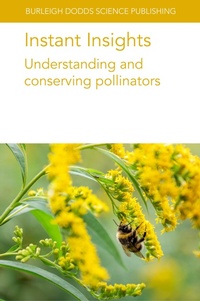
Instant Insights: Understanding and Conserving Pollinators
Published on 20. May 2025
110 pages
978-1-83545-257-8 (ISBN)
Description

This book features four peer-reviewed reviews on understanding and conserving pollinators.
The first chapter provides a brief overview on pollinators and the ecosystem services they offer, as well as the role of data collection and sharing in achieving more sustainable farming and beekeeping practices. The chapter also considers how existing data collected by farm management systems can be used to ascertain the impact of particular agricultural practices on pollinators and key pollinator services.
The second chapter summarises the variety of ways in which bee species are managed for optimal pollination of crops and harvest of honey, beeswax and other products. The chapter also reviews methods to encourage biodiversity and populations of indigenous pollinating insects.
The third chapter considers using network ecology to understand, support and enhance pollination services through farm management and integrated decision-making. The chapter also addresses how these networks can be assessed from field to national scales.
The final chapter reviews the role of habitat conservation and restoration for solitary bee species. The chapter addresses key challenges facing habitat restoration, such as changes in global temperature and precipitation, as well as the effectiveness of existing restoration projects in the European Union and North America.
The first chapter provides a brief overview on pollinators and the ecosystem services they offer, as well as the role of data collection and sharing in achieving more sustainable farming and beekeeping practices. The chapter also considers how existing data collected by farm management systems can be used to ascertain the impact of particular agricultural practices on pollinators and key pollinator services.
The second chapter summarises the variety of ways in which bee species are managed for optimal pollination of crops and harvest of honey, beeswax and other products. The chapter also reviews methods to encourage biodiversity and populations of indigenous pollinating insects.
The third chapter considers using network ecology to understand, support and enhance pollination services through farm management and integrated decision-making. The chapter also addresses how these networks can be assessed from field to national scales.
The final chapter reviews the role of habitat conservation and restoration for solitary bee species. The chapter addresses key challenges facing habitat restoration, such as changes in global temperature and precipitation, as well as the effectiveness of existing restoration projects in the European Union and North America.
More details
Series
Language
English
Place of publication
Cambridge
United Kingdom
Target group
College/higher education
Professional and scholarly
Illustrations
Color tables, photos and figures
File size
5,03 MB
ISBN-13
978-1-83545-257-8 (9781835452578)
DOI
10.19103/9781835452578
Copyright in bibliographic data and cover images is held by Nielsen Book Services Limited or by the publishers or by their respective licensors: all rights reserved.
Schweitzer Classification
Other editions
Additional editions
Various Authors | Noa Simon Delso | Walter Haefeker
Instant Insights: Understanding and Conserving Pollinators
Understanding and conserving pollinators
Book
05/2025
Burleigh Dodds Science Publishing Limited
€64.40
Shipment within 3-4 weeks
Persons
Professor Evans is an ecologist and conservationist at Newcastle University, UK using network theory and DNA-metabarcoding to understand the impacts of environmental change on species-interactions and ecosystem functioning.
Content
Chapter 1 - Using data to assess the impact of agriculture on pollinators and pollinator services: Noa Simon Delso, BeeLife European Beekeeping Coordination, Belgium; and Walter Haefeker, European Professional Beekeepers Association, Germany;
1 Introduction
2 Current data on pollinators
3 Farm data standardization
4 Data standardization in beekeeping
5 Data sharing in farming
6 Data sharing in beekeeping
7 Solutions to data sharing
8 Conclusion
9 Competing interests
10 Where to look for further information
11 References
Chapter taken from: Chapter taken from: Atkins, J. (ed.), Protecting natural capital and biodiversity in the agri-food sector, Burleigh Dodds Science Publishing, Cambridge, UK, 2024, (ISBN: 978 1 80146 351 5)
Chapter 2 - Organic and natural beekeeping, and caring for insect pollinators: Nicola Bradbear, Bees for Development, UK;
1 Introduction
2 The need for pollinators
3 Encouraging indigenous pollinators
4 Management of bees
5 Management of honey bees
6 Management of bumblebees
7 Conclusion
8 References
Chapter taken from: Vaarst, M. and Roderick S. (eds.), Improving organic animal farming, Burleigh Dodds Science Publishing, Cambridge, UK, 2019, (ISBN: 978 1 78676 180 4)
Chapter 3 - Ecological network approaches for promoting pollinators in agriculture: Darren M. Evans and Fredric M. Windsor, Newcastle University, UK;
1 Introduction
2 Plantpollinator networks
3 Networks across scales
4 Increasing the completeness of pollination networks
5 Embedding pollination within wider agro-ecosystem networks
6 Next steps for pollination networks
7 Conclusion
8 Where to look for further information
9 Acknowledgements
10 References
Chapter taken from: Kevan P. and Willis Chan S. (eds.), Promoting pollination and pollinators in farming, Burleigh Dodds Science Publishing, Cambridge, UK, 2023, (ISBN: 978 1 80146 098 9)
Chapter 4 - The role of habitat conservation and restoration in protecting pollinators in agricultural landscapes: Stephen Buchmann, University of Arizona, USA;
1 Introduction
2 Bees as pollinators
3 Challenges in habitat restoration
4 Assessing the effectiveness of habitat restoration
5 Case studies
6 Conclusion
7 Where to look for further information
8 References
Chapter taken from: Kevan P. and Willis Chan S. (eds.), Promoting pollination and pollinators in farming, Burleigh Dodds Science Publishing, Cambridge, UK, 2023, (ISBN: 978 1 80146 098 9)
1 Introduction
2 Current data on pollinators
3 Farm data standardization
4 Data standardization in beekeeping
5 Data sharing in farming
6 Data sharing in beekeeping
7 Solutions to data sharing
8 Conclusion
9 Competing interests
10 Where to look for further information
11 References
Chapter taken from: Chapter taken from: Atkins, J. (ed.), Protecting natural capital and biodiversity in the agri-food sector, Burleigh Dodds Science Publishing, Cambridge, UK, 2024, (ISBN: 978 1 80146 351 5)
Chapter 2 - Organic and natural beekeeping, and caring for insect pollinators: Nicola Bradbear, Bees for Development, UK;
1 Introduction
2 The need for pollinators
3 Encouraging indigenous pollinators
4 Management of bees
5 Management of honey bees
6 Management of bumblebees
7 Conclusion
8 References
Chapter taken from: Vaarst, M. and Roderick S. (eds.), Improving organic animal farming, Burleigh Dodds Science Publishing, Cambridge, UK, 2019, (ISBN: 978 1 78676 180 4)
Chapter 3 - Ecological network approaches for promoting pollinators in agriculture: Darren M. Evans and Fredric M. Windsor, Newcastle University, UK;
1 Introduction
2 Plantpollinator networks
3 Networks across scales
4 Increasing the completeness of pollination networks
5 Embedding pollination within wider agro-ecosystem networks
6 Next steps for pollination networks
7 Conclusion
8 Where to look for further information
9 Acknowledgements
10 References
Chapter taken from: Kevan P. and Willis Chan S. (eds.), Promoting pollination and pollinators in farming, Burleigh Dodds Science Publishing, Cambridge, UK, 2023, (ISBN: 978 1 80146 098 9)
Chapter 4 - The role of habitat conservation and restoration in protecting pollinators in agricultural landscapes: Stephen Buchmann, University of Arizona, USA;
1 Introduction
2 Bees as pollinators
3 Challenges in habitat restoration
4 Assessing the effectiveness of habitat restoration
5 Case studies
6 Conclusion
7 Where to look for further information
8 References
Chapter taken from: Kevan P. and Willis Chan S. (eds.), Promoting pollination and pollinators in farming, Burleigh Dodds Science Publishing, Cambridge, UK, 2023, (ISBN: 978 1 80146 098 9)
